The best safari tour operator software, judged on safari terms.
The best safari tour operator software depends on which problem hurts your desk most. At the time of writing: Wetu leads on itinerary content and digital showcases, Safari Portal on design-led client documents, Tourwriter on mature tailor-made workflows, SafariOffice on quick safari-specific quoting, and Itero Desk on operations and pricing: park fees, seasonal contracted rates and whole-party quotes in one workspace. This page compares all five on safari-weighted criteria, with every product described from its own public website.
Disclosure, before anything else. We build Itero Desk. It is on this list. The list is still worth your time for three reasons: the criteria are stated before the products, every competitor is described from its own site rather than from hearsay, and we say plainly where Itero Desk is not the pick. The category-wide version of this exercise, ranked on general criteria, lives at best tour operator software. This page re-runs it for safari desks only.
In a hurry: read the six criteria, shortlist two products, and take the same real trip to both demos. If one of the two is Itero Desk, book a demo.
Why a safari list needs its own criteria.
A general round-up ranks tour operator software on general axes: pipeline, itinerary output, price, support. Those axes are real, but they do not decide a safari purchase, because the thing that breaks first on a safari desk is the quote. A safari price is assembled from park authority fees, seasonal contracted rates, the party mix and the vehicles. Software that cannot model those four does not replace the spreadsheet; it decorates it, and the desk keeps paying for pricing mistakes in silence: an under-collected park fee comes straight out of margin, and an over-collected one loses the booking to a sharper quote.
What the full category has to cover, end to end, is on the safari tour operator software page. Here the same ground is re-weighted so the pricing engine counts for more than the brochure.
The six criteria that decide a safari quote.
Use this section as your own evaluation sheet, with any vendor, including us.
Park fee handling. Fees have to be computed per person and per vehicle, by visitor category and by age band, per authority: TANAPA, NCAA and SENAPA in Tanzania, KWS and the Mara conservancies in Kenya, UWA in Uganda, ZimParks in Zimbabwe, SANParks in South Africa, DWNP in Botswana, NWR in Namibia, RDB in Rwanda, DNPW in Zambia, ANAC in Mozambique, EWCA in Ethiopia. If the software cannot show the fee breakdown per park, someone is still checking it by hand, and hand-checked fees are where quotes quietly leak money.
Seasonal contracted rates by board basis. Your lodge contracts are the real price list: season bands, room types, and a board basis that runs from room only through half board to full board and game package. The software must hold rates in that shape, price from them, and warn you when no rate covers the travel date, instead of silently using a stale season.
Whole-party pricing. Two adults, a teenager and a seven-year-old in two rooms with one vehicle is an ordinary safari booking. The system has to price each person by age band, each room by its own rate, and the vehicles and guides as costed resources, per day. If the demo can only price two adults in one room, the spreadsheet survives.
Agent-facing document quality. Overseas agents judge a safari desk by the document it sends. The proposal has to hold its own next to the best showcase tools: photography-led layouts, a web version and a matching PDF, the operator's own branding, and ideally the client's own language.
Operations after the win. A confirmed safari is a stack of supplier requests and option holds with expiry dates. Software that stops at the proposal leaves the riskiest phase, the one where a lapsed hold costs a room in peak season, to memory and email.
Works on safari. Owners guide, managers travel, sales happens at trade shows. The software has to answer a lead and look up a rate from a phone in the field, not only from the office laptop.
The five products, in alphabetical order.
This is a segment map, not a ranked scoreboard. Each entry states what the product says it is on its own website, the safari-weighted read against the criteria above, and pricing as published at the time of writing.
Itero Desk, the pick for pricing and running the safari desk.
Ours, as disclosed. Itero Desk is operations software for safari and tour operators: itineraries, quotes, proposals, invoices, CRM and pricing in one workspace, on web and mobile, with AI assistance built in.
Against the six criteria: the cost engine is tuned for fifteen safari countries at signup and for the way their real fee authorities charge (TANAPA, KWS, UWA, RDB, ZimParks, SANParks, DWNP, NWR, DNPW, ANAC, EWCA and more), and fees are computed per person and per vehicle, by visitor category and age band, with the breakdown visible per park, once the operator's own fee amounts are in. Contracted rates are held by season and board basis, imported from PDF, Word or Excel rate sheets by Itero AI rather than re-typed, with rate-gap warnings when no rate covers the date. Parties price across multiple rooms with child rate bands, and vehicles and guides are costed resources with double-booking warnings. Proposals render in three templates (Lookbook, Rounded, Studio) as a web link plus a matching PDF, translatable into seven languages. After the win, reservations run a lifecycle with option holds, expiry reminders and clean no-price supplier requests, and the whole desk works from a phone as an installable app.
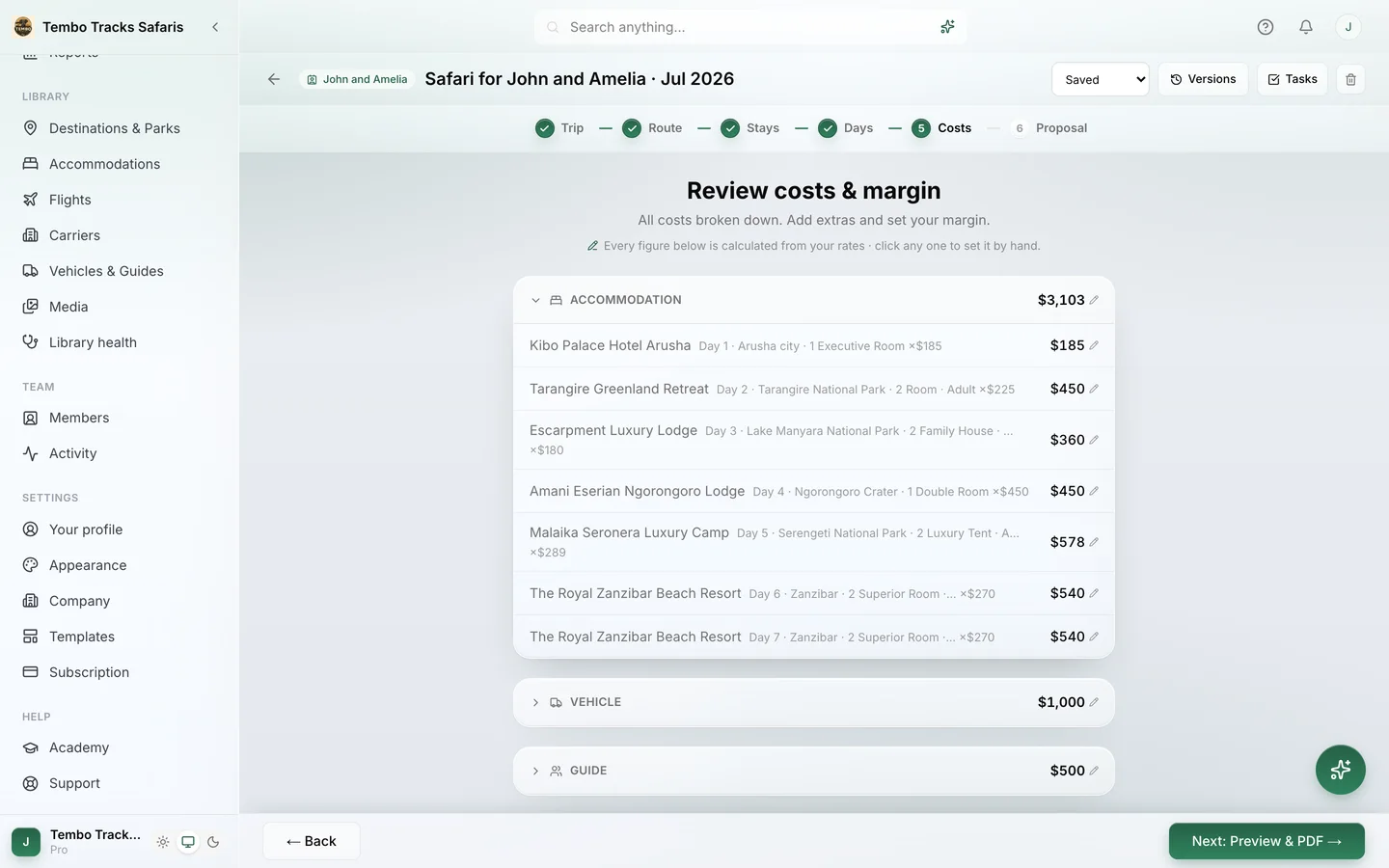
Pricing is public: Starter at $74.99 per month, Pro at $109.99 per month, both about 20% cheaper billed annually, with a 30-day full-Pro trial and no credit card; details on the pricing page. The public customer reference is Breeze Safaris in Tanzania and Zanzibar, and there are dedicated pages for desks in Tanzania, Kenya and Botswana.
Not the pick when: your desk sells outside the safari world entirely, say European city breaks or US domestic travel, because the mechanics that justify the switch are built around parks, camps and safari logistics; or you are a pure agency reselling other operators' packages, where the pricing engine has nothing to price. In both cases one of the other four tools will serve you better today.
Safari Portal, the pick for design-led documents with public pricing.
Safari Portal describes itself, at the time of writing, as travel management software for tour operators, DMCs and travel advisors that puts design on equal footing with efficiency. Its site leads with interactive digital itineraries and print-ready proposals, backed by a content library, a traveler app, flight integration, multi-language support, plus contact database, sales pipeline, task management and payment and invoicing features.
The safari-weighted read: document quality is clearly the centre of gravity, and the showcase work on its site is genuinely strong, so criterion four is well covered. On the pricing criteria, its public site does not state park fee computation by authority and age band, seasonal rate structure by board basis, or per-vehicle party pricing at the time of writing, so test those three live in a demo rather than assuming either way. Pricing is refreshingly public: $199, $299 and $399 per month across three tiers, plus applicable taxes, with a free trial advertised.
Pick it when the battle you are losing is the document an agent forwards, you want published pricing, and your quoting process can stay wherever it lives today.
SafariOffice, the pick for a light safari-specific sales tool.
SafariOffice positions itself, at the time of writing, as sales software built for the safari industry: quote and itinerary creation with a content database of thousands of destinations, accommodations and activities, auto-generated content suggestions, team collaboration, and tracking that shows when a sent quote gets opened. Its site names client companies in Tanzania and South Africa, so the Africa focus is real, not decorative.
The safari-weighted read: this is one of the few tools on the market that is safari-first by design, and the fast quote-and-itinerary flow covers the front of the sales funnel well. Park fee computation per authority and age band, seasonal rates by board basis, whole-party pricing and option-hold management are not stated on its public site at the time of writing, so a desk that needs the pricing depth should probe exactly those in a trial. Pricing for the tour operator side is not published; the site offers a free sign-up, and its published price list covers accommodation listings rather than operator seats.
Pick it when you want a lightweight, safari-native tool to send quotes and track opens, and your pricing can remain a manual step.
Tourwriter, the pick for established tailor-made desks.
Tourwriter is mature itinerary and proposal software for tour operators, and a serious product with years of history. Its site, at the time of writing, targets luxury and bespoke DMCs, travel designers, advisors and inbound operators building multi-day FIT trips, and covers itinerary design with drag-and-drop, a travel CRM with commission tracking, financial tooling with built-in pricing, supplier and traveler payments, Xero and Stripe integrations, booking requests sent from the itinerary with automatic supplier confirmations, plus tasks and reporting.
The safari-weighted read: of the non-safari-specific tools here, Tourwriter goes deepest on operations after the win; booking requests with supplier confirmations is exactly criterion five, and the financial layer is broader than most. Safari-specific pricing, park fees by authority and age band and rates by board basis, is not stated on its public site at the time of writing. Pricing is public: Starter at $99 per user per month billed annually with up to 25 itineraries a year, Pro at $149 per user per month with up to 50 a year, Premium on application, and a one-time setup fee of $1,199. A safari desk quoting daily should check those itinerary caps against its own volume. The full feature-by-feature view is on the Tourwriter alternative page.
Pick it when you run an established tailor-made or FIT operation, value supplier booking workflows and accounting integrations, and safari park fee automation is not the deciding factor.
Wetu, the pick for content depth and digital showcases.
Wetu is a widely used itinerary content and digital-showcase platform, particularly strong in Southern Africa, and the incumbent many safari desks already know. Its site, at the time of writing, presents an itinerary builder, a product manager for centralised supplier content with images and commission rates, a contact manager, and TravelKey, a branded traveler app with interactive itineraries, maps and offline access. The content library exceeds 100,000 images of accommodations, experiences and destinations, which is the largest established content asset on this list, and it serves agents, DMCs, operators and suppliers in one ecosystem.
The safari-weighted read: for criterion four, agent-facing documents fed by deep, maintained content, Wetu has earned its position, and any competitor claiming otherwise is not being straight with you. On criteria one to three and five, its public site does not state park fee computation, seasonal rate structures by board basis, whole-party pricing or option-hold management at the time of writing; desks commonly pair it with their own pricing spreadsheet. Pricing is published at wetu.com/pricing-plans at the time of writing, from $75 per month for the Lite tier, and a 14-day trial is advertised. The detailed comparison is on the Wetu alternative page.
Pick it when your priority is showcase itineraries built on the trade's deepest content library and broad industry adoption, and you are content to keep pricing in a separate system.
The comparison table, on safari axes.
Competitor cells contain only facts found on each vendor's own public site on the day of writing. Not stated publicly means we could not find it there; it does not prove the capability is absent, so treat those cells as demo questions.
| Itero Desk | Safari Portal | SafariOffice | Tourwriter | Wetu | |
|---|---|---|---|---|---|
| Park fee mechanics | 15 safari countries, per person and per vehicle, by age band and visitor category | Not stated publicly | Not stated publicly | Not stated publicly | Not stated publicly |
| Seasonal rate structure | By season band and board basis, with rate-gap warnings | Not stated publicly | Not stated publicly | Built-in pricing per its site; safari rate detail not stated | Not stated publicly |
| Party and vehicle pricing | Multi-room, child rate bands, vehicles and guides costed | Not stated publicly | Not stated publicly | Not stated publicly | Not stated publicly |
| Proposals and web itineraries | 3 templates, web link plus matching PDF, 7 languages | Interactive digital itineraries and print-ready proposals | Branded itineraries with quote-open tracking | Drag-and-drop itineraries with shareable outputs | Digital itineraries, TravelKey app, 100,000 plus images |
| Reservations and holds | Lifecycle with option holds and expiry reminders | Not stated publicly | Not stated publicly | Booking requests with automatic supplier confirmations | Not stated publicly |
| Pricing transparency | Public: from $74.99/mo | Public: $199 to $399/mo | Operator pricing not published; free sign-up | Public: from $99/user/mo billed annually, plus $1,199 setup | Public: from $75/mo (Lite); 14-day trial |
Read the table honestly and it says something useful: the showcase column belongs to Wetu and Safari Portal, the post-sale operations row is a genuine two-horse race between Tourwriter and Itero Desk, and the safari pricing rows are where Itero Desk was built to be different. Where your desk feels the pain decides which rows matter.
How to choose in one afternoon.
You do not need a three-month evaluation. You need one afternoon and one real trip.
- Shortlist two. Use the segment map above: one document-first tool, one operations-first tool, or whichever pairing matches your pain. More than two demos and the details blur.
- Pick a real trip from last season. Not a clean sample: the awkward one. Two rooms, a child in an age band that matters, two parks under different authorities, a vehicle and a guide, one night that fell across a season boundary.
- Bring it to both demos and build it live. Do not watch the vendor's prepared trip. Ask them to build yours while you watch the clock.
- Compare the quote produced. Are park fees itemised per park, per person, per vehicle? Did the child price by age band? Did the season boundary price correctly, or did someone type a number to move on? Every number typed by hand in the demo is a number your team will type by hand forever.
- Compare the document sent. Open both proposals on a phone, the way your agent will. Would you forward either to your best agent without apology?
- Compare the real cost in writing. Published price, setup fees, per-user charges, itinerary caps, and what happens after the trial. A quote-based price is not a red flag, but it belongs in writing before you decide.
The tool that priced your awkward trip correctly and produced the better document, at a total cost you saw in writing, is your answer. If no tool manages both, you have at least learned which half of the problem you are really buying for.
Frequently asked questions.
What software do safari operators use?
Most safari desks run one of three set-ups. Spreadsheets still price the majority of trips, usually one workbook per senior consultant. Showcase and itinerary tools, such as Wetu and Safari Portal, produce the client-facing documents. Operations platforms, such as Tourwriter and Itero Desk, add pricing, CRM and reservations around the itinerary. Safari-specific quoting tools such as SafariOffice sit between the two. Many desks combine a showcase tool with a pricing spreadsheet.
What is the best safari tour operator software?
There is no single best; it depends on the job. For agent-facing showcase documents, Wetu and Safari Portal are the established names. For mature tailor-made workflows with supplier bookings, Tourwriter. For a light safari-native sales tool, SafariOffice. For pricing and operations built around park fees and contracted seasonal rates in fifteen safari countries, Itero Desk, which we build. Shortlist two and demo the same real trip on both.
How is safari software different from general tour operator software?
The cost model. A safari price depends on park authorities and their fee rules, per person and per vehicle, by age band and visitor category, plus seasonal lodge rates by board basis and a party spread across rooms, vehicles and guides. General tour software rarely models any of that, so the real pricing stays in a spreadsheet and the software only handles the document.
How much does safari tour operator software cost?
Public prices at the time of writing: Itero Desk from $74.99 per month, Safari Portal from $199 to $399 per month, Tourwriter from $99 per user per month billed annually plus a $1,199 one-time setup fee. Wetu publishes prices from $75 per month at wetu.com/pricing-plans; SafariOffice does not publish operator pricing on its site, so budget that one from a written quote. Always ask about setup fees, per-user charges and itinerary caps.
Can I keep my showcase tool and add an operations platform?
Yes, and some desks do exactly that during a transition: the showcase tool keeps producing documents while quoting moves into an operations platform. It costs two subscriptions and some double entry, so most desks treat it as a bridge rather than a destination. Before paying for two systems, test in a demo how one system produces both the price and the document.
Which of these tools handles park fees automatically?
Of the five compared here, only Itero Desk states publicly that it computes park fees per person and per vehicle, by visitor category and age band, for the authorities of fifteen safari countries. The other four do not state park fee computation on their public sites at the time of writing, which does not prove absence: ask each vendor to price a Serengeti or Chobe day live in the demo and show the fee breakdown.
How long does switching from spreadsheets take?
The slow part is getting contracted rates in, not learning the interface. Ask every vendor how rates arrive: manual entry line by line, a paid import service, or an import you review and confirm. In Itero Desk, lodge rate sheets in PDF, Word or Excel import through Itero AI, and the trial runs 30 days on the full Pro feature set, so a desk can load one season's rates and judge the result on its own trips.
Two demos, one real trip, one afternoon. If Itero Desk makes your shortlist, bring your awkwardest booking and we will price it live. Book a demo · Existing customer? Sign in