Kenya tour operator software that prices parks and conservancies in one quote.
Kenya tour operator software is operations software for companies that plan and sell Kenya safaris: it manages enquiries, builds day-by-day itineraries, prices trips from the operator's own contracted rates, and produces the proposals and invoices that agents and travellers judge. The requirement that makes Kenya different is structural: the country prices two fee systems at once. The KWS national parks follow one fee logic, and the Maasai Mara ecosystem adds reserve entry plus per-night fees in the conservancies around it. Software that models only one of the two prices half the country.
Itero Desk is operations software for safari and tour operators: itineraries, quotes, proposals, invoices, CRM and pricing in one workspace, on web and mobile, with AI assistance built in. This page is the Kenya chapter of the category; the hub page on safari tour operator software covers it end to end. Here the focus is the Kenya desk: the two fee systems, the trip shapes a Nairobi operation actually sells, and the season bands that move a price without the route changing.
Book a demo. Price one of your own Mara itineraries in Itero Desk, on a call with a person who knows the trade. Book a demo
Two fee systems, and both usually land in the same quote.
Every safari country charges to enter its parks. Kenya is the one where the charging works two different ways at once, and where a single ten-day itinerary routinely uses both.
The first system is the KWS estate. Amboseli, Tsavo East and Tsavo West, Lake Nakuru and the other national parks share a recognisable fee logic: entry priced per person, by visitor category and age band, with the vehicle carrying its own line. A desk that can price one KWS park can reason about the others.
The second system is the Maasai Mara ecosystem. There is the reserve itself, with park entry logic of its own, and around it the Mara conservancies: Mara North, Naboisho, Olare Motorogi and their neighbours. A conservancy stay is commonly priced per guest per night, tied to the nights the party actually sleeps inside the conservancy, and it sits alongside the entry logic rather than replacing it. Move a camp one valley over and the fee model changes shape.
The classic Kenya quote, the Mara plus Amboseli, therefore carries both systems inside one price: per-night conservancy lines for the Mara nights, park entry lines for the Amboseli days, each with its own categories and age bands. In a spreadsheet, this is exactly where money leaks. A formula built for park entries gets copied onto conservancy nights. Dates shift by a day, a night moves across a boundary, and the fee lines do not move with it. A twelve-year-old is an adult on one sheet and a child on another. Errors in the client's favour walk out the door unnoticed; errors against the client come back as an awkward email from the agent. Both cost money.
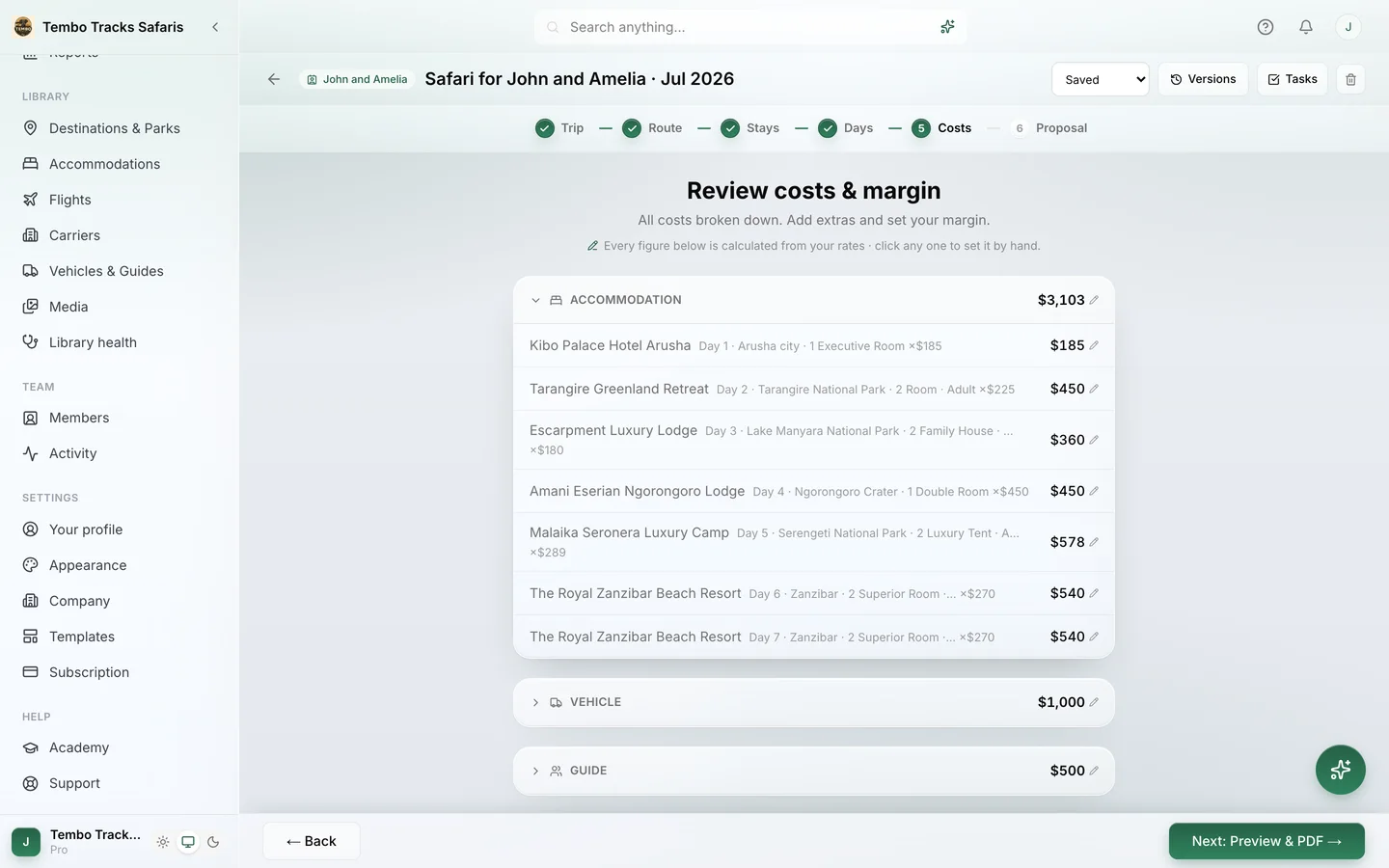
Itero Desk's cost engine is tuned to KWS and the Mara conservancies for every Kenya workspace. It computes fees per person and per vehicle, by visitor category and age band, once you add your own fee amounts, and shows the breakdown per park: the conservancy nights as their own lines, the park entries as theirs, so the desk reads the quote the way the fees are actually charged. Day-visit fee logic covers the park the party drives through without sleeping in. This page prints no amounts, because authorities change them; the mechanics by country are laid out in the guide on safari park fees by country.
The trips a Nairobi desk actually sells.
Most of the Kenya trade runs from Nairobi, and a Kenya workspace reflects that from signup: NBO, Jomo Kenyatta International, is the hub airport default from day one, so arrival and departure days anchor correctly with no setup. From there the trip shapes are familiar to anyone at a Kenya desk.
The fly-in Mara is the standard pattern. Guests land at NBO, transfer across town to Wilson, and take a light aircraft to one of the Mara airstrips; the routine is so well established that a quote which prices the flight wrong marks the desk as an amateur before the agent reads page two. The drive down remains the alternative for parties who want the road. The classic combination adds Amboseli; longer trips add Laikipia to the north or finish on the coast. Demand clusters hard around the migration in the Mara, with the river crossings commonly the peak of both occupancy and pricing, and the green season sitting at the quiet end of the same curve.
The itinerary builder is shaped for these trips. Flights are lines in the Days step, priced like everything else. Multi-destination days are supported, for the morning that starts in one ecosystem and ends in another. And because the same trip is re-quoted every time an agent moves a date, the cost panel recomputes live instead of waiting for a manual re-cost.
| The trip | What the quote has to get right | How Itero Desk prices it |
|---|---|---|
| Fly-in conservancy stay | Per-night conservancy fees for every guest, flights as day lines | Conservancy fee logic ready from day one, priced from your own entries, flights costed in the Days step |
| Mara plus Amboseli | Two fee systems in one price | Both fee logics in one cost panel, breakdown per park |
| Family in two rooms | Age bands on fees, child rates at the camp, the room mix | Per-person fees by age band, child rate bands, multi-room parties |
| Migration-season departure | The season band that matches the exact dates | Seasonal rates by date, rate-gap warning when no band covers them |
| Day visit en route | Entry for a park the party crosses, not sleeps in | Day-visit park fee logic, per day |
Season bands move the price when the route does not.
A Kenya rate sheet rarely has one price. Camps and lodges commonly publish several season bands in a single year: a peak band around the migration window, high and shoulder bands either side, a green-season band, sometimes festive dates as a band of their own. The same room at the same camp carries a different rate depending on the night, and board basis multiplies the grid again, from room only through half board and full board to the inclusive game-package boards common at conservancy camps.
The failure mode every desk knows is the stale rate. An enquiry arrives for next year's crossing dates, the new sheet has not landed yet, and the quote goes out on the current one. A stale rate is a discount you did not decide to give, and by the time the new sheet arrives, the agent already has the old number in writing.
Itero Desk treats the season band as data, not as a note in the margin. Imported rates are organised by season and board basis. When no rate covers the travel dates, the Costs step raises a rate-gap warning instead of pricing silently from the wrong band. If the desk chooses, closest-year pricing can fill the gap, and it is always labelled estimated, so an estimate never masquerades as a contracted rate. Any line can still be overridden by hand. The wider mechanics of building a price this way are covered on the tour pricing software page.
One workspace from the agent's email to the invoice.
The fee mechanics are the reason a Kenya desk looks at Itero Desk; the rest of the workspace is the reason it stays.
Enquiries answered while the agent is still at their desk.
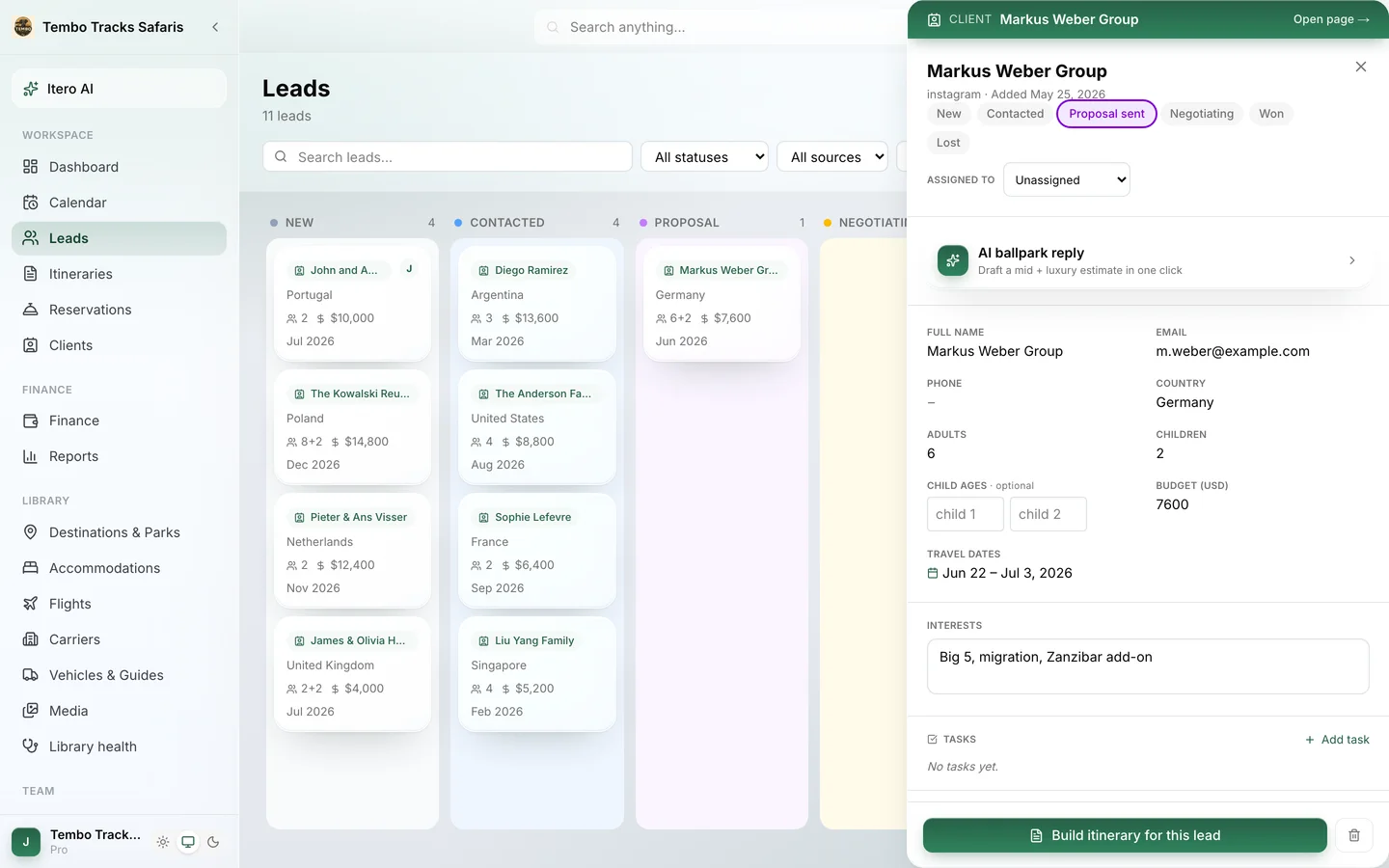
Kenya sells through overseas agents more than most markets, and agents shortlist the operator who replies first with a credible number. Enquiries land in a pipeline with six stages: new, contacted, proposal, negotiating, won, lost. The lead drawer holds the conversation, the party details and a Ballpark panel that produces an indicative price before anyone builds a full itinerary, which is how a same-day reply happens across time zones. One click converts the lead into an itinerary, and a won lead becomes a client automatically, with trip history, passports and documents, and dietary and medical notes on the record.
Six steps from route to price.
Building the trip walks through six steps: Trip, Route, Stays, Days, Costs and Proposal. The Days step holds parks, activities and flights per day, which is where the Wilson departure and the airstrip pickup live. The Costs step shows how the price is built, with margin as its own visible layer rather than a number buried inside a total, and the cost panel updates live as nights, rooms or dates change. Manual overrides exist on every line: accommodation, vehicle, guide, transfers, flights, optional activities, park fees and additional costs.
Proposals an overseas agent will forward.
An agent in London judges the Nairobi desk by the document it sends. Itero Desk renders a finished itinerary through three templates with distinct characters: Lookbook, a photography-led coffee-table book; Rounded, soft and warm; Studio, a modern dark editorial. Behind the templates sits a full proposal editor, closer to a word processor than a form, with sections to reorder and hide, image slots, a price table, a route map and version history. Proposals publish as a web page on a share link or download as a matching PDF, and translate into seven languages, which matters when the end client reads German and the agent reads English.
See a Mara plus Amboseli trip priced end to end. A demo walks one of your own itineraries through the builder, both fee systems included. Book a demo
Invoices, reservations and option holds.
The itinerary that wins the booking generates the invoice, in its own template set, as a share link and a matching PDF; nobody re-types a price table into a second tool. Reservations track the requests behind the trip through a lifecycle from draft to requested to option to confirmed, with waitlisted and declined recorded rather than lost in an inbox. An option hold carries its expiry date, and the desk is warned three days and one day before it lapses, which is the difference between keeping a migration-season room and explaining to an agent why it is gone. Hotel requests go out as clean documents with the trip facts and no prices. Vehicles and guides carry daily rates and capacity, and double-booking one across trips raises a conflict warning naming the vehicle or the guide, per day.
The desk in the field, and the training on the desk.
Itero Desk runs in the browser on any laptop and installs as an app on the phone, with bottom tabs for the jobs that happen away from the office: checking the pipeline, answering a lead, looking up the library, asking Itero AI. A desk owner at a camp in the Mara can still answer the agent in New York. Every plan also includes Itero Academy, eight self-paced courses with exams and verifiable certificates, so a new consultant learns the desk from the software rather than from a colleague's spare hour.
Where Itero AI fits.
Itero Desk is an operations platform with AI in the places where it saves real hours, not an AI product with a database attached. In a Kenya workspace the assistant, Itero AI, earns its keep in a few specific jobs.
- Rate sheet import. Camps send season grids as PDFs, Word files and spreadsheets every year. Itero AI reads them into structured seasonal rates that the desk reviews and confirms, so the annual re-typing week disappears.
- Park fee and flight rate imports. The same read-and-confirm pattern applies to fee schedules and flight rates.
- Itinerary import. A trip arrives as a PDF, a pasted agent email or a photographed document, and Itero AI drafts it in the builder.
- Builder actions and drafting. From a bounded action list with undo, it applies changes on request; it also rewrites day descriptions, drafts welcome letters and proposal emails, and translates.
Every plan includes a monthly allowance of AI actions, and the AI never prices from imagination: every number comes from imported rates and the park fee library. AI assists; the desk decides.
Who it is for, and who it is not for.
Itero Desk fits a Kenya desk of roughly one to fifteen people, based in Nairobi or up-country, selling to international agents and direct travellers, and currently running on spreadsheets or on a tool that only solved the document. The fee machinery earns its keep the first time a quote spans a conservancy and a KWS park.
It is equally honest to say who should look elsewhere. A coastal operator selling beach stays only, with no park or conservancy lines in the quote, needs far less of this machinery and may be better served by lighter software. A desk selling outside the safari world entirely, say European city breaks or US domestic travel, would not benefit: the mechanics are built around parks, camps and safari logistics. And the operating country picked at signup only sets defaults: a desk that sells both Kenya and Tanzania keeps one library with parks from both countries, and each park prices from its own fee entries, cross-border itineraries included.
Neighbouring desks have their own pages: Tanzania tour operator software for Arusha and the northern circuit's multi-authority fees, and Botswana tour operator software for the Maun fly-in trade. For a genuine comparison of tools, competitors included and with the disclosure that Itero Desk is our product, see the page on the best safari tour operator software.
What it costs.
Itero Desk publishes its prices, which is not universal in this market. Starter is $74.99 per month ($59.99 per month billed annually) with one user and 50 itineraries a month. Pro is $109.99 per month ($89.99 per month billed annually) with four users, 200 itineraries a month, team roles and social exports. Enterprise is custom, for groups that need SSO, SLAs and integrations. Every new workspace starts with a 30-day trial of the full Pro feature set, no credit card, with the cost engine already tuned to Kenya's fee mechanics from the first login. Current details live on the pricing page.
Frequently asked questions.
Does Itero Desk handle Mara conservancy fees?
Yes, at the mechanics level the Mara requires: the cost engine already knows the Mara conservancies' fee logic alongside KWS's, and conservancy fees are computed per person by age band and visitor category, night by night, as their own lines in the cost breakdown, once you add your own fee amounts. Reserve entry logic sits next to them in the same quote. Amounts are entered and kept current by the operator rather than printed on this page, because authorities change them.
Can I quote a trip that combines Kenya and Tanzania?
A workspace picks one operating country at signup, which sets defaults such as the hub airport, visitor categories and the default VAT on park fees; destinations, seasons and fees are still the operator's to build. The library is not limited to that country: a desk selling both Kenya and Tanzania adds parks from both, each with its own fee entries, and the engine prices every park from its own figures, cross-border itineraries included.
Which Kenya parks and fees does Itero Desk already know how to price?
A Kenya workspace has the KWS and Mara conservancy fee mechanics ready from day one, and NBO as the hub airport default, so once you enter your own Amboseli and conservancy fee amounts they price correctly straight away. Fees compute per person and per vehicle, by visitor category and age band, with the breakdown visible per park. Every cost line, inside or outside those authorities, accepts a manual entry or override.
How does Itero Desk price children on a Kenya trip?
Park and conservancy fees compute per person by age band, so a seven-year-old and a teenager can land in different fee lines on the same day. On the lodge side, child rate bands and multi-room parties are modelled, with per-day meal plans where they apply. The breakdown shows every line, so the desk checks the maths instead of trusting a single total.
What happens when a rate sheet does not cover my travel dates?
The Costs step raises a rate-gap warning instead of silently pricing from a stale season band. You can turn on closest-year pricing, which is always labelled estimated so nobody mistakes it for a contracted rate, or override the line by hand. Either way the quote states what it knows, which matters most around migration dates, when sheets change and demand peaks at the same time.
Does Itero Desk book the Wilson flights or sell the trip?
No. Itero Desk is software for the operator's own desk, not a travel agency: it does not sell, book or arrange trips, and it does not process or hold traveller payments. Flights appear as costed lines in the Days step, priced from imported flight rates or entered by hand, and the booking itself happens through the channels the desk already uses.
Can overseas agents see proposals online?
Yes. Every itinerary can go out as a published web proposal on a share link or as a matching PDF, rendered in the same template, so an agent can forward either. Proposals translate into seven languages: English, Portuguese, Spanish, French, Italian, German and Dutch. Confirmed trips get a client portal page, and invoices follow the same web-plus-PDF pattern.
The next agent enquiry deserves a same-day number. Book a demo and price a real Mara itinerary in Itero Desk, both fee systems in one quote. Book a demo · Existing customer? Sign in