Tanzania tour operator software built in Arusha, for trips that cross park authorities.
Tanzania tour operator software is operations software for the desks that plan and sell Tanzanian trips: northern circuit safaris, the southern circuit, Kilimanjaro treks and Zanzibar extensions. Its defining technical problem is that one Tanzanian itinerary crosses park authorities. A classic northern circuit touches TANAPA parks such as Tarangire, Lake Manyara and the Serengeti, plus the NCAA in Ngorongoro, and inside the Serengeti SENAPA specifics apply on top; each authority has its own fee logic, and the software has to price all of them on a single trip. Itero Desk already knows how to price all three, computing fees per person and per vehicle by age band and visitor category, and showing the breakdown per park on one quote, once the fee amounts are entered.
This is the Tanzania page under the main guide to safari tour operator software. Itero Desk is operations software for safari and tour operators: itineraries, quotes, proposals, invoices, CRM and pricing in one workspace, on web and mobile, with AI assistance built in. This page covers what that means for a desk selling Tanzania, written from inside the country the trips start in.
Book a demo. Price a real northern circuit trip, crater morning included, on a call with a person who knows the trade. Book a demo
One Tanzanian trip, three park authorities.
Take the itinerary every Arusha desk knows by heart: land at JRO, a night near Arusha, then Tarangire, Lake Manyara, a Ngorongoro crater morning, and three nights in the Serengeti before flying back for the beach. That one trip is priced by three different rule sets.
- TANAPA parks. Tarangire, Lake Manyara and the Serengeti are national parks, priced under TANAPA's logic.
- The NCAA. Ngorongoro is not a national park; the crater and the conservation area around it run under the NCAA, with fee logic of its own, and the trip meets it twice: once for the crater morning and once for the drive through the highlands toward the Serengeti gate.
- SENAPA specifics. Inside the Serengeti, park-specific rules apply on top of the general national park pattern.
Each authority decides differently what is charged per person, what is charged per vehicle, how the age bands cut, how visitor categories apply and what counts as a day. A desk pricing this in a spreadsheet keeps three sets of rules in one person's head and one tab of formulas. When an authority revises something, or one cell quietly breaks, the error ships inside a confirmed quote, and the desk pays the difference at the gate or absorbs it in the margin.
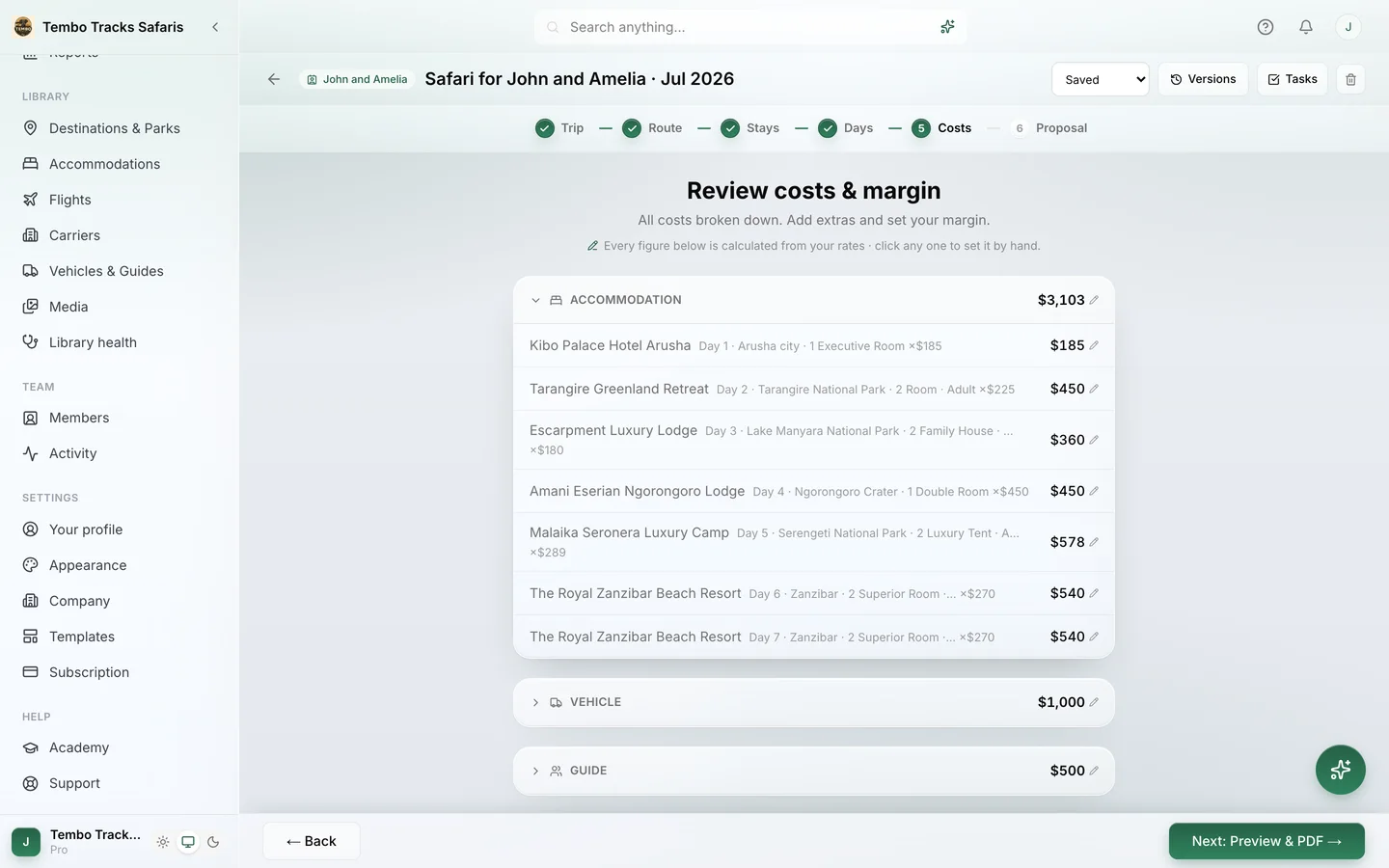
Itero Desk's cost engine is tuned to TANAPA, the NCAA and SENAPA for every Tanzania workspace. Fees are computed per person and per vehicle, by age band and visitor category, per day, once the fee amounts are entered, and the breakdown stays visible per park, so a consultant can see what the Serengeti nights cost against the crater morning before margin goes on top. This page states no fee amounts on purpose: authorities revise them, and a stale number on a marketing page is exactly the failure the software exists to prevent. How the fee systems work, country by country, is explained in the open in the guide to safari park fees by country.
What one classic trip asks of the pricing engine.
| Leg of the trip | Whose rules apply | What moves the price |
|---|---|---|
| Arrival at JRO, night near Arusha | No park authority | Transfer, lodge rate, season band |
| Tarangire day | TANAPA | Per person by age band and visitor category, plus the vehicle |
| Lake Manyara day | TANAPA | Same pattern, different park, priced per day |
| Ngorongoro crater morning | NCAA | Day-visit logic inside a longer trip, vehicle included |
| Transit across the conservation area | NCAA | The drive itself meets NCAA rules, not TANAPA ones |
| Three Serengeti nights | TANAPA, with SENAPA specifics | Per person per day by age band and category, multi-day |
| Fly out, Zanzibar week | No park authority | Flights, hotel season bands, no park machinery at all |
One trip, one client document, one invoice · and behind it, several distinct rule sets that all have to be right at once. That is what safari-specific software has to mean in Tanzania.
The crater morning inside a longer trip.
Ngorongoro is the sharpest test. A crater visit is usually a morning, not a stay: the trip sleeps on the rim or outside the conservation area, drops into the crater early, and moves on after lunch. Priced naively as "a day in a park", the number comes out wrong in one of two directions: too high and the booking goes to a sharper quote, too low and the desk covers the gap. Itero Desk models day-visit park fee logic directly, so a crater morning inside an eight-day trip is priced as exactly that. Multi-destination days, where the vehicle leaves one authority's rules and enters another's before dinner, are supported in the Days step of the builder.
Per person and per vehicle, by age band.
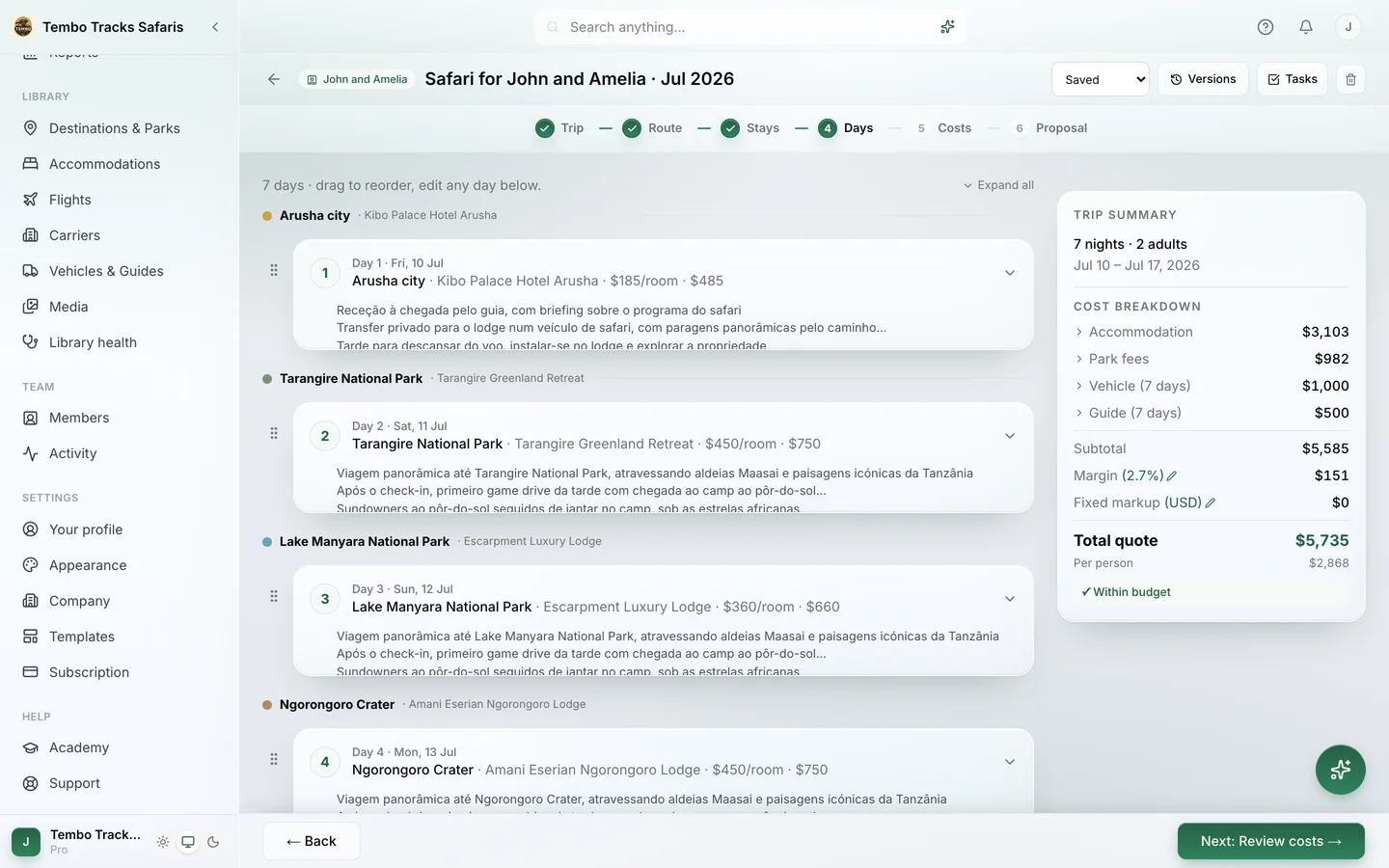
A normal Tanzanian booking is a family: two adults, a fifteen-year-old and a seven-year-old, two rooms, one vehicle. Each authority treats the children differently from the adults, and treats the vehicle as its own line. Itero Desk prices each person by age band and visitor category, and each vehicle separately, per park, per day. The party mix is entered once, in the Trip step, and every fee downstream respects it. No blended per-head guesses, no "children priced as adults and fixed later".
Built in Arusha, inside the trade it serves.
Itero Desk is built in Arusha, Tanzania. That is not a flag on a slide; it has practical consequences for the product.
The park fee mechanics and the season logic were built against Tanzanian reality first: the three-authority northern circuit, the crater day-visit case, the age bands, the per-vehicle lines, and green against high season bands in real lodge rate sheets. The mechanics for the other countries came after, on a model that had already survived contact with the hardest local case. A Tanzania workspace gets JRO, Kilimanjaro International, as its hub airport default; the country's destinations, parks, fees and seasons are the operator's to build from signup.
The social proof is honest and short: Itero Desk is trusted by real safari operators, including Breeze Safaris in Tanzania and Zanzibar. No wall of logos, no invented review counts. Book the demo and judge the product on one of your own trips instead.
The shape of the Tanzanian market, and how the desk holds it.
Tanzanian operators do not sell one kind of trip, and the software has to carry all of them in one system.
Arusha and Moshi: the northern circuit.
Most desks in Arusha and Moshi live on the northern circuit: Tarangire, Lake Manyara, Ngorongoro and the Serengeti, with arrivals through JRO. These are the trips where the multi-authority fee problem bites hardest, and where quote speed wins bookings, because the same enquiry usually sits in several other inboxes at once. The leads pipeline, the Ballpark quick quote on a lead card, and the six-step safari itinerary builder exist to turn that enquiry into a priced, branded proposal the same day.
Dar es Salaam and the southern circuit.
Desks selling out of Dar es Salaam work the southern circuit: Nyerere and Ruaha, longer distances, more light-aircraft legs, quieter parks. The same library structure covers it: destinations and parks, accommodations, flights and carriers, vehicles and guides. The same per-person and per-vehicle fee logic applies, and flight legs sit inside the day-by-day plan rather than in a side spreadsheet nobody reconciles.
Treks and beaches attached to safaris.
The Tanzanian product is often a combination: a Kilimanjaro trek and then a short safari, a safari and then a Zanzibar week, sometimes all three for one family. Itero Desk builds multi-destination trips in one itinerary, so the trek days, the park days and the beach days live in one document with one price, one proposal and one invoice. The client sees a single coherent trip; the desk sees each leg costed on its own lines. A Zanzibar extension needs no park fee machinery, and it gets none: hotel season bands, transfers and flights carry that part of the trip.
Seasons are a pricing mechanic here, not a brochure paragraph.
Tanzanian lodge rate sheets are built around season bands: high season, green season, sometimes shoulder dates between them, commonly shaped around the long rains that fall roughly in April and May and the drier months that follow. Same room, same board basis, two or three prices depending on the date, all in one PDF that arrives every year.
Two failure modes cost desks real money:
- The trip spans a boundary. A stay that starts in one band and ends in another has to be priced night by night, not from the band the trip started in. Priced flat off the arrival date, the quote looks fine and is wrong, and nobody notices until the lodge invoice arrives.
- The sheet is stale. Lodges circulate new sheets well ahead of the season. A quote built against last year's sheet is quietly wrong in every line that changed.
Itero Desk stores rates as seasonal bands by board basis, from room only through game package, prices each night against the band its date falls in, and raises a rate-gap warning when no imported rate covers the travel date. If the desk chooses, it can price from the closest available year, and that price is always labelled estimated rather than presented as real. Nothing prices silently off the wrong band, which on a multi-night Serengeti stay is the difference between a healthy margin and an awkward email to an overseas agent.
See your own sheets in the system. A demo prices one of your real trips with your rates and the real park fee breakdown, not sample data. Book a demo
The whole desk, from enquiry to invoice.
Park fees get the headlines on this page because they are the distinctly Tanzanian problem. Day to day, the fee engine is one part of a whole desk.
Enquiry to itinerary.
Enquiries land in a pipeline with six stages, from new to won or lost. Each lead card holds the conversation, the party details and a Ballpark panel for a fast indicative price before anyone builds the full trip. One click converts the lead into an itinerary, and a won lead becomes a client record automatically, with trip history, passports and documents, and dietary and medical notes attached.
Documents overseas agents judge.
A large share of Tanzanian business arrives through overseas agents, and an agent judges a desk by the document it sends. Itineraries render into three template characters: Lookbook, a photography-led coffee-table book and the default; Rounded, soft and warm; Studio, a modern dark editorial. Proposals go out as a PDF or as a published web page on a share link, and can be translated into seven languages, which matters when the agent sits in Milan or Berlin and the traveller does not read English.


Invoices, reservations and resources.
The itinerary that wins generates the invoice, with its own template set and a share link plus a matching PDF. Reservations track what sits behind the trip: hotel requests go out as clean documents without prices, option holds carry expiry dates, and the desk is reminded before a hold lapses or a request goes stale. Vehicles and guides are costed resources with daily rates and capacity, and double-booking one across trips raises a conflict warning naming the vehicle or guide, per day. That warning earns its keep in the peak months, when every good vehicle and every strong guide in Arusha is spoken for.
A desk that answers from the field.
Itero Desk installs as an app on a phone, with bottom tabs for Home, Leads, Itero AI and the Library. An owner halfway between Manyara and the Serengeti can still see the pipeline, answer a lead and check a rate. Tanzanian safari companies are commonly run by people who spend part of the season in a vehicle, and the software assumes it rather than pretending everyone sits at a desk in town.
Training that lives in the product.
Every plan includes Itero Academy: eight self-paced courses, exams, and shareable certificates that can be verified online. A new consultant in the Arusha office learns the desk from the software itself, not from the one senior colleague who has no spare hours in July.
Where Itero AI fits on a Tanzanian desk.
Itero AI is the assistant inside the workspace, and its jobs are specific rather than decorative:
- Rate sheet import. Tanzanian lodges send seasonal rate sheets as PDFs, Word files and spreadsheets, every year. Itero AI reads them into structured seasonal rates that the desk reviews and confirms, so contracted rates enter the system without a week of re-typing.
- Itinerary import. An agent forwards another operator's PDF, a pasted email, or even a photographed page; Itero AI drafts the trip in the builder from it, ready to be repriced on your own rates.
- Drafting and translation. Welcome letters, proposal emails, rewriting a day's description, translating the proposal for the agent's market.
Two rules hold everywhere: AI assists and the desk decides, and AI never prices from imagination. Costs come from imported rates and the park fee library, or they do not appear.
Who this page is not for.
Honesty first, because a demo exposes any overclaim within ten minutes.
- A desk selling outside the safari world entirely, say European city breaks or US domestic travel, would not benefit: the mechanics are built around parks, camps and safari logistics.
- A Zanzibar-only beach operator needs much less of the park fee machinery this page describes. The itinerary builder, proposals, invoices and CRM still apply, but the hardest argument on this page is not that operator's problem.
- A desk comparing the whole market should read the open comparison on the best safari tour operator software page, where Itero Desk is disclosed as our product and the competitors are treated as the serious tools they are.
And the neighbours: a desk running out of Nairobi should read the Kenya page, which leads with the conservancy and park mechanics that shape Mara pricing, and a desk in Maun should read the Botswana page, which leads with fly-in logistics. Same software, different local problem first.
What it costs.
Prices are public. Starter is $74.99 per month ($59.99 per month billed annually) with one user and 50 itineraries a month. Pro is $109.99 per month ($89.99 per month billed annually) with four users, 200 itineraries a month and team roles. Enterprise is custom. Every new workspace starts with a 30-day trial of the full Pro feature set, no credit card, and the cost engine is already tuned to Tanzania's fee mechanics from the first login. Current details live on the pricing page.
Frequently asked questions.
Does Itero Desk cover Ngorongoro and the Serengeti?
Yes. The cost engine already knows the NCAA's and the Serengeti's fee logic in every Tanzania workspace, alongside TANAPA parks such as Tarangire and Lake Manyara. Fees are computed per person and per vehicle, by age band and visitor category, once you add your own fee amounts, and a crater morning inside a longer trip is priced with day-visit logic rather than as a full stay. The breakdown stays visible per park on the Costs step.
Can one itinerary combine a safari with a Zanzibar beach extension?
Yes. Itero Desk builds multi-destination trips in one itinerary, so the park days and the beach days live in one document with one price, one proposal and one invoice. The Zanzibar leg is priced from hotel season bands, transfers and flights, with no park fee machinery involved, while the safari leg keeps its full per-park fee breakdown.
Is Itero Desk really built in Tanzania?
Yes. It is built in Arusha, inside the trade it serves. The park fee mechanics and the season logic were built against the Tanzanian case first: three authorities on one trip, crater day visits, age bands, per-vehicle fee lines, and green against high season rate bands. Its one public reference is Breeze Safaris, operating in Tanzania and Zanzibar.
Does it cover the southern circuit, Nyerere and Ruaha?
Yes. The Tanzania library covers southern circuit destinations as well, and the same pricing logic applies: fees per person and per vehicle by age band, seasonal lodge rates by board basis, and light-aircraft legs placed inside the day-by-day plan. Desks selling out of Dar es Salaam run on the same workspace as northern circuit desks.
How does it handle green season and high season rates?
Lodge rates are stored as seasonal bands by board basis, and every night is priced against the band its own date falls in, so a stay spanning a season boundary is split correctly. When no imported rate covers a date, a rate-gap warning appears, and any closest-year fallback price is always labelled estimated instead of passing as real.
Where can I see actual park fee amounts?
Not on this page, on purpose. Authorities revise their fees, and a stale figure on a marketing page is worse than none. Inside the product, the Tanzania workspace's own fee entries carry the figures used in quotes, kept current by the operator. For how the fee systems work, country by country, read the guide to safari park fees by country.
What does it cost for a Tanzanian desk?
Starter is $74.99 per month and Pro $109.99 per month, both around 20% cheaper billed annually, in USD, with pricing public rather than quote-based. Every plan includes the cost engine tuned to Tanzania's fee mechanics, the itinerary builder, proposals, invoices, CRM and Academy training, and every new workspace gets 30 days of full Pro with no credit card.
The next JRO arrival is already being quoted by someone else. Book a demo and price a real northern circuit trip in Itero Desk, crater morning included. Book a demo · Existing customer? Sign in