A Wetu alternative for the desk behind the showcase.
Most operators searching for a Wetu alternative are not unhappy with the showcase. Wetu is a widely used itinerary content and digital-showcase platform, strong in Southern Africa, and the digital itinerary it produces is genuinely good. What sends desks looking is everything around that document: where the price comes from, where the enquiry pipeline lives, who chases the option holds, and which tool produces the invoice. Itero Desk is an alternative on that axis. Itero Desk is operations software for safari and tour operators: itineraries, quotes, proposals, invoices, CRM and pricing in one workspace, on web and mobile, with AI assistance built in.
One thing before the comparison: this page is written by Itero Desk, so read it as a vendor's argument with the receipts shown. Every specific statement about Wetu below comes from wetu.com as it read at the time of writing, in July 2026, and where their public site is silent we say so instead of guessing. Wetu has earned its place in this trade, and plenty of readers of this page should stay on it. We say who, first.
Book a demo. Bring one trip you priced last month and see it rebuilt from enquiry to invoice. Book a demo
What Wetu does well, and who should stay on it.
At the time of writing, Wetu's homepage describes it as a collaboration platform for operators, agents and suppliers building trusted, bookable itineraries. The product list on their site backs that up: an Itinerary Builder with a content management system, a Product Manager for centralised product knowledge, a Contact Manager for traveller details, TravelKey, a branded traveller app that their site says works offline, iBrochures for suppliers, and a Catalogue Manager that groups brochures into themed collections.
The depth of the content layer is the real moat. Their operators page describes a library of 250k+ product-curated images and descriptions that can be searched and dropped straight into an itinerary, digital itineraries built from drag-and-drop themes with co-branding, and translation into 17 languages. Their products page lists integrations with reservation and back-office systems including Tourplan, ResRequest, Dolphin, Travelogic, Tour32, Travelyst, Lemax and Nitro Travel Solutions, plus content and connect APIs. They offer a 14-day free trial.
That is a serious product, and it earns its loyalty. A desk should probably stay on Wetu when:
- The bottleneck is content and presentation. If quotes go out fast and priced correctly today, and the fight is producing rich, branded trip documents at volume, Wetu solves the problem you actually have.
- The back office is already settled. If reservations and costing live in an integrated system the desk likes, Wetu is the presentation layer that stack was built around. Ripping it out buys little.
- The supplier ecosystem matters to your distribution. iBrochures, catalogues and shared supplier content are a network. If your agents expect those links, that network has value no single-company tool replaces.
- You need client documents in many languages. Their site says 17 languages. Itero Desk translates proposals into seven: English, Portuguese, Spanish, French, Italian, German and Dutch. If you regularly sell in languages beyond those, count that against us.
If none of those describe your desk, keep reading.
Why desks go looking for a Wetu alternative.
The reasons below are about fit, not failure. They describe desks whose problem moved from the document to the numbers behind it.
The price is built somewhere else.
A safari price is not a lookup. It is park fees per authority, per visitor category and age band, sometimes per vehicle. It is lodge rates that change by season band, board basis and room type. It is two adults, a teenager and a seven-year-old in two rooms with one vehicle, priced correctly per person per day.
At the time of writing, Wetu's pricing page lists an Excel costing spreadsheet among the inclusions of its entry plan, and its products page points costing-heavy desks toward integrations with reservation and back-office systems. Read plainly, that is a coherent design: the itinerary and its presentation live in Wetu, and the numbers live somewhere else, in a spreadsheet or in a second system.
The cost of that split is measured in money, not tidiness. Every re-type between the costing sheet and the client document is a chance to send a price that is wrong in the client's favour. A season band that changed in the lodge's new rate sheet but not in the spreadsheet eats margin silently, booking after booking, until someone audits the formula.
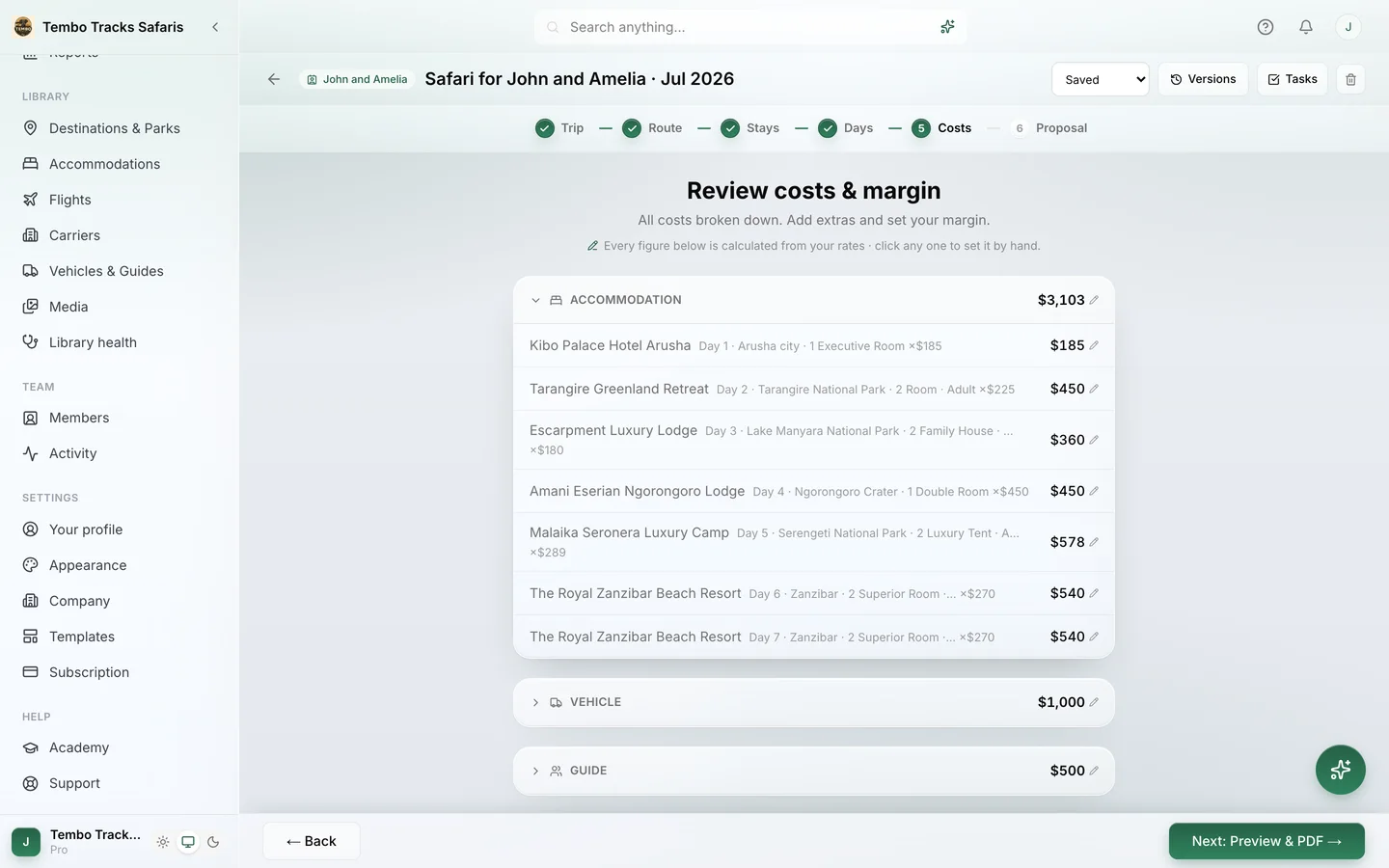
Itero Desk puts the numbers inside the itinerary. The cost engine is tuned for fifteen safari countries and the way their real fee authorities charge: TANAPA, NCAA and SENAPA in Tanzania, KWS and the Mara conservancies in Kenya, UWA in Uganda, RDB in Rwanda, ZimParks in Zimbabwe, SANParks in South Africa, DWNP in Botswana, NWR in Namibia, DNPW in Zambia, ANAC in Mozambique, EWCA in Ethiopia and more. Lodge rates are stored by season and board basis, imported from your own rate sheets. When no rate covers the travel date, the desk sees a rate-gap warning instead of a silently stale price, any line can be overridden by hand, and margin sits on top as its own visible layer. The full mechanics are on the tour pricing software page.
One system from lead to invoice.
The second reason is the shape of the stack. A common Wetu-era desk runs the enquiry in an inbox, the pipeline in a spreadsheet, the costing in Excel, the presentation in Wetu, the reservations in email threads, and the invoice in an accounting tool. Six surfaces, and the trip's facts re-typed at every handoff. When the person who knows where everything lives goes on leave, the desk stops selling. Itero Desk's homepage calls that the one-laptop problem.
In Itero Desk the journey is one flow. An enquiry lands in a pipeline with six stages, gets a Ballpark quick quote while it is still warm, and converts to an itinerary in one click. The itinerary prices itself as it is built, renders into the client proposal, and, once won, generates the reservations requests, the client portal page and the invoice, all carrying the same trip facts because they are the same record. The wider category is mapped on the safari tour operator software page.
The subscription stack, and what each part costs.
Credit where it is due: Wetu publishes its pricing, which is rarer in this market than it should be. At the time of writing, their pricing page lists a Lite plan at $75 per month for one user plus $35 per additional user, a Premium plan at $150 per month plus $65 per additional user, and an Enterprise tier by quote, prices excluding VAT.
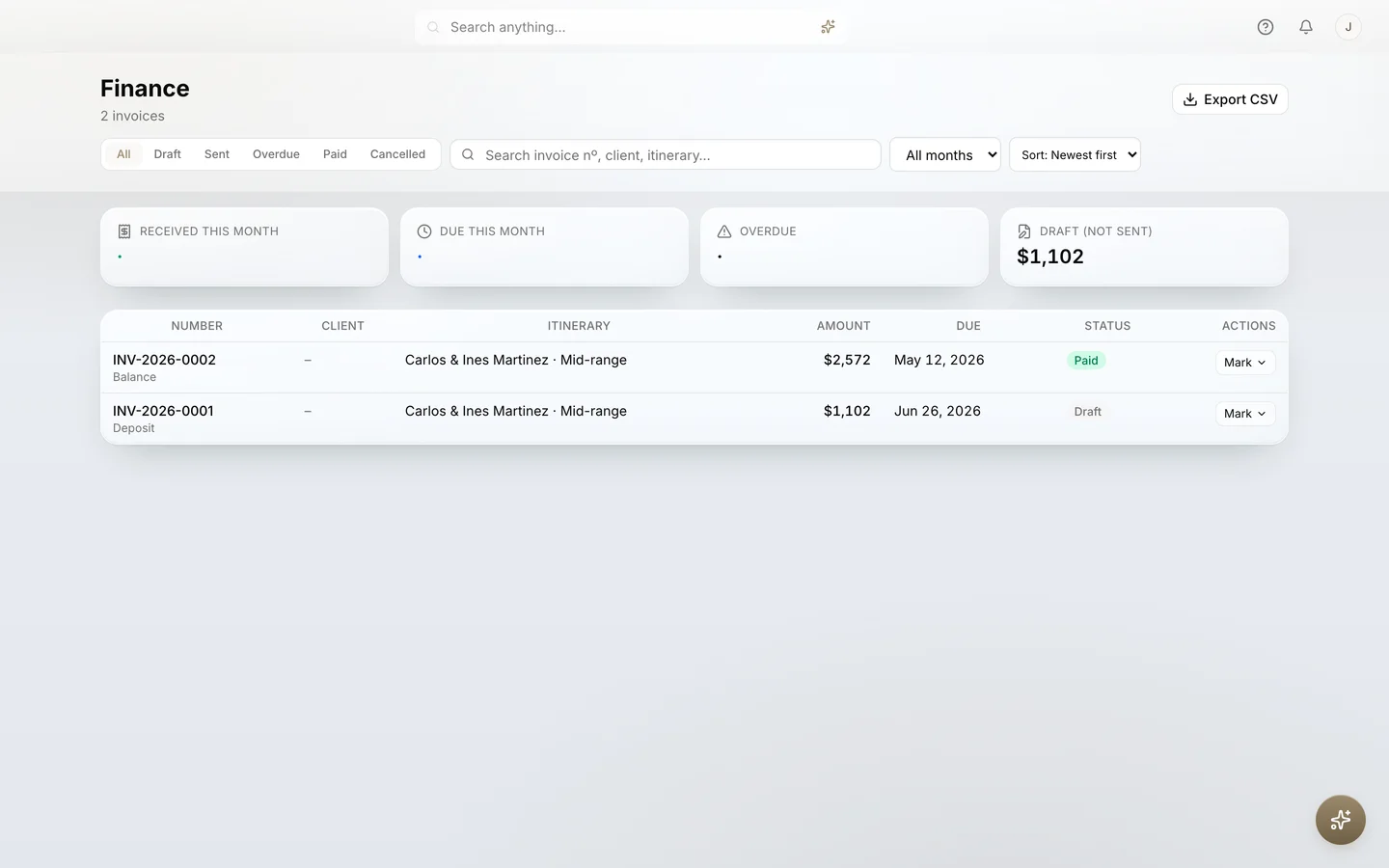
So the question is not transparency. Both companies put numbers on a public page. The question is how many subscriptions the desk stacks to cover the whole journey. A showcase tool plus a costing tool plus a CRM plus an invoicing tool is four renewals, four logins and three gaps for trip facts to fall through. Itero Desk's plans, Starter at $74.99 per month and Pro at $109.99 per month, both around 20% cheaper billed annually, cover the itinerary builder, the cost engine with its tuned fee mechanics, CRM, reservations, proposals, invoices and Academy training in one bill. Current details are on the pricing page.
See your own numbers, not ours. A demo prices a real trip of yours, park fees included, on a call with someone who knows the trade. Book a demo
Wetu and Itero Desk, side by side.
Rules of the table: every Wetu cell is either verified on wetu.com at the time of writing or marked as not described there. Nothing is inferred from forums, reviews or hearsay. Their product evolves, so check their current pages before deciding.
| Axis | Wetu, from their public site | Itero Desk |
|---|---|---|
| Centre of gravity | Itinerary content and the digital showcase; a collaboration platform for operators, agents and suppliers | The operations desk: pricing, CRM, reservations and invoices, with the client documents included |
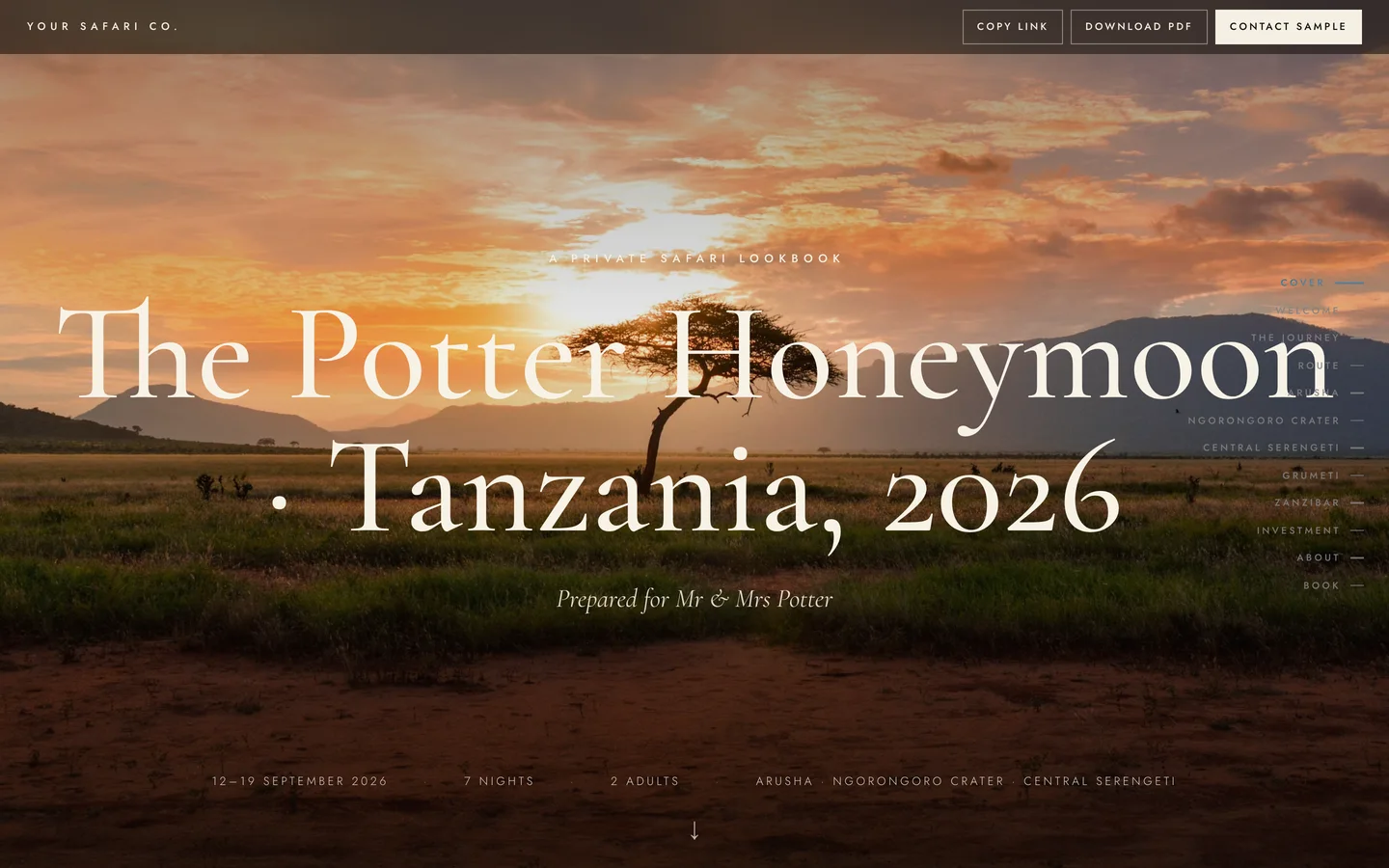
| Itinerary presentation | Strong. Digital itineraries from drag-and-drop themes with co-branding, a content library their operators page describes as 250k+ images and descriptions, translation into 17 languages, TravelKey traveller app, iBrochures | Lookbook, Rounded and Studio templates, a word-processor-grade proposal editor, web proposals on share links with matching PDFs, translation into 7 languages |
| Pricing from contracted rates and park fees | Their pricing page lists an Excel costing spreadsheet among plan inclusions at the time of writing; a built-in cost engine or park fee library is not described on their public site | Seasonal rates by board basis with rate-gap warnings and manual overrides; fee mechanics tuned for 15 safari countries, per person and per vehicle, by visitor category and age band |
| CRM pipeline | Contact Manager, described on their site as a central hub for contacts, preferences and trips; a staged sales pipeline is not described publicly at the time of writing | Six-stage pipeline from new to won, Ballpark quick quotes on the lead, one-click conversion to itinerary, won leads become clients automatically |
| Reservations with option holds | Their site lists integrations with reservation systems such as Tourplan and ResRequest; a native reservations module is not described publicly at the time of writing | Draft to confirmed lifecycle with option holds carrying expiry dates, warnings at 3 days and 1 day, and reminders on stale requests |
| Invoices from the trip | Not described on their public site at the time of writing | Generated from the itinerary, with a share link and matching PDF and its own template set |
| Training included | A Help Centre is linked from their site; a built-in certification academy is not described publicly at the time of writing | Itero Academy in every plan: eight self-paced courses, exams, shareable certificates verifiable online |
| Pricing transparency | Public at the time of writing: Lite $75 and Premium $150 per month, $35 and $65 per additional user, Enterprise by quote | Public: Starter $74.99 and Pro $109.99 per month, cheaper annually, Enterprise custom, all on /pricing |
Two notes on reading it fairly. First, the presentation row is a genuine contest, and Wetu's column is long because their showcase deserves the detail; if you want to judge our side of that row properly, the safari itinerary templates page shows Lookbook, Rounded and Studio at full size. Second, "not described on their public site" means exactly that and no more: it is not a claim the capability is absent, it is the boundary of what we will assert about someone else's product. The whole-market version of this exercise, with more tools in the table, lives on the best tour operator software hub, and the closest sibling comparison is the Tourwriter alternative page.
Running both: the showcase and the desk.
Here is the part a comparison page usually skips: for some desks the right answer is not replacement, it is pairing. Wetu's own products page makes the case, listing integrations with Tourplan, ResRequest, Travelogic and half a dozen other operations systems. The pattern of a showcase layer in front and an operations system behind is how a large slice of this market already runs, with Wetu's evident blessing.
If your agent network expects iBrochure links, or your travellers are used to TravelKey, keeping Wetu as the distribution and showcase layer is a defensible call. Itero Desk still fits behind it: the enquiry pipeline, the Ballpark quote, the contracted rates and park fees, the option holds and their expiry warnings, and the invoice generated from the trip all run in Itero Desk, and the desk presents the finished trip through the showcase workflow it already has. You pay two subscriptions and accept one re-entry point between the systems, at the itinerary. For a desk protecting an established distribution channel, that trade can be worth it.
Replacing entirely makes sense when the desk wants one record from enquiry to invoice and the client-facing layer included. Itero Desk's documents are not a compromise: proposals render in Lookbook, Rounded or Studio, publish as web pages on share links with matching PDFs, confirmed trips get a client portal, a branded web page per trip that needs no login from the traveller, and the invoice comes off the same record with its own share link and PDF. The honest difference to weigh: Itero Desk has no branded native traveller app. If TravelKey-style app delivery is a hard requirement, that is a real point for Wetu. If a clean branded web page on the traveller's phone does the job, the portal covers it without another moving part.
The sweet spot for full replacement is a desk of one to fifteen people operating in one of the fifteen supported safari countries, from Tanzania and Kenya to Rwanda, Botswana and the Indian Ocean islands, currently paying for two or three tools and still keeping the real pricing logic in a spreadsheet. A desk selling outside the safari world entirely, say European city breaks, loses the main event, the tuned fee mechanics, and may be better served staying put for now.
Moving to Itero Desk: what migration really involves.
No one is going to tell you migration is one click, least of all us. There is no automated Wetu-to-Itero import, and any vendor promising a lossless one-button move between two structurally different systems is selling something. Here is the actual work, in order.
Your rates come in through AI import, not re-typing. The slow part of any move is the contracted rates, and this is the part Itero AI genuinely compresses. It reads lodge rate sheets in PDF, Word or Excel and converts them into structured seasonal rates by season band and board basis, which you review and confirm before they price anything. The AI never invents a number: if it did not read it, the rate is not there, and rate-gap warnings will tell you where the holes are.
The library is a full rebuild, with the fee logic already worked out. Destinations, parks, fees, seasons, accommodations, preferred room names, vehicles, guides and media for your operating country are all your work to enter; nothing ships pre-built. What is already there is the mechanics: how TANAPA, NCAA, SENAPA and the other authorities charge, per person, per vehicle, by age band. Past trips can be recreated fast by pointing the AI import at an old itinerary PDF or a pasted email, then saving the result as a reusable saved safari.
The team trains itself in Academy. Every plan includes Itero Academy: eight self-paced courses with exams and verifiable certificates, so the switch does not depend on one champion evangelising the office.
The trial runs in parallel, on purpose. Every new workspace gets 30 days of the full Pro feature set, no credit card. Do not cancel anything on day one. Pick three trips you priced recently, rebuild them in Itero Desk, and compare the numbers line by line against what you actually sent. If the desk does not trust the park fee breakdowns and the season bands by the end of the month, stay where you are and you have lost nothing but a few hours.
Frequently asked questions.
Is Itero Desk better than Wetu?
They have different centres of gravity, so it depends on the job. Wetu leads with itinerary content and the digital showcase, and their public site shows real depth there. Itero Desk leads with operations: pricing from contracted rates and park fees, CRM, reservations and invoices, with the client documents included. If your bottleneck is presentation, stay on Wetu. If it is the numbers behind the document, Itero Desk is built for exactly that.
Can I run Wetu and Itero Desk together?
Yes, and some desks should. Keep Wetu as the showcase and distribution layer your agents already know, and run the pipeline, pricing, option holds and invoices in Itero Desk. Wetu's own site lists integrations with operations systems, so the pairing pattern is normal in this market. You pay two subscriptions and re-enter the itinerary once between systems; many desks later consolidate because Itero Desk includes the client-facing documents.
Does Wetu publish its pricing?
Yes. At the time of writing, wetu.com lists a Lite plan at $75 per month for one user plus $35 per additional user, Premium at $150 per month plus $65 per additional user, and Enterprise by quote, excluding VAT. Itero Desk's pricing is also public: Starter at $74.99 per month, Pro at $109.99 with four users included, extra seats at $20. Compare total stack cost, not single line items.
Does Itero Desk have a traveller app like TravelKey?
Not a native app, no. Wetu's site describes TravelKey as a branded traveller app that works offline, and if that exact delivery is a hard requirement, count it for Wetu. Itero Desk gives every confirmed trip a client portal: a branded web page per trip that opens on the traveller's phone with no login and no install, alongside web proposals and matching PDFs.
Do I have to re-type my lodge rates to switch?
No, and this is the point of the move. Itero AI reads rate sheets in PDF, Word or Excel and turns them into structured seasonal rates by season band and board basis, which you review and confirm before anything is priced. Where no rate covers a travel date, the desk gets a rate-gap warning rather than a stale price, and every cost line can still be overridden by hand.
Which countries does Itero Desk cover?
Fifteen: Botswana, Ethiopia, Kenya, Madagascar, Malawi, Mauritius, Mozambique, Namibia, Rwanda, Seychelles, South Africa, Tanzania, Uganda, Zambia and Zimbabwe, with the cost engine tuned to each country's real fee authorities, from TANAPA, KWS and UWA to RDB, ZimParks, SANParks, DWNP, NWR, DNPW, ANAC and EWCA. A workspace picks its operating country at signup; destinations, fees and rates are still yours to build. A desk selling outside the safari world entirely gains little from the tuned mechanics and may be better served on its current stack for now.
How long does switching from Wetu take?
Plan for inside a month, run in parallel. The trial gives 30 days of full Pro with no credit card, the fee mechanics for your country are ready from day one, and the real work is building your library and importing rate sheets, which Itero AI accelerates, and rebuilding your accommodations and media. Itero Academy trains the team with self-paced courses and certificates. There is no automated Wetu import, so keep Wetu live until your rebuilt trips match your sent quotes.
The showcase was never the problem. The desk behind it was. Book a demo and price a real trip from enquiry to invoice. Book a demo · Existing customer? Sign in