Safari tour operator software that knows what a park fee is.
Safari tour operator software is operations software built for companies that plan and sell safaris: it manages enquiries, builds day-by-day itineraries, prices trips from the operator's own contracted rates including national park fees, and produces the client-facing proposals and invoices. It differs from generic tour software in one structural way: the cost of a safari depends on park authorities, seasons, party mix and vehicles, and the software has to model all four.
That is the category. This page explains what the software has to do, how Itero Desk does it, what it costs, and how it compares with the other ways safari desks run today: spreadsheets, generic CRMs, and itinerary-first tools.
Book a demo. See your own trips priced in Itero Desk, on a call with a person who knows the trade. Book a demo
Why generic software keeps failing safari desks.
Most tour operator software is written for the volume travel trade: package holidays, city breaks, coach tours. A safari breaks its assumptions on day one.
- The price is not a lookup. A lodge rate depends on the season band, the board basis, the room type and the child policy. The park fee depends on the authority, the visitor category, the age bands and, in some parks, the vehicle. None of that fits a flat price list.
- The party is not one unit. Two adults, a teenager and a seven-year-old in two rooms with one vehicle is a normal booking. The software has to price each person and each vehicle correctly, per day.
- The itinerary is the product. An overseas agent judges the desk by the document it sends. A plain quote table loses against a proposal that looks like a coffee-table book.
- The rates live in PDFs. Lodges send rate sheets as PDFs, Word files and spreadsheets, every season, every year. Software that expects you to re-type them into forms just moves the spreadsheet problem indoors.
A safari desk that forces generic software to do this work ends up keeping the real logic in one person's head and one spreadsheet. Itero Desk's homepage calls that failure mode "the one laptop": rates, contacts and quotes live with one person, and when they are away, nobody sells.
What safari tour operator software has to cover.
Use this as an evaluation checklist, for Itero Desk or for anything else you are considering.
- Enquiry to quote in one flow. A lead arrives, gets qualified, becomes an itinerary, becomes a priced proposal. No re-typing between stages.
- Park fees as first-class data. Fees per authority, per visitor category, per age band, with concession and crater-style special fees handled, and updated when authorities change them.
- Your rates, not estimates. Contracted lodge rates by season and board basis, imported rather than re-typed, with warnings when a rate is stale or missing.
- Whole-party pricing. Multiple rooms, child rate bands, per-day meal plans, vehicles and guides as costed resources.
- Professional output. Branded proposals and invoices a desk is proud to send, as PDF and as a web page, in more than one visual style.
- Operations after the win. Reservations with option holds and expiry dates, client records, documents, a calendar the whole team sees.
- Works where the desk works. In the office on a laptop, in the field on a phone.
- A team, not a laptop. Roles and permissions, so the desk survives holidays, growth and staff changes.
The rest of this page walks through how Itero Desk answers each line.
One workspace, from enquiry to invoice.
Itero Desk is built as a single workspace rather than a bundle of modules. The through-line is the quote-to-confirm journey.
Leads and clients: a CRM shaped like a safari pipeline.
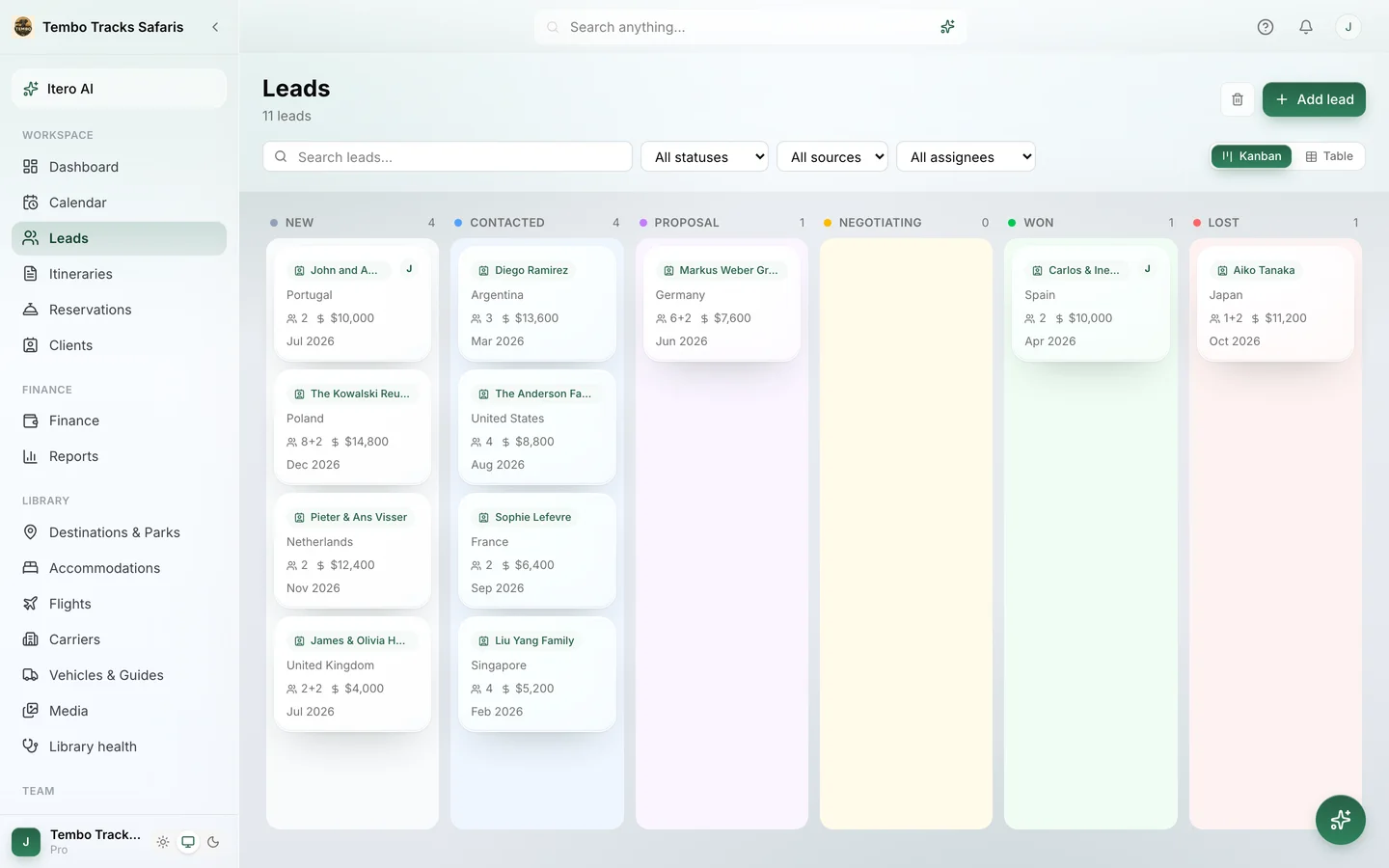
Enquiries land in a pipeline with six stages: new, contacted, proposal, negotiating, won, lost. Each lead card holds the conversation, the party details and a Ballpark panel for a fast indicative price before anyone builds a full itinerary. One click converts a lead into an itinerary, and a won lead becomes a client automatically, with trip history, passports and documents, and dietary and medical notes on the record.
If the CRM slice is your main problem, the dedicated page on tour operator CRM goes deeper.
The itinerary builder: six steps, one calm workflow.
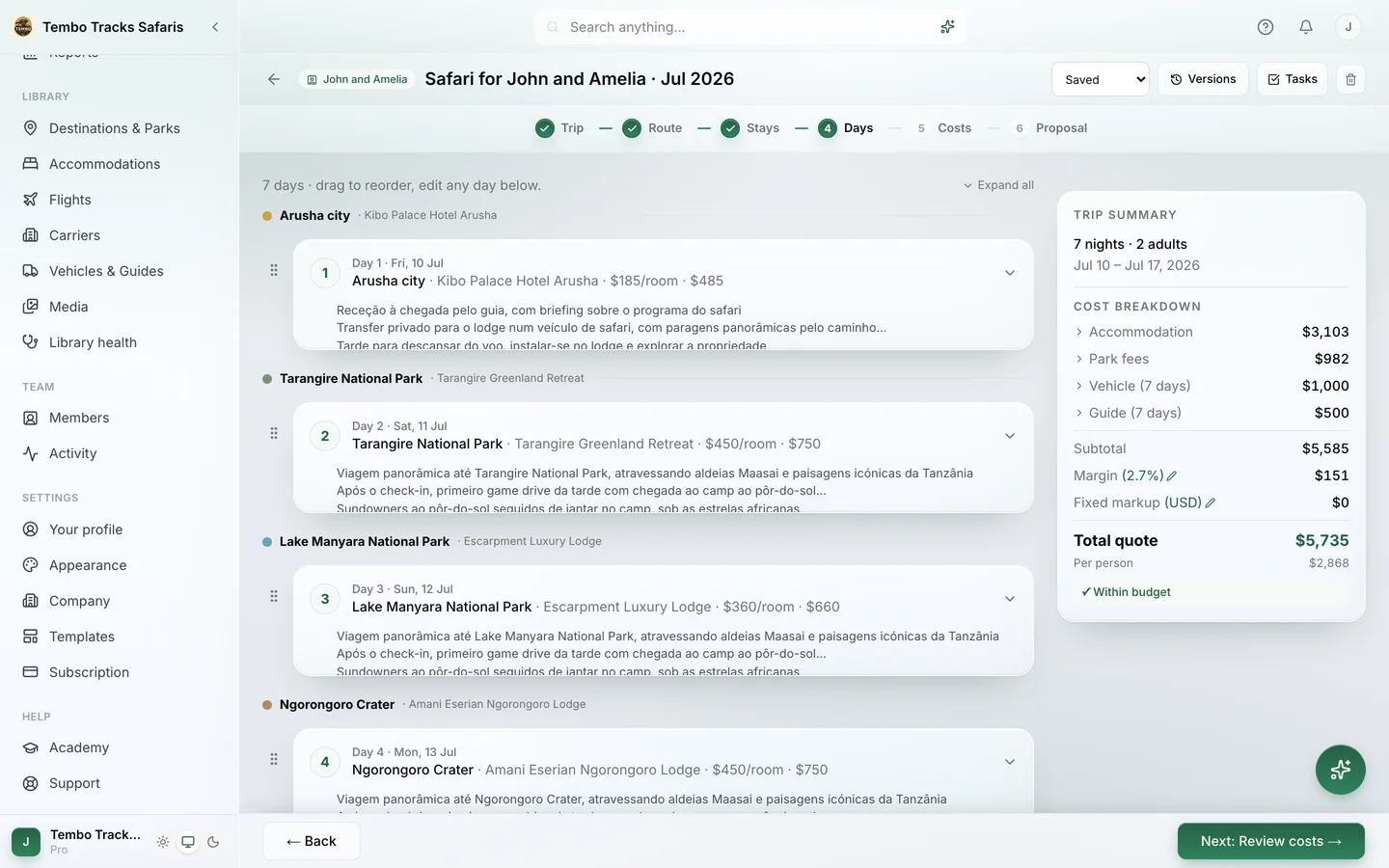
Building a trip walks through six steps: Trip (who is travelling and when), Route (destinations and nights), Stays (rooms and board basis), Days (parks, activities and flights per day), Costs (how the price is built) and Proposal (the client document). The cost panel updates live as the trip changes, so pricing is never a separate job done later.
The cost engine: park fees, seasons and margin, not guesswork.
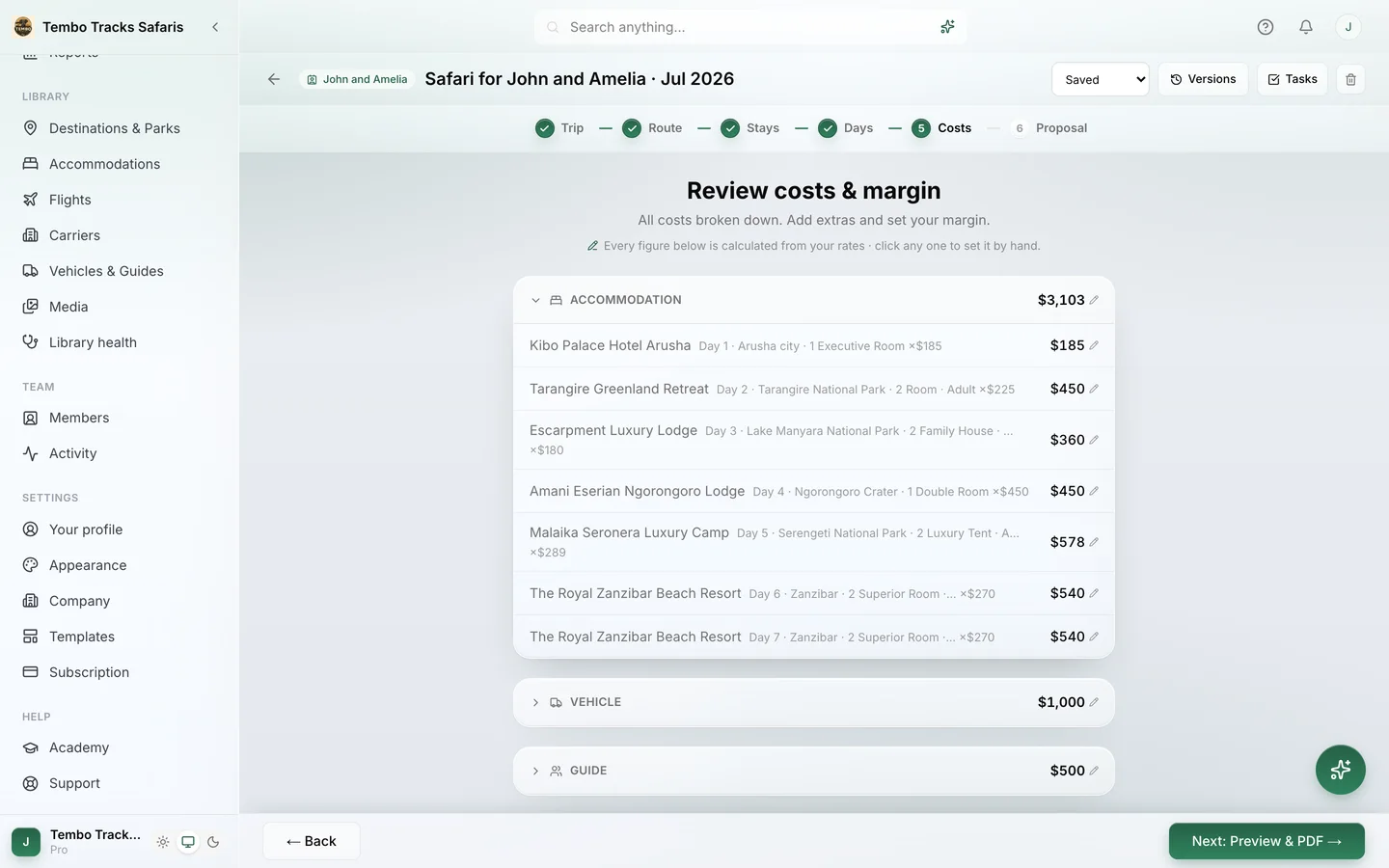
This is the part that has to be safari-specific, and it is. Itero Desk's cost engine is tuned for safari country, fifteen countries at signup, and for the way real fee authorities charge: TANAPA, NCAA and SENAPA in Tanzania, KWS and the Mara conservancies in Kenya, UWA in Uganda, RDB in Rwanda, ZimParks, SANParks, DWNP, NWR, DNPW, ANAC, EWCA and more. Fees are computed per person and per vehicle by visitor category and age band, and the breakdown is visible per park, once you add your own fee amounts.
Lodge rates come from your own rate sheets, organised by season and board basis, from room-only through full board and game package. When a rate does not cover the travel date, the desk sees a rate-gap warning instead of a silently wrong price, and any line can be overridden by hand: accommodation, vehicle, guide, transfers, flights, activities, park fees or additional costs. Margin sits on top as its own visible layer.
The guides on how to price a safari itinerary and park fees by country cover the mechanics in the open, and the safari quote builder lets you try the pricing logic before a demo.
Proposals and documents: the part the client actually sees.
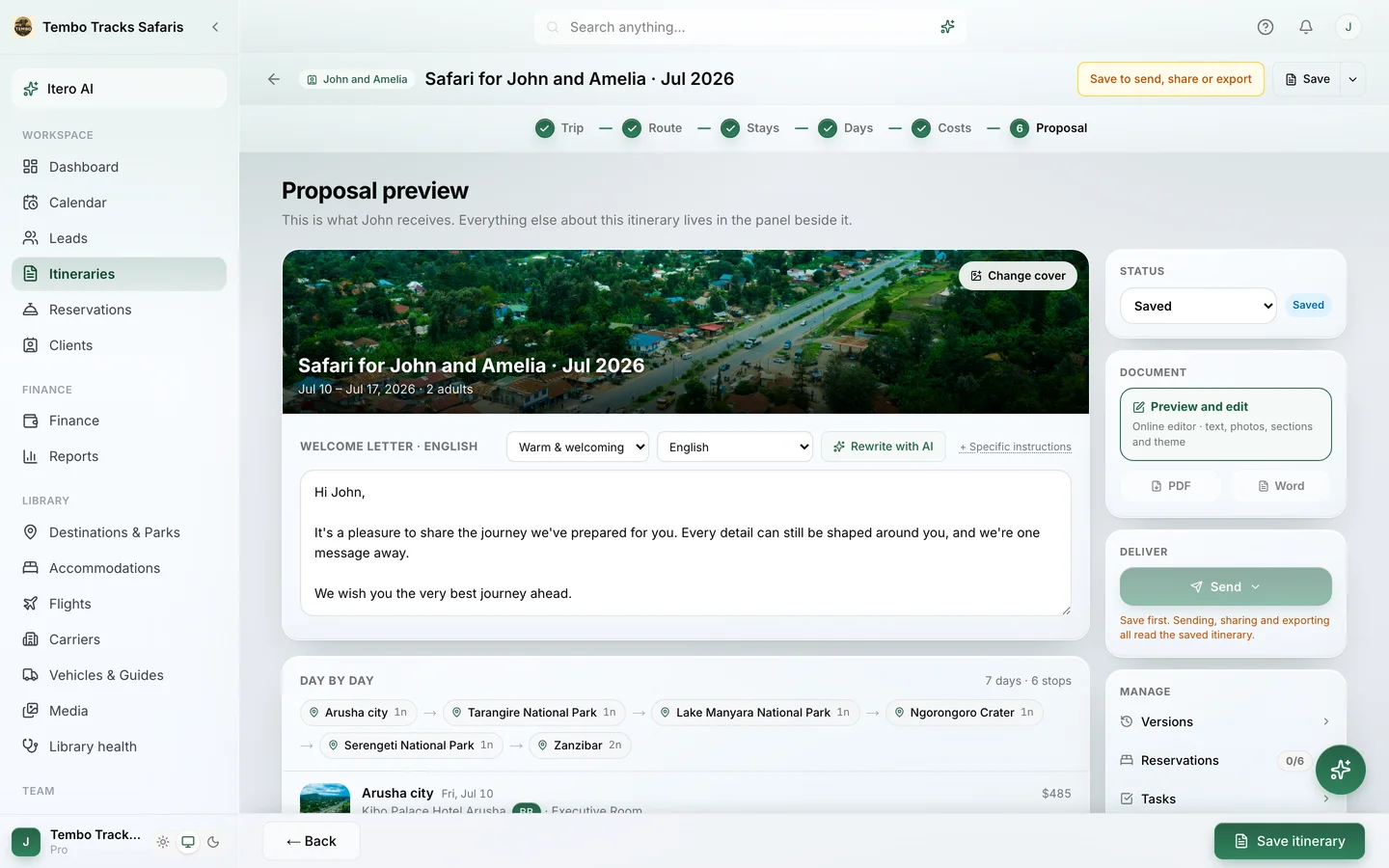
A finished itinerary renders into a client document through templates with distinct characters: Lookbook, a photography-led coffee-table book; Rounded, soft and warm; Studio, a modern dark editorial. Colours, fonts and light or dark backgrounds are set once in company settings, so every consultant sends documents that look like the same company made them.
Beyond templates there is a full proposal editor, closer to a word processor than a form: sections you can reorder and hide, image slots, pull quotes, price tables, a route map, version history, and a print layout that matches the PDF exactly. Proposals can go out as a PDF or as a published web proposal on a share link, and can be translated into seven languages: English, Portuguese, Spanish, French, Italian, German and Dutch.
What your team sees
What your client sees


Invoices, reservations and the rest of the desk.
The itinerary that won the booking generates the invoice, in its own set of invoice templates, with a share link and a PDF that match. Reservations track the requests behind the trip: a hotel request goes out as a clean document without prices, an option hold carries its expiry date, and the desk gets reminded before a hold lapses or a request goes stale. A shared library holds destinations and parks, accommodations, flights and carriers, vehicles and guides, and media; double-booking a vehicle or a guide across trips raises a conflict warning naming the resource. Finance and reports round out the back office.
See the whole flow on your own trips. A demo walks enquiry to invoice with your rates, not sample data. Book a demo
Web and mobile: the desk in the office and in the field.
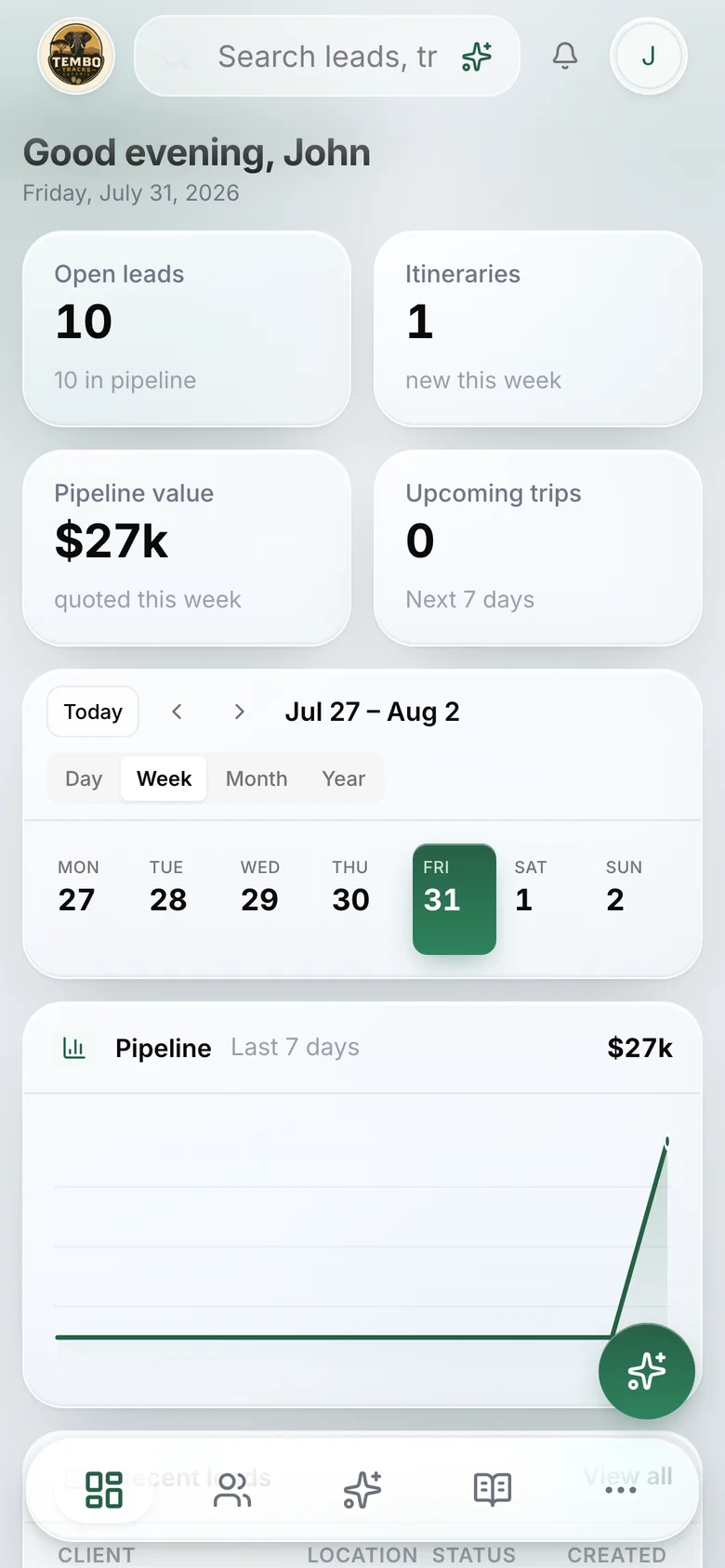
Itero Desk runs in the browser on any laptop and installs as an app on a phone, with a mobile layout built around the jobs that happen away from the desk: checking the pipeline, answering a lead, looking up the library, asking Itero AI. A safari company does not stop selling because the owner is on a game drive.
The team layer: roles, activity and training.
Owner, admin, finance, member and viewer roles keep pricing and settings with the right people. An activity feed shows who changed what. And every plan includes Itero Academy, a built-in training school with eight self-paced courses, exams and verifiable certificates, so a new hire learns the desk from the software itself instead of from whoever has time that week.
Where Itero AI fits.
Itero Desk is not an AI product with a database attached; it is an operations platform with AI where AI genuinely saves hours. The assistant, called Itero AI, works across the app with a few specific jobs:
- Rate sheet import. It reads a lodge's PDF, Word or Excel rate sheet and turns it into structured seasonal rates, so contracted rates get into the system without a week of re-typing. There is a dedicated page on AI rate sheet import.
- Itinerary import. It reads an itinerary from a PDF, a pasted email or even a photographed document and drafts the trip in the builder.
- Drafting and translation. Welcome letters, proposal emails, rewriting a day's description, translating a proposal into the client's language.
- Builder actions. In the itinerary builder it can apply concrete changes on request, from a bounded list of actions, with undo. It assists; the desk decides.
Every plan includes a monthly allowance of AI actions, and the AI never prices from imagination: costs always come from your rates and the park fee library.
How Itero Desk compares with the alternatives.
An honest comparison, because switching software is expensive and the alternatives are real. The columns are the ways safari desks actually run today.
| Spreadsheets | Generic CRM | Itinerary-first tools | Itero Desk | |
|---|---|---|---|---|
| Enquiry pipeline | Manual | Strong | Varies | Built in, safari-shaped |
| Park fees by authority and age band | Hand-built formulas | Absent | Rarely modelled | Engine tuned for 15 safari countries, your own rates |
| Prices from your contracted seasonal rates | Yes, fragile | No | Sometimes, often manual entry | Yes, with AI import and stale-rate warnings |
| Whole-party pricing (rooms, children, vehicles) | Fragile | No | Partial | Built in |
| Branded proposals | No | No | Strong, often the core focus | Strong: templates plus a full editor |
| Invoices matched to the quote | Separate tool | Separate tool | Usually separate | Generated from the itinerary |
| Reservations with option holds | Manual | No | Rarely | Built in |
| Survives the "one laptop" problem | No | Partly | Partly | Yes: roles, shared library, activity, training |
Two named tools deserve straight treatment. Tourwriter is mature itinerary and proposal software for tour operators with years of history and a real customer base; Wetu is a widely used itinerary content and digital-showcase platform, particularly strong in Southern Africa. Both are serious products. The difference is centre of gravity: they lead with the itinerary document, Itero Desk leads with the operations of a safari desk, pricing included, and treats the document as the output. If you are evaluating either, the detailed pages on the Tourwriter alternative and the Wetu alternative compare feature by feature without straw men.
Itero Desk also states what it is not, because trust survives contact with a demo: it is software, not a travel agency; it does not sell or book trips; and it does not process or hold traveller payments. You collect from clients however you already do.
What safari tour operator software costs.
Itero Desk publishes its prices. Starter is $74.99 per month ($59.99 per month billed annually) with one user and 50 itineraries a month. Pro is $109.99 per month ($89.99 per month billed annually) with four users, 200 itineraries a month, team roles and social media exports. Enterprise is custom, for groups that need SSO, SLAs and integrations. Every new workspace starts with a 30-day trial of the full Pro feature set, no credit card. Extra seats, storage and AI allowances are add-ons rather than forced tier jumps. Current details and annual pricing live on the pricing page.
For context when comparing: itinerary-first tools in this market commonly price per user per month in the same broad range but quote bespoke pricing per operator, so get like-for-like numbers in writing, including onboarding fees, before deciding on cost.
Who it is for, and who it is not for.
Itero Desk is built for safari and tour operators, and DMCs, operating in Botswana, Ethiopia, Kenya, Madagascar, Malawi, Mauritius, Mozambique, Namibia, Rwanda, Seychelles, South Africa, Tanzania, Uganda, Zambia and Zimbabwe, selling to international agents and direct travellers. The sweet spot is a desk of one to fifteen people currently running on spreadsheets, or on a tool that only solved the document.
It is honest to say who should look elsewhere. A desk selling outside the safari world entirely, say European city breaks or US domestic travel, would not benefit: the mechanics are built around parks, camps and safari logistics. A pure travel agency reselling other operators' packages needs different software. And an operator who only wants a prettier PDF and is happy pricing by hand may be well served by an itinerary-first tool.
Itero Desk is built in Arusha, Tanzania, inside the trade it serves, and is trusted by real safari operators, including Breeze Safaris in Tanzania and Zanzibar. That is the honest state of its social proof: real and short, not a wall of invented logos.
Frequently asked questions.
What is safari tour operator software?
Safari tour operator software is operations software for companies that plan and sell safaris. It manages enquiries and clients, builds day-by-day itineraries, prices trips from contracted lodge rates and national park fees, and produces branded proposals and invoices. The safari-specific part is the pricing model: park authorities, seasonal rates, party mix and vehicles all change the cost of the same trip.
How is it different from a normal CRM?
A CRM tracks relationships and deals; it has no concept of a park fee, a season band or a child rate. Safari software starts where the CRM stops: the moment a lead needs a priced itinerary. Itero Desk includes the pipeline, so most desks replace both the CRM and the pricing spreadsheet with one system.
Which countries does Itero Desk cover?
Fifteen: Botswana, Ethiopia, Kenya, Madagascar, Malawi, Mauritius, Mozambique, Namibia, Rwanda, Seychelles, South Africa, Tanzania, Uganda, Zambia and Zimbabwe, with the cost engine tuned to the way real fee authorities charge: TANAPA, KWS, UWA, RDB, ZimParks, SANParks, DWNP, NWR, DNPW, ANAC, EWCA and more. A workspace picks its operating country at signup, which sets the hub airport default; destinations, fees, seasons and rates are still yours to add.
Do I have to re-type my lodge rate sheets?
No. Itero AI reads rate sheets in PDF, Word or Excel and converts them into structured seasonal rates you review and confirm. When a trip date falls outside any imported rate, the software warns about the gap instead of pricing from a stale sheet, and any cost line can be overridden by hand.
Can my clients see itineraries online, or only as PDFs?
Both. Every itinerary can go out as a branded PDF or as a published web proposal on a share link, rendered in the same template. There is a client portal for confirmed trips, and invoices follow the same pattern: web link and matching PDF.
Does Itero Desk take bookings or payments from travellers?
No. Itero Desk is software for the operator's own desk. It is not a travel agency or a marketplace, it does not sell or arrange trips, and it does not process or hold traveller payments. You invoice through it and collect payment through whatever channels you already use.
How long does it take to get started?
The trial is 30 days with the full Pro feature set and no credit card. Your workspace starts empty on purpose, so the real onboarding work is building your library and importing your rate sheets, both of which the AI import accelerates, and the built-in Itero Academy trains the team with self-paced courses and certificates rather than an external consultant.
What does it cost?
Starter is $74.99 per month and Pro $109.99 per month, both around 20% cheaper billed annually, with a custom Enterprise tier above. All plans include the itinerary builder, the cost engine's tuned fee mechanics, proposals, invoicing and Academy training; see the pricing page for the current details.
The next enquiry deserves a same-day quote. Book a demo and price one of your real trips in Itero Desk, end to end. Book a demo · Existing customer? Sign in