A Tourwriter alternative built around the safari desk.
Most operators searching for a Tourwriter alternative are not unhappy with their itineraries. They want the machinery around the document: pricing that understands park fees, reservations with option holds, invoices generated from the trip, and a price list they can read without requesting a quote. Itero Desk is that alternative for safari operators across fifteen countries, from Tanzania and Kenya to Rwanda, Botswana and the Indian Ocean islands. For a luxury FIT desk selling the rest of the world, Tourwriter remains a serious choice, and this page says so plainly.
Itero Desk is operations software for safari and tour operators: itineraries, quotes, proposals, invoices, CRM and pricing in one workspace, on web and mobile, with AI assistance built in. What follows is an honest comparison. Every specific claim about Tourwriter on this page was verified on tourwriter.com on the day of writing, and where their site does not state something, the table below says exactly that.
Book a demo. Price one of your own trips in Itero Desk, park fees included, on a call with someone who knows the trade. Book a demo
What Tourwriter does well, and who should stay on it.
Tourwriter is mature itinerary and proposal software for tour operators, and it deserves a straight description. At the time of writing, their homepage describes the product as a fast, flexible way to design, sell and manage luxury travel, aimed at travel designers, luxury DMCs, travel advisors and inbound tour operators building custom FIT trips. Their tagline is candid about the niche: "Built for the best, not for everyone."
Their product pages describe a drag and drop itinerary builder, a CRM for travel contacts, financial tools that price itineraries and send invoices, a Xero integration in beta, booking requests that suppliers answer through a secure portal, custom reporting, and a tailored onboarding in which their team trains you and helps set up your supplier database. That is a real operations product, not just a document tool, which is exactly why this comparison has to be about fit rather than features counted on fingers.
Some desks should stay on Tourwriter, and it costs nothing to say which ones:
- Desks selling worldwide destinations. Itero Desk's fee mechanics cover fifteen safari countries. An operator building trips to Japan, Patagonia or the Loire gets no benefit from them, and Tourwriter's generalist supplier model fits that desk better.
- Desks that want traveller payments inside the software. Tourwriter's pricing page lists Stripe payments from its Starter plan. Itero Desk does not process or hold traveller payments, by design.
- Desks that need agency commissions and accounting integration. Their Pro tier lists agency commissions and accounting software exports, with a two-way Xero integration as an add-on.
- Desks that want onboarding done for them. Their one-time setup covers data migration, account setup and training by their team. Itero Desk's onboarding is self-serve, backed by Academy courses.
None of those are weaknesses. They are a different centre of gravity, and centre of gravity is what the rest of this page is about.
Why safari operators go looking for an alternative.
Nobody re-platforms a desk for fun. Switching costs real days, so the reasons have to be structural. These are the ones that show up, stated as fit rather than fault.
Park fees are the hard part of safari pricing. A Serengeti quote depends on the authority, the visitor category, the age of each traveller and, for some fees, the vehicle. Generalist supplier-and-rates databases treat a park fee as one more rate row that someone at the desk types in and maintains. When an authority changes its fees, every hand-built table is a wrong quote waiting to be sent, and a wrong quote costs money twice: once when the desk absorbs the gap, again when the agent notices. Tourwriter's public pages describe supplier and rates management and automatic pricing; safari park fee mechanics are not described there at the time of writing.
The arithmetic of caps and seats. At the time of writing, Tourwriter's pricing page lists its Starter plan at 25 itineraries a year and its Pro plan at 50 a year, with unlimited itineraries reserved for the Premium tier, priced on application. A safari desk in the July rush can build 25 itineraries in a month. Plans are priced per user, at USD $99 and USD $149 a month billed annually, with a one-time setup of USD $1,199. None of that is hidden, and none of it is wrong for their market. It is simply an equation a busy safari desk keeps re-checking.
Pricing you can read without a call. Every Tourwriter plan sits behind a "Request a quote" button, and a free trial is not mentioned on their pricing page at the time of writing. Some desks are fine with that. Others want to see flat numbers, start a trial the same afternoon and decide inside a month.
Operations that continue after the win. Confirmed safaris live or die on holds: the lodge gives you an option until Friday, and Friday arrives whether anyone remembers or not. Tourwriter's site describes booking requests that suppliers answer through a portal; an option-hold lifecycle with expiry reminders is not stated publicly at the time of writing. Desks that want those specific mechanics, plus vehicle and guide double-booking warnings, go shopping.
Rate sheets arrive as PDFs. Every season, every lodge, another attachment. Any system that expects the desk to re-type those into forms charges an annual tax in evenings. Itero Desk treats the import itself as a product: the AI rate sheet import reads the PDF, Word file or spreadsheet and produces structured seasonal rates the desk reviews and confirms.
If the tool you are outgrowing is Wetu rather than Tourwriter, the sibling page on the Wetu alternative covers that comparison, and the hub on the best tour operator software ranks the whole market by segment.
Tourwriter and Itero Desk, side by side.
Every Tourwriter cell below comes from tourwriter.com as read on the day of writing. Where their public pages do not state something, the cell says so, which is not the same as saying the product lacks it. Check their site yourself; products change.
| Tourwriter (their site, at the time of writing) | Itero Desk | |
|---|---|---|
| Centre of gravity | Design, sell and manage luxury FIT travel; itinerary builder, CRM, bookings, financial tools | The safari desk's operations: pricing, reservations, invoices, CRM, with the itinerary as one step |
| Safari park fee mechanics | Not described on their public feature or pricing pages | Tuned for 15 safari countries, per person and per vehicle, by visitor category and age band |
| Pricing transparency | Per-user prices listed (Starter USD $99, Pro USD $149, Premium on application) behind "Request a quote", plus USD $1,199 setup | Flat public prices: $74.99 and $109.99 a month, no setup fee, 30-day trial without a card |
| Itinerary allowance | 25 a year on Starter, 50 a year on Pro, unlimited on Premium | 50 a month on Starter, 200 a month on Pro |
| Reservations with option holds | Booking requests answered by suppliers through a secure portal; option holds with expiry not stated publicly | Draft, requested, option with expiry date, confirmed; reminders at 3 days and 1 day before a hold lapses |
| Invoices from the trip | Financial tools price itineraries and send invoices; Xero integration in beta | Generated from the itinerary, own template set, share link plus matching PDF |
| Included training | Tailored onboarding and training as part of the one-time setup | Itero Academy in every plan: eight courses, exams, verifiable certificates |
| Mobile app | Mobile app access listed under the Premium tier | Installable mobile app on every plan, with offline-tolerant shell and push notifications |
| AI rate sheet import | Not stated publicly | PDF, Word or Excel rate sheets become structured seasonal rates, review and confirm |
| Traveller payments | Stripe payments listed from the Starter plan | None, by design; you collect from clients however you already do |
Read that last row twice. It cuts both ways, and it is covered honestly further down.
The whole desk, not just the document.
A comparison page is a bad place to discover the product is thin, so here is the whole of it, briefly. The full walkthrough lives on the safari tour operator software page.
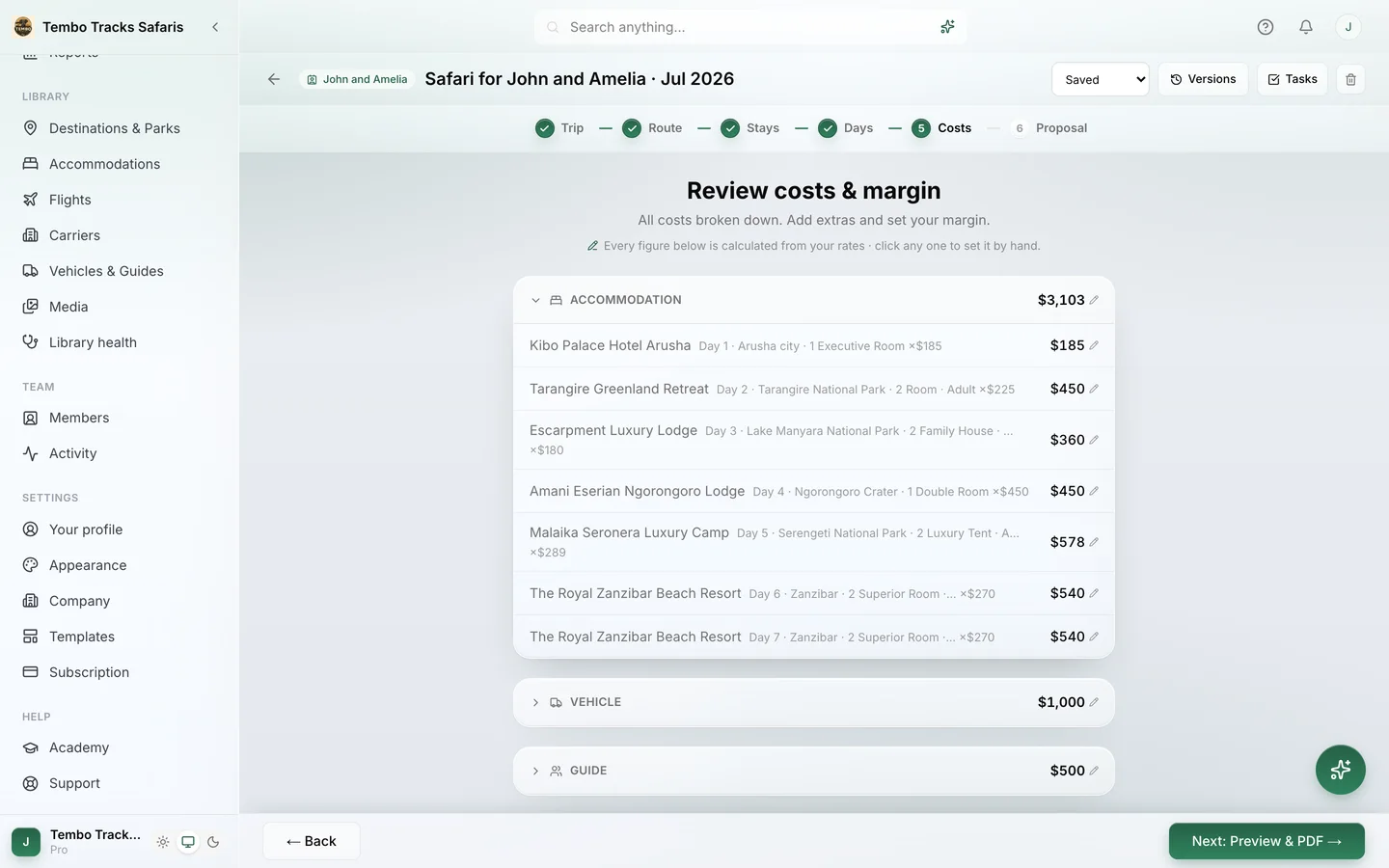
The itinerary builder works in six steps: Trip, Route, Stays, Days, Costs, Proposal. The cost panel updates live while the trip is built, so pricing is never a separate job done later by whoever owns the spreadsheet.
The cost engine is the safari-specific core. It already knows how to compute park fees across fifteen safari countries, the way the real authorities charge, from TANAPA, NCAA and SENAPA in Tanzania and KWS and the Mara conservancies in Kenya to UWA, RDB, ZimParks, SANParks, DWNP, NWR, DNPW, ANAC and EWCA, per person and per vehicle by visitor category and age band, with the breakdown visible per park, once you enter your own fee amounts. Lodge rates are seasonal, by board basis from room only to game package. When no rate covers the travel date, the desk gets a rate-gap warning instead of a silently wrong number, and any line can be overridden by hand. Margin sits on top as its own visible layer. The tour pricing software page goes deeper on the engine.
Proposals and invoices come from the same trip. Three proposal templates (Lookbook, Rounded, Studio), a word-processor-style editor, publication as a web link or a matching PDF, and translation into seven languages. The invoice is generated from the itinerary with its own template set, so the client never receives a document that disagrees with the quote. A disagreement between quote and invoice is not a formatting bug; it is a discount you did not intend to give.
The CRM runs a six-stage pipeline from new to won, with a Ballpark quick-quote panel on each lead and one-click conversion to an itinerary. Won leads become clients automatically, carrying trip history, passports, documents, and dietary and medical notes.
Reservations and resources carry the trip after the win. Requests go to lodges as clean documents without prices, option holds carry expiry dates with reminders before they lapse, and double-booking a vehicle or a guide across trips raises a conflict warning naming the resource and the day.
Mobile and training round it out. The app installs on a phone with bottom tabs for the jobs that happen away from the desk, and Itero Academy ships in every plan: eight self-paced courses, 25-question exams, certificates verifiable online. A new hire learns the desk from the software, not from whoever has a free hour.
And Itero AI is one lever among these, not the headline. It imports rate sheets, park fees and flight rates, drafts itineraries from a PDF or a pasted email, rewrites a day, translates a proposal, and applies bounded builder actions with undo. It never prices from imagination: every number comes from your imported rates and the park fee library. AI assists; the desk decides.
See it against your own numbers. Bring one real trip and one lodge rate sheet to a demo and watch both go in. Book a demo
Pricing, with the numbers in the open.
Both products publish enough to compare, which is to their credit and rare in this market.
At the time of writing, Tourwriter's pricing page lists Starter at USD $99 per user per month for one person, Pro at USD $149 per user per month for teams of 2 to 5, both billed annually, and a Premium tier priced on application for teams of 5 to 20 and beyond. A one-time setup of USD $1,199 covers data migration, account setup and training, prices exclude local sales tax, and each plan's button reads "Request a quote".
Itero Desk's prices are flat and public: Starter at $74.99 a month ($59.99 billed annually) for one user and 50 itineraries a month, Pro at $109.99 a month ($89.99 billed annually) including four users and 200 itineraries a month, extra seats at $20 a month each ($16 annually), no setup fee, and a 30-day trial of full Pro with no card. Details on the pricing page.
The arithmetic for a four-person desk, using their listed rates: Tourwriter Pro is USD $596 a month billed annually, plus the USD $1,199 setup in year one. Itero Desk Pro is $89.99 a month billed annually, all four seats included. That is a large gap, and it still is not the whole story: Tourwriter's price includes hands-on onboarding and a dedicated success executive at Pro, and a desk that values a done-for-you database setup is buying something real. Compare on what your trips cost to price, not on the seat maths alone.
What moving a desk actually involves.
No one-click migration exists between Tourwriter and Itero Desk, and this page will not pretend otherwise. Moving a desk is a project measured in weeks of part-time attention, not an afternoon. Here is the honest shape of it.
- Rates come from your rate sheets, not from an export. The contracted rates a desk actually quotes with live in the lodge PDFs it already holds. Feed each one to the AI rate sheet import; it returns structured seasonal rates for review and confirmation. Minutes per sheet instead of an evening, but reviewing sixty lodges is still real work. Budget for it.
- The fee mechanics are already modelled. Itero Desk already knows how TANAPA, NCAA, SENAPA and the other fourteen countries' authorities charge, per person, per vehicle, by age band, and sets the hub airport default at signup, so nobody has to design that logic from scratch. Parks, fee amounts, seasons and rates still have to be entered for the desk's own country, the same as on any new system.
- In-flight trips can be drafted by import. Itero AI reads an itinerary from a PDF, a Word file, a pasted email or a photographed document and drafts the trip in the builder. The desk then re-checks prices against its own imported rates, because a migrated number nobody verified is a migrated error.
- Clients rebuild with the pipeline. There is no bulk client migration to promise, so plan the switch across a quieter month and let new enquiries land in the new system while confirmed trips wind down in the old one.
- The team retrains inside the product. Itero Academy's courses and certifications replace the retraining that usually makes switching feel impossible. Run the 30-day full-Pro trial in parallel: price three real trips in both systems, compare the outputs line by line, and only then decide.
The cost of switching is real. Weigh it against the recurring cost of the current setup: the re-typing each rate season, and the margin lost to every quote built on a stale fee.
What Itero Desk is not.
Trust survives contact with a demo, so the limits go here in plain text. Itero Desk is software, not a travel agency: it does not sell, book or arrange trips. It does not process or hold traveller payments; you invoice through it and collect through the channels you already use, so if in-software card collection is on your requirements list, Tourwriter's listed Stripe payments serve that and Itero Desk deliberately does not. And its fee mechanics cover fifteen safari countries, so a desk selling outside the safari world entirely, say European city breaks, would be buying the engine without its fuel. The one public customer reference is Breeze Safaris in Tanzania and Zanzibar: real and short, not a wall of logos.
Frequently asked questions.
Is Itero Desk better than Tourwriter?
It depends on the desk. A safari operator in any of the fifteen supported countries, from Tanzania and Kenya to Rwanda, Botswana and the Indian Ocean islands, gets fee mechanics tuned to their country, option holds and flat public pricing that Tourwriter's public pages do not describe. A luxury FIT desk selling worldwide destinations, or one that wants traveller payments collected inside the tool, is better served by Tourwriter. The honest split is geography and centre of gravity, not a scoreboard.
What does Tourwriter cost compared with Itero Desk?
At the time of writing, Tourwriter's pricing page lists Starter at USD $99 per user per month and Pro at USD $149 per user per month, billed annually, plus a Premium tier on application and a one-time USD $1,199 setup, each plan behind a quote request. Itero Desk's flat public prices are $74.99 and $109.99 a month, with four users included on Pro and no setup fee.
Can I import my Tourwriter data into Itero Desk?
There is no one-click migration, and no honest vendor should claim one. What moves well: lodge rate sheets, which Itero AI converts from PDF, Word or Excel into seasonal rates you review and confirm, and in-flight itineraries, which it drafts from an exported PDF or a pasted email. Park and fee data still has to be entered, the same as any new system; what Itero Desk already knows is the fee mechanics for the operator's country. Client records rebuild as the pipeline turns over.
Does Itero Desk actually compute park fees, or just store them?
It computes them. Fees are modelled per authority, per visitor category and age band, per person and, where a park charges it, per vehicle, across fifteen safari countries. The breakdown is visible per park on every quote, day-visit fee logic and multi-destination days are handled, and the AI never invents a fee: every number comes from the library and your imported rates.
Can travellers pay through Itero Desk?
No, by design. Itero Desk does not process or hold traveller payments; you invoice through it and collect through your existing channels. Tourwriter's pricing page lists Stripe payments from its Starter plan at the time of writing, so if collecting traveller card payments inside the software is a hard requirement, that is a genuine reason to choose Tourwriter instead.
How long does switching from Tourwriter take?
Plan for weeks of part-time attention, not an afternoon. Ready-made fee mechanics remove the need to design the pricing logic from scratch, and AI rate sheet import turns each lodge PDF into reviewable seasonal rates in minutes, but building the country's park and fee data, reviewing a full rate library, re-drafting live trips and training the team is real work. The 30-day full-Pro trial exists so a desk can run both systems in parallel before committing.
Does Itero Desk work for operators outside Africa?
Not well, yet. The cost engine's fee mechanics cover Botswana, Ethiopia, Kenya, Madagascar, Malawi, Mauritius, Mozambique, Namibia, Rwanda, Seychelles, South Africa, Tanzania, Uganda, Zambia and Zimbabwe, and a workspace picks its operating country at signup. A desk selling Europe, Asia or the Americas would lose the core advantage and should shortlist a generalist tool such as Tourwriter. The hub on the best tour operator software recommends by segment for exactly this reason.
The next rate sheet does not have to be re-typed. Book a demo and watch one of your own lodge PDFs become seasonal rates, then price a real trip on top. Book a demo · Existing customer? Sign in