The best tour operator software, chosen by the trips you sell.
There is no single best tour operator software; there is a best fit for each operating model. An inbound operator assembling multi-day trips from contracted supplier rates needs pricing depth and a back office. A volume day-tour seller needs per-seat checkout and channel connections. A travel designer selling through the document needs the document above all. This guide compares seven products against six disclosed criteria, with every product fact taken from that vendor's own public website, and it recommends by segment instead of crowning one winner.
Disclosure, up front: we build Itero Desk. It is on this list, and we mark where it is not the right pick. Every product below gets the same four-part entry at roughly the same length, including ours, and every entry states plainly who should not buy that product. Where a claim comes from a vendor's site, we say so; where pricing is unpublished, we say that instead of guessing. If this page ever reads like a rigged scoreboard, close the tab.
This is a guide, not a pitch. Read the segment table before any single entry. If it points you at Itero Desk, a demo prices one of your own real trips end to end. Book a demo
How we chose, before any product is named.
Six criteria, in the order they tend to matter for an operator's desk:
- Fit to the operator's model. Inbound multi-day operators, DMCs and tailor-made desks assemble trips from supplier contracts. Volume day-tour and activity sellers move seats through online checkout. These are different businesses, and software built for one is usually poor at the other, no matter how good it is. The tour operator software page defines the category in full.
- Pricing depth. Can the product price a trip from contracted seasonal rates, model fees such as park and entrance charges per person and per vehicle, handle a mixed party of adults and children in several rooms, and show margin as its own layer? Wrong prices cost money in one direction or the other, every time.
- Document quality. The proposal or itinerary is what the agent or traveller judges the desk by. It has to be something the desk is proud to send.
- Operations coverage. What happens between the enquiry and the money: CRM, quoting, reservations, invoicing. A tool that stops at the PDF leaves the desk on spreadsheets for everything after the win.
- Pricing transparency. Published prices allow a comparison before the first sales call. Quote-based pricing is not disqualifying, but it moves work onto the buyer.
- Geography focus. Content libraries, fee data and support hours live somewhere. A vendor whose data and customer base sit in your region saves months of setup.
The method behind the entries: we read each vendor's public website on 30 July 2026 and took every description and every price from what that vendor itself publishes. There are no scores, no star ratings and no invented review counts on this page. Where a vendor does not publish pricing, the entry says on request.
The seven products, in alphabetical order.
Alphabetical, because any other order would be an editorial thumb on the scale.
Ezus.
What it is. Ezus is software for travel agencies, DMCs and tour operators that sell custom trips; its site frames the job as running the business from request to invoice. The core is a budget engine with real-time markups and VAT handling, automated branded travel documents, an itinerary builder, a CRM, supplier management, a traveller area and financial dashboards.
Where it shines. Desks that quote bespoke trips with real financial logic: markups, VAT, supplier costs and client documents produced from the same data. Its prices are listed in euros and its public materials centre on the European trade, so agencies and DMCs selling custom trips in that market are its natural home.
Where it is not the fit. Its site describes budgets in terms of markups and VAT rather than protected-area fees, so an African inbound desk should make the demo prove park fee handling by authority, visitor category and age band before assuming the budget engine covers it.
Pricing. Published on ezus.io: Professional at €75 per user per month and Premium at €100, billed annually, Enterprise on request, plus one-time setup packs at €1,990 or €2,490.
Itero Desk.
What it is. Itero Desk is operations software for safari and tour operators: itineraries, quotes, proposals, invoices, CRM and pricing in one workspace, on web and mobile, with AI assistance built in. It is built in Arusha, Tanzania, for inbound operators in fifteen safari countries whose park fee authorities the cost engine is tuned for: Botswana, Ethiopia, Kenya, Madagascar, Malawi, Mauritius, Mozambique, Namibia, Rwanda, Seychelles, South Africa, Tanzania, Uganda, Zambia and Zimbabwe. We build it; read this entry knowing that.
Where it shines. Pricing depth for inbound multi-day trips: contracted seasonal rates by board basis, park fees per person and per vehicle by visitor category and age band, rate-gap warnings instead of silently wrong prices, and whole-party pricing across rooms, children and vehicles. Operations run from lead to invoice in one flow, and Itero AI imports lodge rate sheets from PDF, Word or Excel so contracted rates arrive without a week of re-typing. The full walkthrough lives on the safari tour operator software page.
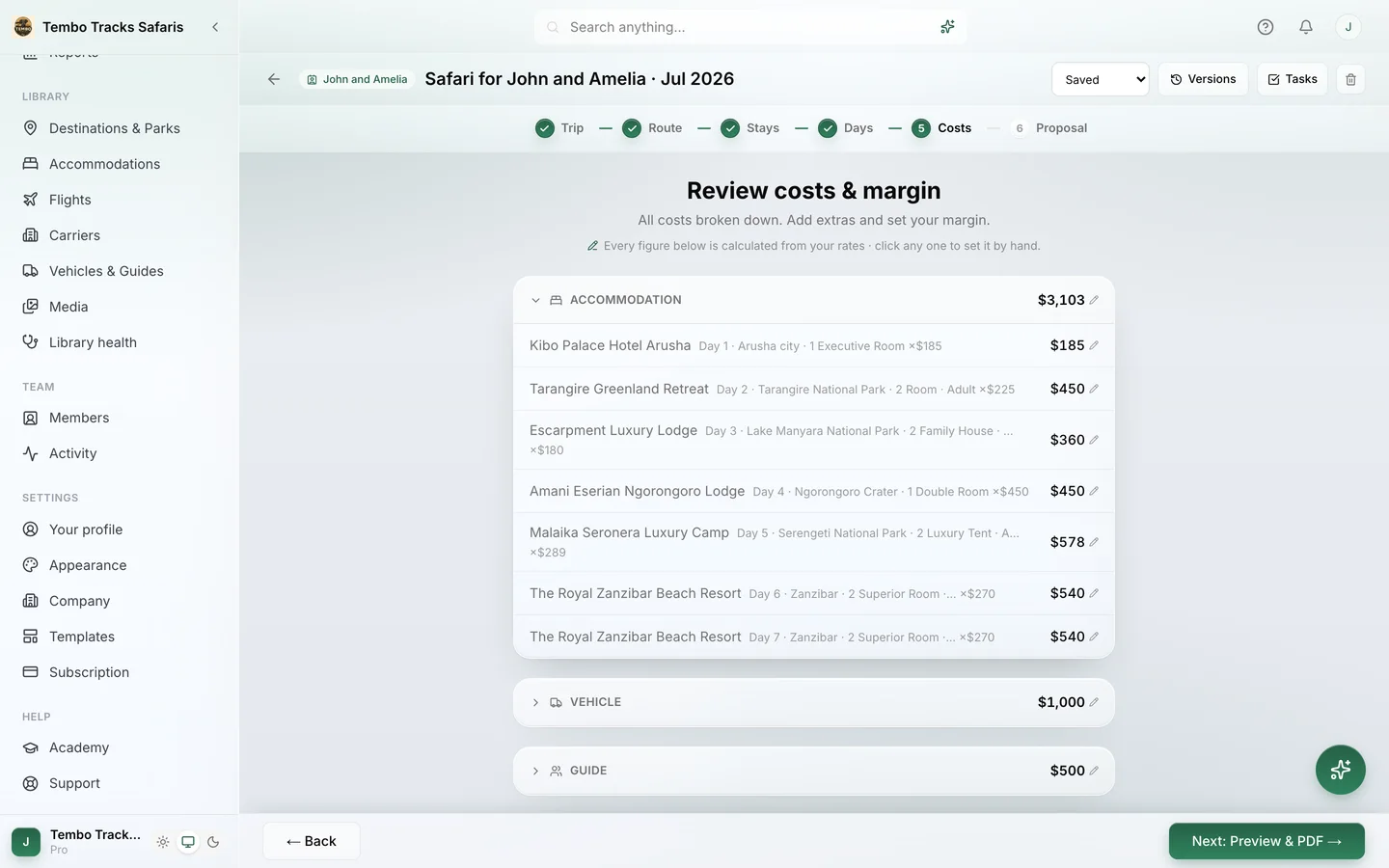
Where it is not the fit. An operator selling outside the safari world entirely, say European city breaks, gets no value from the tuned fee mechanics. A volume day-tour seller that needs online traveller checkout should not buy it: Itero Desk does not sell trips and does not process or hold traveller payments.
Pricing. Published: Starter at $74.99 per month and Pro at $109.99, about 20% less billed annually, with a custom Enterprise tier above; every workspace starts on a 30-day trial of the full Pro feature set, no credit card. Details on the pricing page.

Safari Portal.
What it is. Safari Portal calls itself a platform for itinerary building and travel operations, serving DMCs, travel advisors, agents and tour operators worldwide. It builds interactive digital itineraries and print-ready proposals, with a traveller app, contact management, invoicing, task tools, flight integration and AI features; its sample itineraries lean toward safari and expedition travel.
Where it shines. Luxury travel designers who lead with the visual document: image-rich digital itineraries, matching print output and a traveller app on top, from a vendor that publishes its pricing and offers a free trial, so the evaluation can start without a sales call.
Where it is not the fit. Its public materials centre on the itinerary and the traveller experience. A desk whose hardest problem is contracted seasonal rates and park fee arithmetic should bring its own rate sheets to the demo and make that side carry the weight.
Pricing. Published on safariportal.app: Starter at $199 per month, Tier I at $299 and Tier II at $399, with add-ons priced individually and a free trial offered.
Tourplan.
What it is. Tourplan describes itself as the world's leading software for tour operators and destination management companies: an integrated system covering sales, operations, accounting and management, handling FIT and group bookings, quoting, and web and XML distribution. Its site states 450 tour operators and DMCs in 75 countries, with offices across five continents including Africa.
Where it shines. Large inbound operators and DMCs with departments: group series alongside FIT, financial and operational reporting, and distribution to trade partners, at a scale where accounting integration matters more than signup speed.
Where it is not the fit. Systems in this tier are typically implemented as projects rather than signups. A desk of two to five people should weigh implementation effort against the size of its problem and get the total first-year number in writing. Operators comparing this tier commonly also look at Lemax, which targets mid to large operators and DMCs and likewise prices on request.
Pricing. On request; tourplan.com routes visitors to a demonstration request rather than a price list.
Tourwriter.
What it is. Tourwriter is mature itinerary and proposal software for tour operators, positioned on its site as a fast, flexible way to design, sell and manage luxury travel. It serves DMCs, travel designers and inbound operators with an itinerary builder, CRM, bookings and supplier communication, financials with accounting integrations, and reporting.
Where it shines. Document-led tailor-made operators who want itinerary tooling with years of refinement behind it and a supplier workflow attached, from a vendor that publishes per-user prices. It is a serious product with a real customer base, and it belongs on most shortlists in this category.
Where it is not the fit. Its frame is the tailor-made document and its booking workflow. A safari desk that needs park fees modelled by authority, visitor category and age band should test exactly that in the demo. The Tourwriter alternative page runs the detailed side-by-side against Itero Desk.
Pricing. Published on tourwriter.com: Starter at USD 99 per user per month and Pro at USD 149, billed annually, Premium on application, with one-time setup from USD 1,199.
Travefy.
What it is. Travefy is itinerary, proposal and CRM software aimed first at travel agents and advisors, with agencies, tour operators and DMCs also served. Its site lists an itinerary builder, quotes and proposals, client management, a website builder, a client mobile app and a large set of supplier content integrations.
Where it shines. Independent advisors and micro agencies that mainly need polished client-facing itineraries and proposals, at the lowest published price in this guide, with a 10-day free trial to prove the point before any money moves.
Where it is not the fit. An operator assembling trips from contracted seasonal supplier rates is not its centre of gravity; the product leads with the advisor's client document rather than operator cost engineering, so a desk that builds its own trips should test costing depth hard.
Pricing. Published on travefy.com: Core at $39 per month and Premium at $59, billed annually, with additional team seats at $20 per month.
Wetu.
What it is. Wetu is a widely used itinerary content and digital-showcase platform, describing itself as a collaboration platform where operators build trusted itineraries. It offers an itinerary builder, a content library of more than 100,000 images, supplier iBrochures and profiles, and the TravelKey traveller app, serving agents, operators and suppliers. It is particularly strong in Southern Africa, where much of the trade already exchanges content through it.
Where it shines. Desks that want the established content and showcase layer: lodge and destination content maintained at the source by suppliers, itineraries assembled from it, and a traveller app on top, without building a media library from scratch.
Where it is not the fit. Its centre of gravity is content and presentation. A desk whose main problem is contracted rates, park fees and margin should test the costing side against its own rate sheets before deciding. The Wetu alternative page runs that comparison in detail.
Pricing. Published at wetu.com/pricing-plans at the time of writing: Lite from $75 per month for one user (extra users $35 each), Premium from $150 per month, Enterprise by quote, all excluding VAT, with a 14-day trial advertised.
Best by segment.
This table is the whole page in seven rows. Find your row first, then read the entries it points to.
| The operator | The pick | Why |
|---|---|---|
| African inbound safari or overland operator pricing from contracted rates | Itero Desk | Fee mechanics tuned for 15 safari countries, seasonal rates by board basis, whole-party pricing |
| Document-led tailor-made operator wanting mature itinerary tooling | Tourwriter | Years of refinement in itinerary design plus a supplier workflow, published per-user pricing |
| Southern Africa desk wanting the established content and showcase layer | Wetu | The regional content standard: supplier-maintained lodge content, iBrochures, traveller app |
| Large inbound operator or DMC with groups, departments and accounting needs | Tourplan | Enterprise back office for FIT and group series, offices on five continents |
| Custom-trip agency or DMC pricing with markups and VAT logic | Ezus | Budget engine with VAT handling and document automation from the same data |
| Luxury travel designer leading with visual itineraries and a traveller app | Safari Portal | Image-led digital itineraries, print-ready proposals, published tiers and a free trial |
| Independent advisor or micro agency needing client documents at low cost | Travefy | Lowest published entry price in this guide, 10-day free trial |
Itero Desk takes one row of seven. That is the honest shape of this market: no product here wins more than its own segment, and a vendor guide claiming otherwise is selling, not guiding.
One segment is missing deliberately: high-volume day-tour and activity sellers who need per-seat online checkout, channel managers and OTA connections. None of the seven products above, ours included, leads that segment. That market belongs to a different category of booking and ticketing platforms, and forcing any product on this page into it would be a bad buy.
Pricing transparency, side by side.
Published prices, exactly as each vendor's site stated them on 30 July 2026.
| Product | Prices published | Entry point as published | Worth knowing |
|---|---|---|---|
| Ezus | Yes | €75 per user per month, billed annually | One-time setup packs at €1,990 or €2,490 |
| Itero Desk | Yes | $74.99 per month, $59.99 billed annually | 30-day full Pro trial, no credit card |
| Safari Portal | Yes | $199 per month | Free trial offered |
| Tourplan | No | On request | Demo-led sales process |
| Tourwriter | Yes | USD 99 per user per month, billed annually | One-time setup from USD 1,199 |
| Travefy | Yes | $39 per month, billed annually | 10-day free trial |
| Wetu | Yes | $75 per month (Lite, 1 user) | Per-user add-ons; 14-day trial |
A published entry price is not a total cost. Per-user prices multiply with the team; setup fees land once but land hard; quote-based vendors have onboarding costs of their own that only surface in the proposal. The single comparable number is total first-year cost for your team size, in writing, and the evaluation below is built around getting it.
How to run the evaluation.
Three steps, in order, and none of them is optional.
- Shortlist two or three, not seven. Use the segment table. Seven demos take weeks and blur together; two or three stay comparable in memory and in notes. Add one wildcard from an adjacent segment only if your desk genuinely straddles two rows.
- Demo with your own real trip. Take a booking you actually sold last season, with the awkward parts left in: children at different ages, a single supplement, a date straddling a seasonal rate boundary, a fee that changed mid-year. Make each vendor build and price it live in the demo. The product that survives your trip beats the product with the best slide deck, every time.
- Get like-for-like pricing in writing. Licence per user or per workspace, onboarding and setup fees, training, data migration, contract term and the renewal price. Ask every vendor the same question: total first-year cost for your team, as a number in a document.
One more habit before signing anything: confirm you can export your data. Switching costs are the quiet lock-in of this market, and the vendor's answer to the exit question tells you a lot about the relationship you are entering.
The safari-only version of this guide.
This page judges the whole category with criteria weighted for a general operator. If your desk sells safaris, the weights change: park fee handling stops being a nice-to-have and becomes first-order, geography narrows to specific countries and authorities, and depth of lodge and park data matters more than breadth of category coverage. The best safari tour operator software page re-runs this exact exercise safari-only, with the criteria re-weighted and the same disclosure at the top. And for head-to-head detail against the two most-compared products in that world, the Tourwriter alternative and Wetu alternative pages go feature by feature without straw men.
Frequently asked questions.
What is the best tour operator software?
There is no single best tour operator software; there is a best fit per operating model. In this guide: Itero Desk for African inbound safari operators pricing from contracted rates, Tourwriter for document-led tailor-made operators, Wetu for Southern Africa desks wanting the established content layer, Tourplan for large operators and DMCs, Ezus for custom-trip budget logic, Safari Portal for visual itinerary design, and Travefy for independent advisors.
How much does tour operator software cost?
Published prices in this guide run from $39 per month (Travefy Core, billed annually) to $399 per month (Safari Portal Tier II), with per-user models between €75 and USD 149 per user per month. Several serious products publish no prices at all. Budget for one-time setup too: Tourwriter publishes setup from USD 1,199 and Ezus packs at €1,990 or €2,490, so always compare total first-year cost.
Why do some vendors not publish pricing?
Quote-based pricing usually means the price depends on users, modules and implementation scope, and sometimes on what the vendor believes the deal can bear. It is not a red flag by itself: Tourplan is a serious product. It does mean you should get a written, like-for-like quote covering licences, onboarding, training and renewal before comparing them against published-price products.
What is the best software for a safari tour operator?
Run the safari-only version of this exercise, where park fee handling, contracted seasonal rates and whole-party pricing carry more weight than category breadth. We keep that comparison on its own page: best safari tour operator software. The disclosure applies doubly there, because we build Itero Desk for exactly that segment, so check every claim against your own trips in a demo.
Can I trust a best-of guide written by a software vendor?
Only as far as you can verify it. We build Itero Desk, we say so at the top, and every competitor fact here comes from that vendor's own public website, with no scores or invented ratings. Treat the page as a structured starting point: confirm each claim on the vendors' sites, then let a live demo with one of your own real trips make the decision.
What is the difference between tour operator software and travel agency software?
Tour operator software builds and prices the trip itself: supplier rates, costs, margin, operations and the client documents for trips the operator assembles. Travel agency software resells other companies' products, so it centres on client management and presentation rather than cost engineering. A desk that assembles its own trips from contracted rates should evaluate the operator side first; the tour operator software page defines that category.
How many products should I shortlist, and how do I compare them?
Two or three, chosen from the segment table. Book demos with a real trip you sold last season and make each vendor price it live, awkward parts included: child ages, single supplements, seasonal rate boundaries. Then get final pricing in writing, including onboarding and setup fees, as one total first-year number per vendor. The comparison decides itself from there.
Shortlist of two or three made? If Itero Desk is on it, bring your hardest trip and we will price it live, park fees included. Book a demo · Existing customer? Sign in