Botswana tour operator software for the fly-in safari trade.
Botswana tour operator software is operations software for desks that sell the Botswana model: low volume, high value, fly-in. It has to build multi-camp itineraries connected by light-aircraft legs, price them from the operator's own contracted rates plus DWNP park fees per person and per vehicle, keep the margin visible on every quote, and produce client documents that belong next to the product being sold. When one booking carries this much value, pricing precision and flawless documents are not features of the software. They are the product.
Itero Desk is operations software for safari and tour operators: itineraries, quotes, proposals, invoices, CRM and pricing in one workspace, on web and mobile, with AI assistance built in. Botswana is one of the fifteen safari countries its cost engine is tuned for, with DWNP fee logic built in and Maun (MUB) as the hub airport default. This page covers how the desk fits the Botswana trade specifically; the hub page on safari tour operator software covers the full category end to end.
Book a demo. Price one of your own Delta itineraries in Itero Desk, on a call with a person who knows the trade. Book a demo
The Botswana model: few guests, most of the value.
Botswana has spent decades selling fewer beds at higher prices than its neighbours, and the trade commonly describes the market in exactly those words: low volume, high value. Small parties, private concessions, camps measured in tens of beds rather than hundreds, and a price per night that makes every quote a serious document. Software built for the volume travel trade meets this market and fails quietly, because the volume trade optimises for throughput and the Botswana trade optimises for precision.
Maun and Kasane, the two doors.
Maun is the safari capital and the staging base. International guests arrive through it, charter operators base there, and light aircraft fan out from Maun to the bush airstrips of the Okavango Delta, Moremi and Khwai. Kasane serves the north: the Chobe riverfront, Savuti and the Linyanti, and the routes that end positioned for Victoria Falls just across the border. Most fly-in itineraries are built around these two doors, and a Botswana workspace in Itero Desk starts with MUB as its hub airport default; the country's destinations and parks are the operator's to build in the Library.
Camps, mobile safaris and self-drive.
The trade commonly splits into three shapes. Fixed premium camps, mostly in the Delta and the private concessions, sold on all inclusive or game package board bases, reached by air. Mobile camping safaris, guided routes through Moremi, Savuti and Chobe with vehicles, guides and a camp crew moving with the guests. And a self-drive segment that mostly organises itself and is only occasionally an operator's client. The first two are where Botswana desks live, and they stress different parts of the software: the fly-in segment stresses flights, board bases and margin; the mobile segment stresses vehicles, guides and per-vehicle park fees.
Two seasons, two rate bands.
Rates in Botswana commonly move in two broad bands: a dry season that runs roughly May to October, when game concentrates on permanent water and the Delta's flood arrives, and a green season through the southern summer, when camps commonly publish lower rates and the Kalahari, Makgadikgadi and Nxai Pan do their best work. The point for software is structural: a camp rate is not a number, it is a set of season bands by board basis, and the system has to store it that way and warn when a travel date falls outside every band it holds.
When one quote carries a month of revenue.
The arithmetic of the Botswana model is unforgiving. A small party, a handful of nights, and an invoice large enough that a single pricing mistake costs more than a year of software. The failure modes are specific and every Botswana desk has met at least one of them: a camp priced on the wrong board basis, so the desk quietly absorbs drinks and activities it thought were extra; a mobile departure quoted without the per-vehicle park fees; a child priced as an adult, or the reverse; a quote built from last season's rate sheet because the new one was still sitting in an inbox.
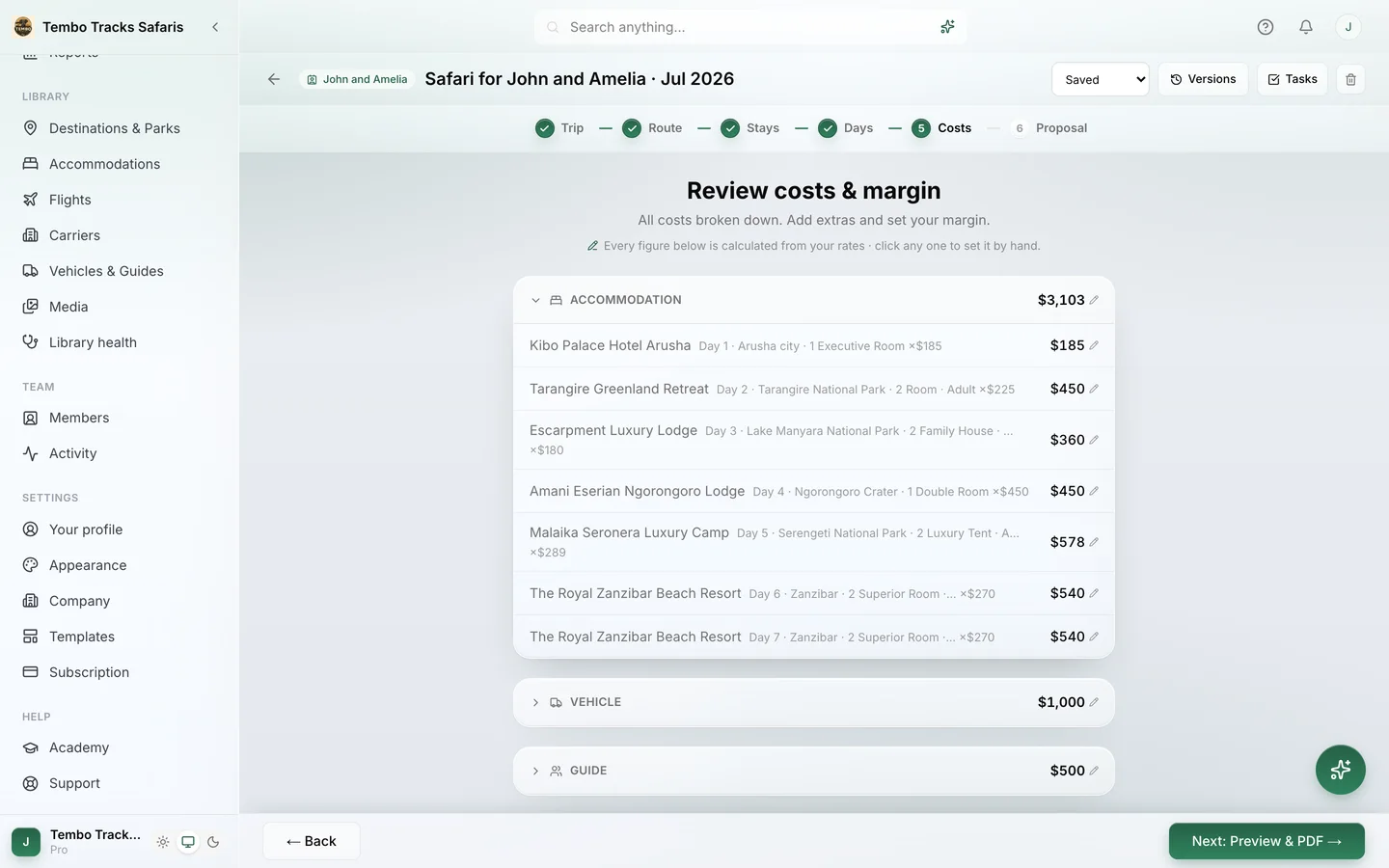
Itero Desk's cost engine is built to close those holes. It already knows how DWNP charges, per person and per vehicle, by visitor category and age band, with the breakdown visible per park once the fee amounts are entered, so a Moremi day and a Chobe day each carry their own correct fee lines. The open guide to park fees by country explains the fee logic in public. Camp rates are stored as seasonal bands by board basis, from room only through full board, all inclusive and game package, and the trip holds a meal plan per day, so a Maun overnight on bed and breakfast sits correctly in the same itinerary as three Delta nights on game package.
Two safeguards matter most at this price point. First, rate-gap warnings: when no imported rate covers the travel date, the desk sees the gap instead of a silently wrong number, and the optional closest-year price is always labelled estimated. Second, margin as its own visible layer: cost, sell price and margin are separated on the Costs step, per trip, before anything goes to the client. On a high-value itinerary the difference between a healthy margin and an accidental discount is exactly the kind of thing that should never live inside a spreadsheet formula nobody dares to touch. Any line can still be overridden by hand: accommodation, vehicle, guide, transfers, flights, optional activities, park fees or additional costs, so negotiated exceptions stay visible instead of hidden.
Logistics is the itinerary: short nights, many legs.
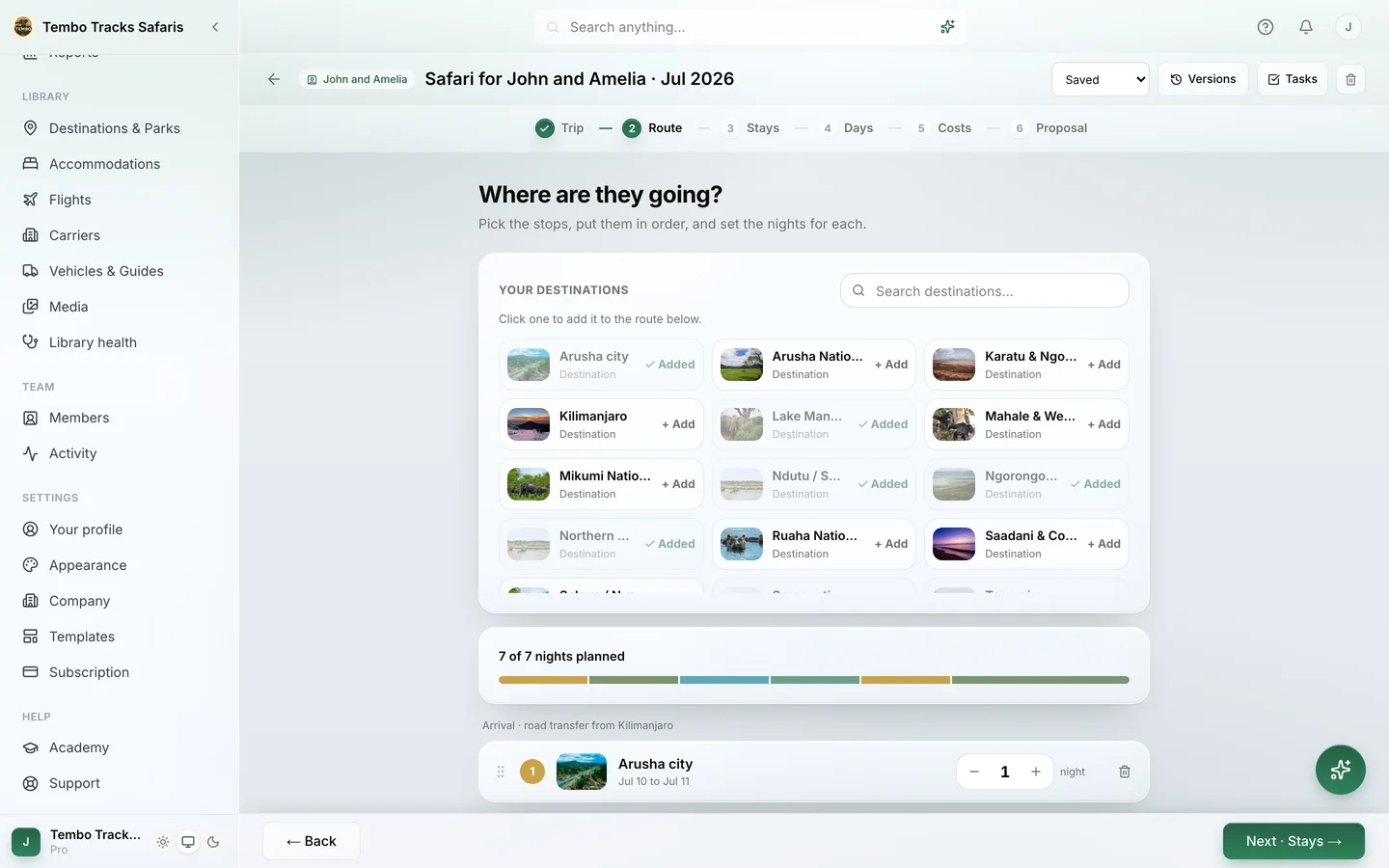
A Botswana fly-in trip has a distinctive structure: short stays, many moves. Two or three nights per camp, a light-aircraft leg between each, and the whole route hanging off the Maun or Kasane schedule. The itinerary is not a list of hotels with transport in the footnotes; the logistics are the itinerary.
Itero Desk's builder holds that structure natively. The Route step carries the stops, their order and the nights at each: three nights in the Delta, two at Khwai, two on the Chobe riverfront. The Days step carries the flight legs on the day they happen, alongside parks and activities, so the client document and the cost sheet both know that day four begins with a flight out of a bush airstrip. Flights and carriers are first-class items in the Library, not free-text lines: the charter carriers a desk uses live there once, and each light-aircraft leg is costed per trip on the Flights line, with a manual override for the quotes where a charter is priced as a whole plane rather than per seat. The open guide on building multi-camp safari itineraries walks the method.
The mobile segment stresses a different resource: the desk's own vehicles and guides. In Itero Desk both live in the Library with daily rates and capacity, and they are costed per day on the trip. When one guide is promised to two departures that overlap, the desk gets a conflict warning naming the guide and the day, and the same applies to vehicles. On a mobile safari, discovering a double-booked guide a week out is a cancelled departure or an expensive freelance rescue; discovering it at quote time is a calm rebooking.
The rest of the desk, from enquiry to invoice.
Fly-in logistics and margin discipline are the Botswana-specific edge, but a desk runs on the whole flow, quote-to-confirm and beyond.
Leads, and answers at agent speed.
Botswana sells substantially through overseas agents, and agents reward the desk that answers first with a credible number. Enquiries land in a pipeline with six stages, from new to won, and each lead card carries a Ballpark panel: a fast indicative price grounded in your own real rates, sent while competitors are still opening spreadsheets. One click converts the lead into a full itinerary, and a won lead becomes a client automatically, with trip history, passports and documents, and dietary and medical notes on the record for the camps that ask.
Proposals that match the price point.
A Delta camp sells on photographs, and the proposal has to keep up. The Lookbook template renders the itinerary as a photography-led coffee-table book, and Rounded and Studio offer a soft luxury and a dark editorial alternative, all carrying the company's colours and fonts set once in settings. Behind the templates sits a full proposal editor: sections to reorder and hide, image slots, pull quotes, a price table, a route map, and a print layout that matches the PDF exactly. Proposals go out as a branded PDF or a web page on a share link, and can be translated into seven languages for the European agents and guests who make up much of the Botswana file.
Reservations: option holds with a countdown.
Premium camps hold space on options, and an option is a clock. A lapsed hold on a high-value camp hurts twice: the space is gone in the exact week the client asked for, and the desk goes back to the market for whatever is left, usually at a worse rate or a worse camp. Itero Desk tracks each reservation through its lifecycle, from draft and requested through option to confirmed, waitlisted or declined, and every option carries its expiry date. The desk gets option-expiry warnings 3 days and 1 day before the hold lapses, and reminders when a request has sat unanswered for 3 or more days. Requests to camps go out as a clean document with the trip facts and no prices. The dedicated page on tour booking management software covers the reservation flow in full.
See your own trips in it. A demo walks a real Botswana itinerary from enquiry to invoice, with your rates, not sample data. Book a demo
Invoices from the itinerary that won.
The confirmed itinerary generates the invoice, with a preview-and-edit surface before anything goes out, its own set of invoice templates, and the same pattern as proposals: a share link and a matching PDF. Itero Desk does not process or hold traveller payments; you collect from clients however you already do, and the invoice simply gets the numbers right because it comes from the same cost engine as the quote.
The desk at the airstrip.
Itero Desk installs as an app on a phone, with a mobile layout built for the jobs that happen away from the office: checking the pipeline, answering a lead, looking something up in the Library, asking Itero AI. A Maun desk spends real time at the airport and on the road, and the sale does not pause for it.
The team survives the season.
Roles keep pricing and settings with the right people: owner, admin, finance, member, viewer. An activity feed shows who changed what. And Itero Academy, included in every plan, trains a new hire with eight self-paced courses, exams and verifiable certificates, which matters in a market where the season peaks hard and the team often grows just before it.
Where Itero AI fits.
Itero AI is the assistant inside the desk, and in Botswana its most valuable job is the least glamorous: reading rate sheets. Camp rates arrive every year as PDFs and spreadsheets full of season bands, board bases and child policies, and Itero AI converts them into structured seasonal rates the desk reviews and confirms, instead of a week of re-typing. It imports flight rates and park fee updates the same way, drafts itineraries from a PDF, a pasted email or a photographed document, powers the Ballpark quick quote on leads, and in the builder applies concrete changes from a bounded action list, with undo. It drafts welcome letters and proposal emails and translates them. It never prices from imagination: every number comes from your imported rates and the park fee library, and every plan includes a monthly allowance of AI actions.
An honest comparison for a Botswana desk.
The realistic alternatives are the spreadsheet that runs the desk today and the itinerary-first tools that solved the document. The rows below are the parts of the job that Botswana punishes hardest.
| Spreadsheets | Itinerary-first tools | Itero Desk | |
|---|---|---|---|
| DWNP fees per person and per vehicle | Hand-built formulas | Rarely modelled | Fee logic ready, breakdown per park |
| Light-aircraft legs as costed lines | An extra column, fragile | Often content, not cost | Flights and carriers in the Library, costed per trip |
| Seasonal rates with game package basis | Fragile, re-typed yearly | Sometimes, often manual | Structured by season and board basis, with AI rate sheet import |
| Option holds with expiry reminders | A calendar and hope | Rarely | Warnings at 3 days and 1 day |
| Margin visible per quote | Only if the formulas hold | Rarely a first-class layer | Its own visible layer |
| Proposal at the Delta price point | No | Strong, often the core focus | Lookbook plus a full editor |
| Guide and vehicle conflicts | Found by accident | Not their job | Per-day warnings naming the resource |
Itero Desk publishes its prices: Starter at $74.99 per month and Pro at $109.99 per month, both around 20% cheaper billed annually, with a custom Enterprise tier above and a 30-day trial of the full Pro feature set, no credit card. Details live on the pricing page. For a wider field including the named competitors, the page on the best safari tour operator software compares the market openly, including where Itero Desk is not the right pick.
Who it is for, and who it is not for.
Itero Desk fits a Botswana operator or DMC selling multi-day trips: fly-in circuits out of Maun and Kasane, mobile camping departures, or the mixed files that combine both, typically a desk of one to fifteen people currently running on spreadsheets or on a tool that only solved the document. Desks that also operate across borders can read the sibling pages for Tanzania and Kenya; a workspace picks its operating country at signup, which tunes the cost engine to that country's fee mechanics and sets the hub airport default.
It is honest to say who should look elsewhere. A volume day-tour seller, moving busloads through single-day products, needs throughput software, not a quote-to-confirm desk built around multi-day margins. A desk selling outside the safari world entirely, say European city breaks or US domestic travel, would not benefit: the mechanics are built around parks, camps and safari logistics. And an operator who is happy pricing by hand and only wants a prettier PDF may be well served by an itinerary-first tool.
Itero Desk is built in Arusha, Tanzania, inside the trade it serves. Its one public reference is Breeze Safaris in Tanzania and Zanzibar, and that is the honest state of its social proof: real and short, with no invented Botswana logos.
Frequently asked questions.
Does Itero Desk cover Botswana?
Yes. Botswana is one of the fifteen safari countries the cost engine is tuned for at signup: DWNP's fee logic, computed per person and per vehicle by visitor category and age band, and Maun (MUB) as the hub airport default. A workspace picks Botswana as its operating country and starts with an empty library, ready for the operator's own destinations, rates and fees.
How do light-aircraft legs go into an itinerary?
The Route step holds the camps, their order and the nights at each stop; the Days step holds each flight leg on the day it happens. Flights and carriers are first-class Library items, so the charter carriers a desk uses are stored once and each leg is costed per trip on the Flights line, with a manual override for whole-plane charter pricing. The legs then appear in the proposal day by day.
How do option holds on premium camps work?
Each reservation moves through a lifecycle: draft, requested, option, then confirmed, waitlisted or declined. An option carries its expiry date, and Itero Desk warns the desk 3 days and 1 day before the hold lapses, plus reminders when a request has gone unanswered for 3 or more days. On camps where a lost hold means losing the client's week entirely, the countdown is the point.
Does it calculate DWNP park fees?
Yes. DWNP fees are computed per person and per vehicle, by visitor category and age band, once entered, and the breakdown is visible per park on the Costs step, so Moremi days and Chobe days each carry their own lines. Fee levels change over time, so the desk never has to hard-code them; the open guide to park fees by country explains the logic.
Can it price a mobile camping safari?
Yes. Vehicles and guides live in the Library with daily rates and capacity and are costed per day on the trip, per-vehicle park fees are computed alongside the per-person ones, and camp crew or equipment can be carried as additional cost lines. If one guide or vehicle is promised to two overlapping departures, the desk gets a per-day conflict warning naming the resource.
How are green season and dry season rates handled?
Camp rates are stored as seasonal bands by board basis, including all inclusive and game package, so the commonly lower green season rates and the dry season rates coexist on one accommodation record. When a travel date falls outside every imported band, the desk sees a rate-gap warning instead of a silently wrong price, and any closest-year estimate is always labelled as estimated.
Does Itero Desk book the charter flights or take payments?
No. Itero Desk is software for the operator's own desk, not a travel agency or a marketplace. It does not sell, book or arrange trips, so charters and camp space are confirmed with the carriers and camps as they are today, and it does not process or hold traveller payments. It prices the trip, produces the documents and tracks the reservations; the desk stays in charge of the relationships.
What does it cost?
Starter is $74.99 per month and Pro $109.99 per month, both around 20% cheaper billed annually, with a custom Enterprise tier above. Every plan includes the itinerary builder, the cost engine tuned to Botswana's fee mechanics, proposals, invoicing, reservations and Academy training, and every new workspace starts with a 30-day Pro trial, no credit card. Current details are on the pricing page.
The next Delta enquiry deserves a same-day number. Book a demo and price a real fly-in itinerary in Itero Desk, margin visible, end to end. Book a demo · Existing customer? Sign in