A tour operator CRM where the deal is a trip, not a number.
A tour operator CRM is a sales pipeline built around the thing a tour operator actually sells: a trip. Where a generic CRM records a deal as a contact, a value and a stage, a tour operator CRM records the party, the travel dates, the day-by-day itinerary and a quote priced from contracted rates, and carries all of it from first enquiry to final invoice. The difference is structural, not cosmetic, and it decides how much re-typing a sales desk does every single day.
That is the category this page defines. It compares buying a purpose-built tour operator CRM with bending a generic one into shape, walks one enquiry through the pipeline in Itero Desk, and is honest about what a generic CRM still does better. Itero Desk is operations software for safari and tour operators: itineraries, quotes, proposals, invoices, CRM and pricing in one workspace, on web and mobile, with AI assistance built in. The CRM is one part of that workspace, and this page shows how it connects to the rest; the safari tour operator software hub covers the full platform.
Book a demo. Watch one of your real enquiries go from new lead to priced proposal, on a call with a person who knows the trade. Book a demo
The problem with a deal that is only a number.
Generic CRMs are good software. Products in the HubSpot, Pipedrive and Salesforce mould run sales teams in every industry, and at the jobs they were built for, pipeline discipline, contact history, marketing automation, they are typically excellent. The problem is not quality. The problem is the deal object.
In a generic CRM, a deal is a name, an amount and a close date. That model fits a software subscription or a consulting contract. It does not fit a family of five travelling through three destinations in two rooms in high season, because the facts that define that sale have nowhere native to live:
- The party ends up in a notes field. Two adults, a teenager and a seven-year-old is pricing-critical information. In free text it gets missed, mistyped, or quoted as four adults.
- The dates end up in a custom field. And nothing checks them against seasons or rate validity, because the CRM has no idea what a season is.
- The quote lives in a spreadsheet. The amount on the deal is typed in by hand, so the pipeline's number and the desk's real price drift apart the moment the client asks for a change.
- The itinerary is an email attachment. Version four of the PDF is in a sent folder; version five is on the one laptop that just went on leave.
- Won is where the CRM stops and the work starts. Confirmations, rooming details, invoices and travel documents happen in other tools, re-typed from the deal.
Each gap gets papered over with custom fields, attachments and discipline, and each workaround has a price in money, not in tidiness: the quote that goes out two days after a competitor's, the follow-up that offers the wrong dates, the spreadsheet revision that never made it back into the deal and quietly gave away margin. Slow quotes lose bookings. Re-typed prices lose margin. That is the bill for storing a trip in an object built for a number.
What a tour operator CRM has to hold.
Strip the category to its load-bearing parts and a tour operator CRM has seven requirements. Use them to evaluate anything, Itero Desk included.
- A trip-shaped deal. Party, dates and destinations as first-class fields on the lead, not paragraphs in a notes box.
- A quote priced from contracted rates. The number on the deal should come from a cost engine reading real rates, not from a keyboard.
- The itinerary attached to the deal. One versioned object that becomes the proposal, not a trail of attachments.
- Proposal sending from the record. The client document goes out from the same place the deal lives, so the pipeline always shows what was actually sent.
- An invoice generated from the won deal. Built from the same data that was quoted, so the invoice cannot disagree with the proposal.
- A client record that outlives the deal. Trip history, documents and preferences, so the second sale costs less to win than the first.
- A handover into operations. Reservations, holds and confirmations should start from the won deal, not from a fresh spreadsheet.
A generic CRM meets perhaps one and a half of these natively, with effort. That is not a criticism of generic CRMs; it is the definition of the category gap.
Generic CRM vs tour operator CRM, capability by capability.
An honest table. The last two rows go to the generic tools, and if those rows describe your main problem, buy accordingly.
| Capability | Generic CRM | Tour operator CRM (Itero Desk) |
|---|---|---|
| The deal object | A contact, a value, a stage | A trip: party, dates, destinations, priced quote |
| Party and dates | Custom fields, unvalidated | First-class fields that the pricing actually reads |
| Quote | Typed in by hand | Priced from contracted seasonal rates and a park fee library |
| Itinerary attached to the deal | An attachment or a link | Built in a six-step builder, versioned, part of the record |
| Proposal sending | Generic email plus a PDF made elsewhere | Branded templates, web share link and matching PDF, from the record |
| Invoice from the won deal | Separate accounting tool, re-typed | Generated from the itinerary, with its own template set |
| Post-booking operations | Ends at closed-won | Reservations, option holds, client records, documents |
| Marketing automation | Strong: sequences, campaigns, scoring | Not included |
| Integration ecosystem | Large app marketplaces | Focused workspace; integrations on the Enterprise plan |
Read the bottom two rows again before deciding anything. Generic CRMs typically win, clearly, on marketing automation and on the breadth of third-party integrations, and a tool built for the trade should say so rather than pretend the contest is a sweep. The question for a tour operator is which rows carry the revenue: for most desks, the money leaks through slow quotes and re-typed prices, not through the absence of a drip campaign.
The pipeline in Itero Desk, one enquiry at a time.
The clearest way to show the difference is to run a single enquiry through it. The pipeline is a Kanban board with a table view for people who prefer lists, and six stages: new, contacted, proposal, negotiating, won, lost.
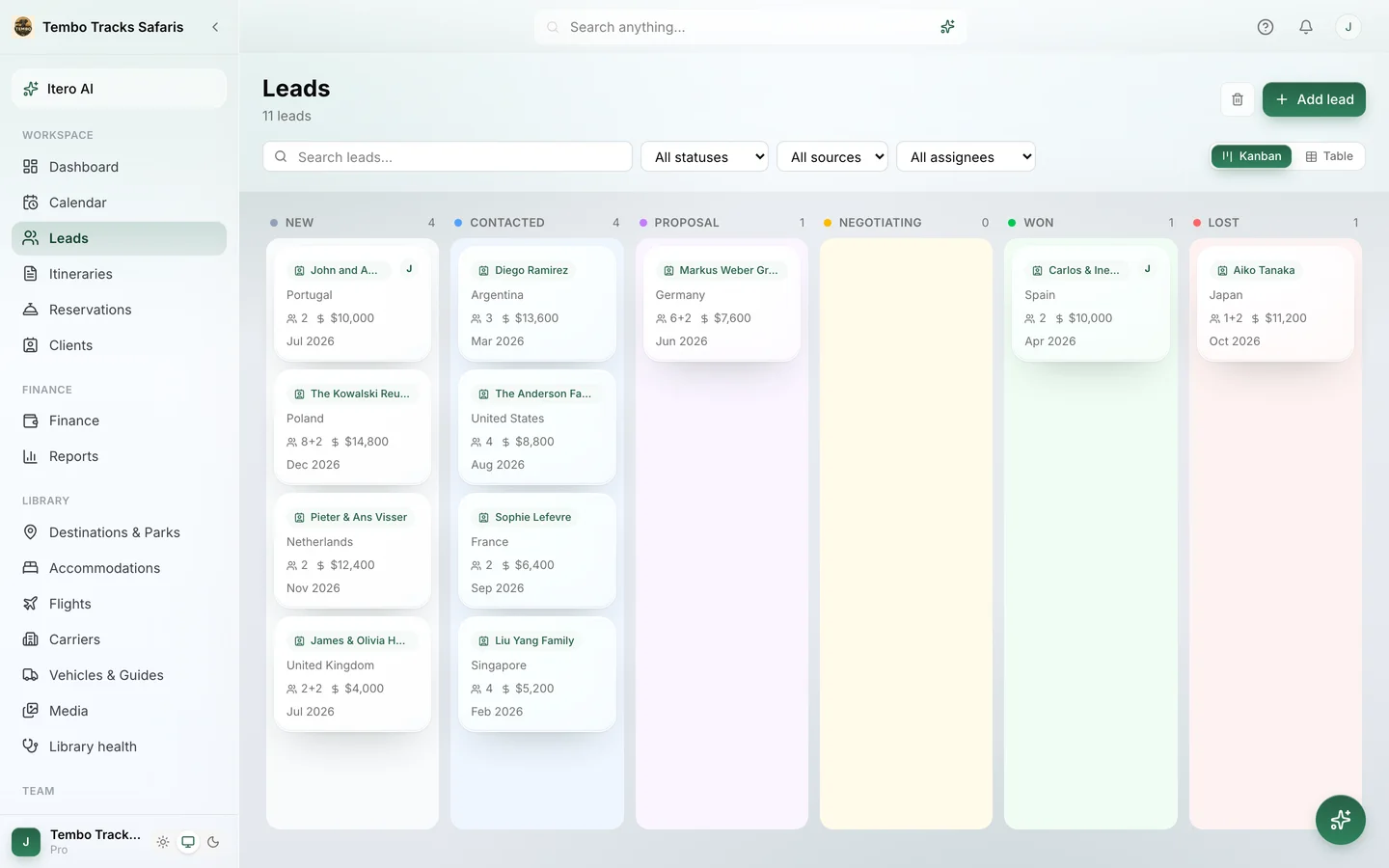
An enquiry lands: new.
A couple with two children write in about specific dates and a rough budget. The enquiry becomes a card in the new column, and the party and dates are recorded as real fields, not as a sentence somebody will have to re-read later. Nothing else has happened yet, and the CRM already knows more about this deal than a generic one would after a week of custom-field discipline.
First contact, with a number in it: contacted.
Open the card and the lead drawer holds the conversation plus two tools that change the quality of the first reply. The Ballpark panel drafts a fast indicative price for the trip before anyone builds a full itinerary, working from the desk's own data rather than from thin air. The message Composer drafts the reply itself, ready to edit before it goes anywhere. A first response that carries a credible number, sent the same day, is the cheapest competitive advantage in this trade, because most desks answer with "we will get back to you" and then take days to do it.
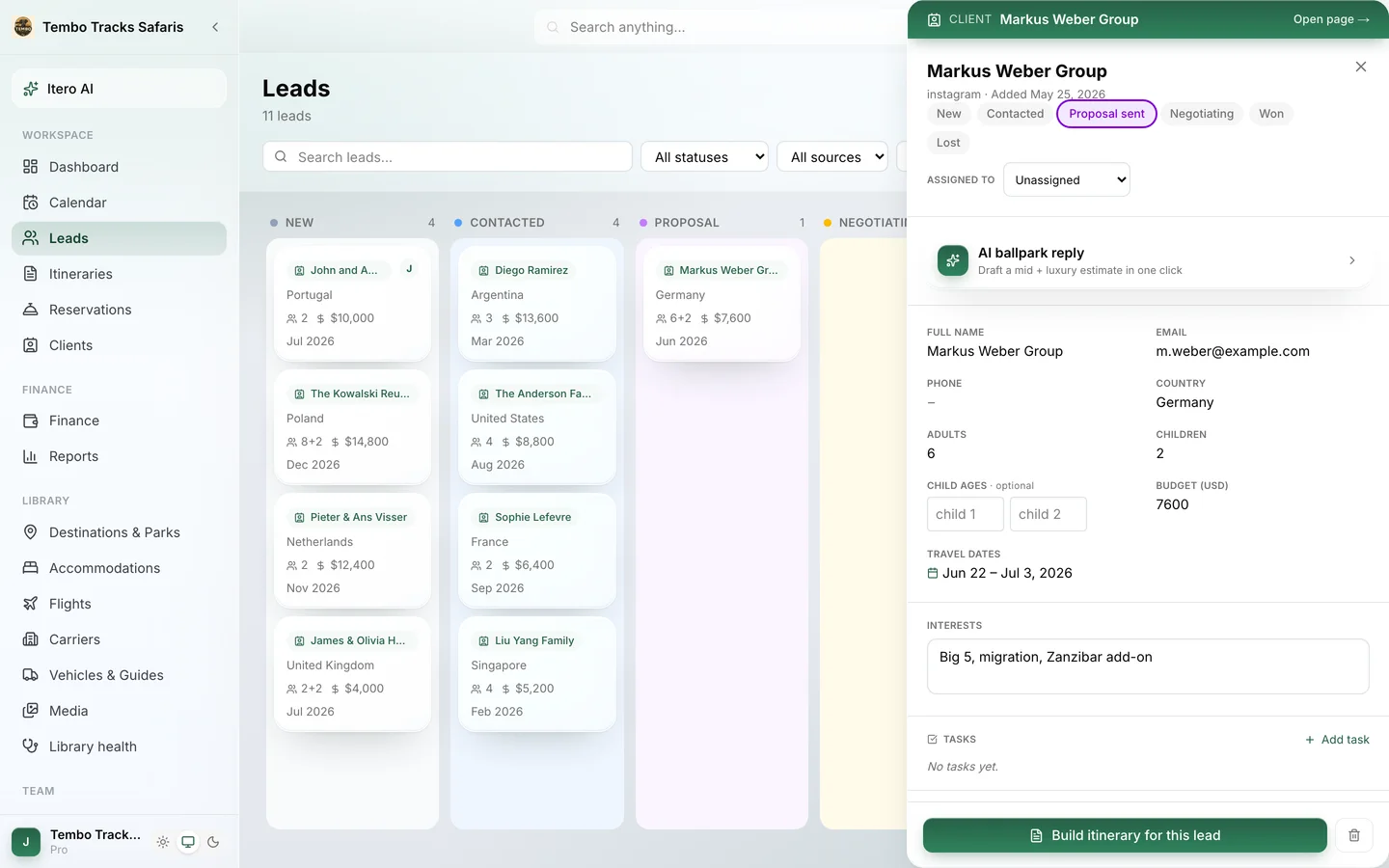
The client is interested: proposal.
One click converts the lead into an itinerary. From there the trip is built in six steps, Trip, Route, Stays, Days, Costs, Proposal, with a cost panel that updates live as the trip changes. The deal and the trip are now the same object: when the itinerary's price moves, the pipeline is looking at the real number, not at an amount somebody remembered to update. The finished proposal goes out as a branded document from the same record, so the stage on the board and the document in the client's inbox can never disagree.
Changes without re-typing: negotiating.
The client wants one fewer night and a better room category. The change happens once, in the itinerary, and the price recalculates in the cost panel. A new version of the proposal goes out from the same record, and the previous versions stay attached to it. There is no archaeology through sent folders to work out which PDF the client is holding.
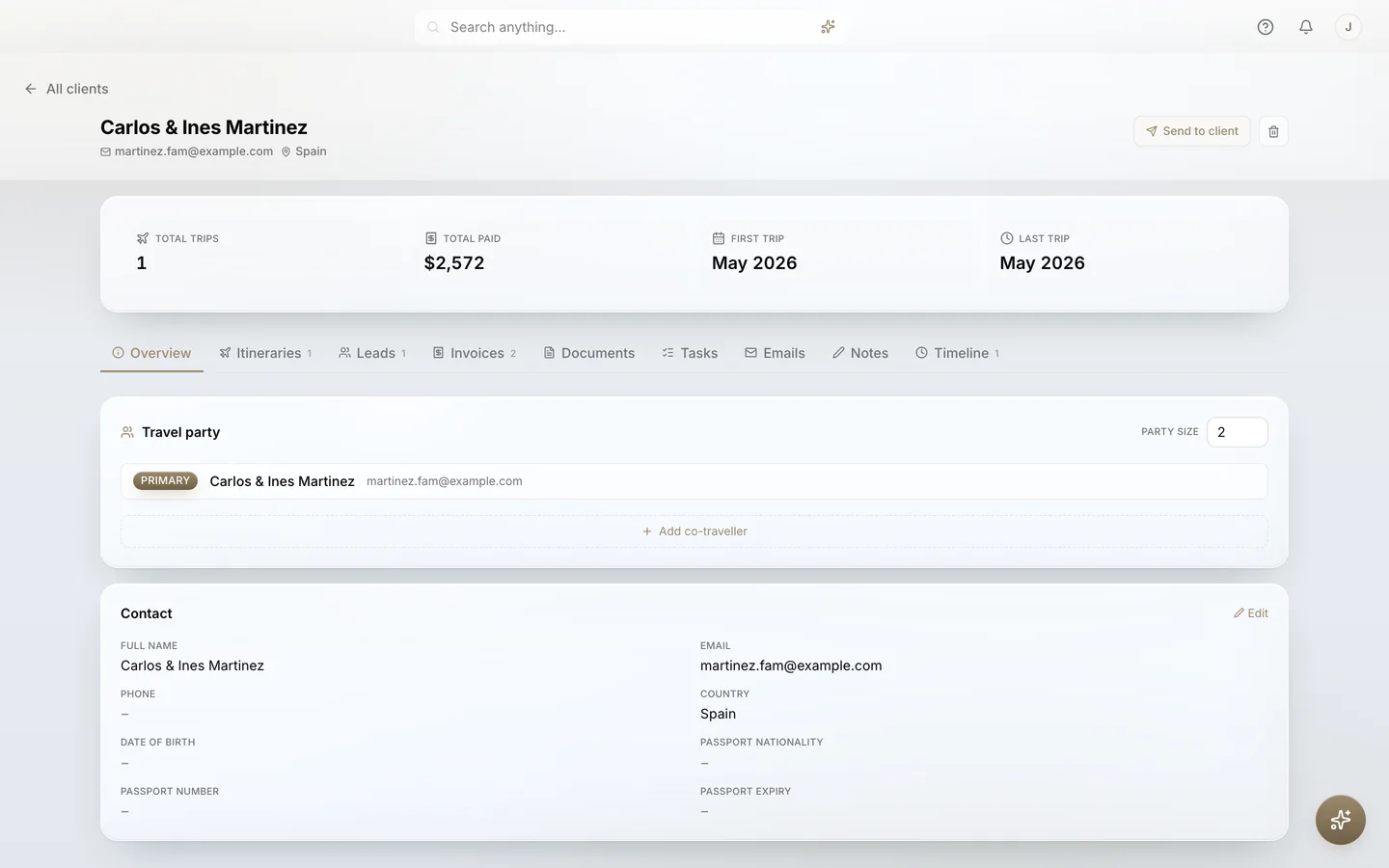
Won, and the client record builds itself.
Mark the lead won and a client record is created automatically, carrying the trip into a history that accumulates: trip history, passports and documents, dietary and medical notes. When the same client writes again in two years, the desk starts from a record, not from zero, and the second quote is faster and better informed than the first. Lost is a stage too, on purpose: a pipeline that hides its losses cannot tell you why quotes die.
Run your own pipeline through it. Bring three live enquiries to a demo and walk them through the stages, end to end. Book a demo
What the pipeline feeds: the rest of the desk.
A CRM alone, however trip-shaped, still leaves quoting and documents somewhere else. The reason the Itero Desk pipeline holds together is what sits behind it in the same workspace.
- The itinerary builder. Six steps from Trip to Proposal, with a live cost panel, versions with compare, and share links. This is where a converted lead becomes a sellable trip.
- The cost engine. Contracted lodge rates organised by season and board basis, park fees by authority, visitor category and age band across fifteen safari countries, warnings when no rate covers the travel date, manual overrides per cost line, and margin as its own visible layer. This is where the number on the deal comes from.
- Proposals. Three templates with distinct characters, Lookbook, Rounded and Studio, plus a word-processor-like editor for the desks that want full control. Every proposal can go out as a published web page on a share link or as a matching PDF, translated into seven languages. The travel proposal generator page covers this slice on its own.
- Invoices. Generated from the winning itinerary, in their own template set: Classic, Modern, Minimal and Bold, again as a share link with a matching PDF. The invoice inherits the trip's data, so it agrees with the quote by construction.
- Reservations. The won trip's hotel requests, option holds with expiry warnings and confirmations run in the same workspace; the tour booking management software page goes deep on that lifecycle.
- The team layer. Owner, admin, finance, member and viewer roles, and an activity feed of who changed what, so the pipeline survives holidays, growth and staff changes instead of living on one laptop.
- Mobile. The workspace installs as an app on a phone, with Leads as one of the bottom tabs, because enquiries do not arrive during office hours.
This is the reverse of the integration approach. Rather than wiring a generic CRM to a quoting spreadsheet to a document tool to an invoicing product, one workspace holds the objects the trade actually uses, and the pipeline is simply the front door to them. The sibling page on tour operator software frames that whole category; this page stays with the CRM slice.
Where AI helps, and where it stays out of the way.
Itero Desk is not an AI product with a pipeline attached. The assistant, Itero AI, appears in the CRM at the two moments where drafting genuinely saves time: the Ballpark panel, which drafts an indicative price on a lead before a full itinerary exists, and the message Composer, which drafts replies in the desk's voice for a human to edit and send. Further back, the same assistant imports lodge rate sheets from PDF, Word or Excel into structured seasonal rates, which is what makes same-day quoting possible in the first place, and it drafts welcome letters and proposal emails when a deal reaches the document stage.
Two guardrails apply everywhere. Every plan includes a monthly allowance of AI actions, so the capability is budgeted rather than metered by surprise. And the AI never prices from imagination: every number traces back to imported rates and the park fee library. The assistant drafts; the desk decides.
What not to expect from this CRM.
Honesty is cheaper than churn, so here is the list.
There are no email marketing blasts, no drip sequences, no ad attribution and no campaign dashboards. The Itero Desk CRM is a sales-and-operations pipeline: it exists to turn an enquiry into a priced trip and a priced trip into a paid booking. An operator whose main bottleneck is top-of-funnel marketing automation should keep a HubSpot-style marketing tool alongside for campaigns and lead capture, and let Itero Desk take over from the moment an enquiry needs a price. The two jobs are different, and pretending one tool does both well is how software disappoints people.
It is also worth restating what the whole product is not. Itero Desk is software, not a travel agency: it does not sell, book or arrange trips, and it does not process or hold traveller payments. You collect from clients however you already do.
One scope note for this page: it stays at the category level on purpose. For how a safari desk in particular runs its client lifecycle inside the CRM, repeat guests, agent relationships and the record-keeping around them, the safari CRM page follows that thread in detail.
What a tour operator CRM costs.
The CRM is not priced as a separate module; it is part of every Itero Desk plan. Starter is $74.99 per month ($59.99 per month billed annually) with one user and 50 itineraries a month. Pro is $109.99 per month ($89.99 per month billed annually) with four users, 200 itineraries a month and team roles. Enterprise is custom for groups that need SSO, SLAs and integrations. Every new workspace starts with a 30-day trial of the full Pro feature set, no credit card. Current details live on the pricing page.
Compare that with the real cost of the generic route: a generic CRM subscription per seat, plus the quoting spreadsheet, plus a document tool, plus the hours spent re-typing between them. The subscription line is only the visible part of that bill.
Frequently asked questions.
What is a tour operator CRM?
A tour operator CRM is a sales pipeline where each deal is a trip: a party, travel dates, a day-by-day itinerary and a quote priced from contracted rates. It manages enquiries through stages from new to won, produces the proposal and the invoice from the same record, and hands the won trip to operations. Generic CRMs track the relationship; a tour operator CRM also holds the product being sold.
Can I not just customise HubSpot or Pipedrive for my tour business?
Partly. Custom fields will hold party sizes and dates, and pipelines in generic CRMs are genuinely strong. What cannot be configured in is the trip itself: pricing from contracted seasonal rates, an itinerary attached to the deal, a proposal and an invoice generated from the same data. Those live in other tools, and re-typing between tools is where quotes slow down and margins leak.
Can I use Itero Desk alongside a HubSpot-style marketing tool?
Yes, and for marketing-heavy operators that is the sensible split. Itero Desk deliberately has no email campaigns, drip sequences or ad attribution, so a marketing tool keeps owning lead generation and newsletters. Itero Desk takes over when an enquiry needs a price: pipeline, Ballpark quote, itinerary, proposal, invoice and the client record after the win.
How do I migrate from a spreadsheet pipeline?
Start with the live deals, not the archive. Open enquiries are usually few enough to enter as leads in an afternoon, with party and dates as real fields. Then import your lodge rate sheets, which Itero AI reads from PDF, Word or Excel into structured seasonal rates, so quoting works from day one. Keep the old spreadsheet as a read-only archive. The 30-day trial covers this comfortably.
What happens when a lead is marked won?
A client record is created automatically, and it outlives the deal: trip history, passports and documents, dietary and medical notes accumulate on it. The won trip carries on into operations in the same workspace, where reservations, option holds and the invoice are generated from the itinerary that won the booking, not re-typed into another tool.
Does the CRM include quoting, or is that a separate product?
Quoting is built in, twice. At the lead stage, the Ballpark panel drafts a fast indicative price from your own data, so the first reply carries a number. When the client engages, one click converts the lead into an itinerary and the full cost engine takes over: contracted seasonal rates, park fees, overrides and a visible margin layer.
Does Itero Desk send marketing emails or take payments from travellers?
No to both. The CRM sends individual replies and proposals, not marketing blasts; campaign email belongs in a dedicated marketing tool. And Itero Desk never processes or holds traveller payments: it produces the invoice, and you collect from clients through whatever channels you already use. It is software for the operator's desk, not a travel agency or a marketplace.
The next enquiry deserves a same-day number. Book a demo and run a real lead from new to won in Itero Desk. Book a demo · Existing customer? Sign in