A safari CRM that knows the difference between an agent and a guest.
A safari CRM is client relationship software shaped around how safaris are actually sold: enquiries arrive from overseas travel agents on one side and direct travellers on the other, trips are commonly booked many months to over a year ahead, and the best future business is a past guest or the friends they send. It has to hold the party, the passports, the dietary and medical notes and the whole trip history, and it has to hand an enquiry to a real quoting engine without re-typing, because most enquiries go to several operators and the first solid proposal usually wins.
Itero Desk builds its CRM on exactly that shape. Itero Desk is operations software for safari and tour operators: itineraries, quotes, proposals, invoices, CRM and pricing in one workspace, on web and mobile, with AI assistance built in. The full platform is covered on the safari tour operator software page; this one stays on the CRM slice: the pipeline, the lifecycle of a safari client, and how a won lead becomes a priced itinerary and an invoice without leaving the system.
One paragraph on generic CRMs, because the full argument lives on the tour operator CRM page: a generic CRM can hold a deal, but it cannot price one. It has no concept of a park fee, a season band, a board basis or a child rate, so the moment an enquiry needs a number the real work leaves the CRM for a spreadsheet, and the CRM decays into a contact list nobody trusts. Everything below assumes that argument and shows what a CRM built inside a safari desk does instead.
Book a demo. Bring a real enquiry and watch it become a priced proposal on the call. Book a demo
The safari client lifecycle.
The clearest way to judge a safari CRM is to follow one client through it. Take a direct enquiry: two adults, a teenager and a seven-year-old, asking about ten days in June. Here is what the desk holds at each stage, and where the money is usually won or lost.
The enquiry arrives.
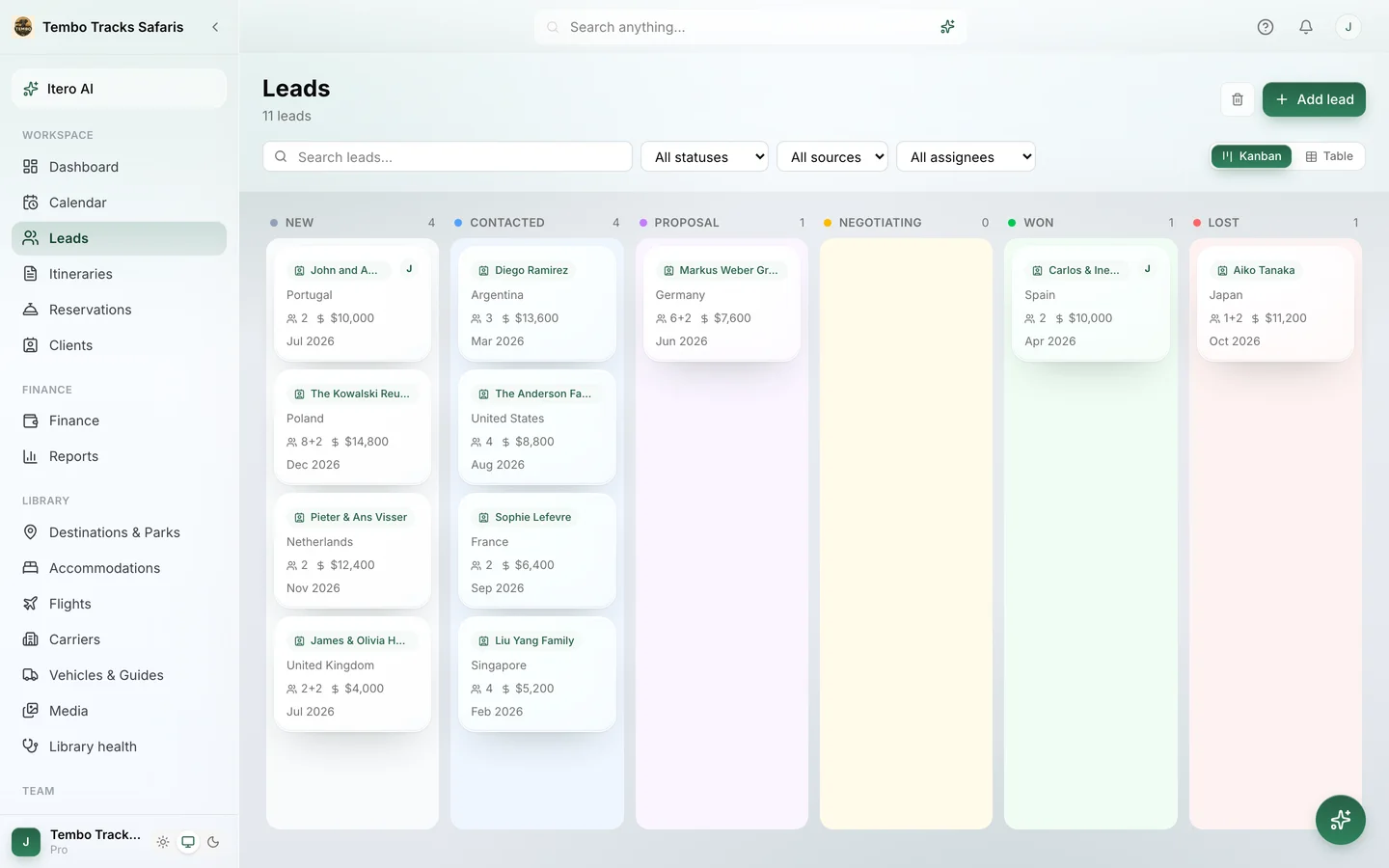
The enquiry lands in the Leads pipeline, in the first of six stages: new, contacted, proposal, negotiating, won, lost. The pipeline shows as a Kanban board or a table, so the owner sees the whole funnel at a glance and a consultant can work through a list. The lead card holds the conversation and the party details from the first message: who is travelling, roughly when, and what they asked for. Nothing else exists yet, and that is fine. What matters is what happens in the next few hours.
The same day: a Ballpark reply.
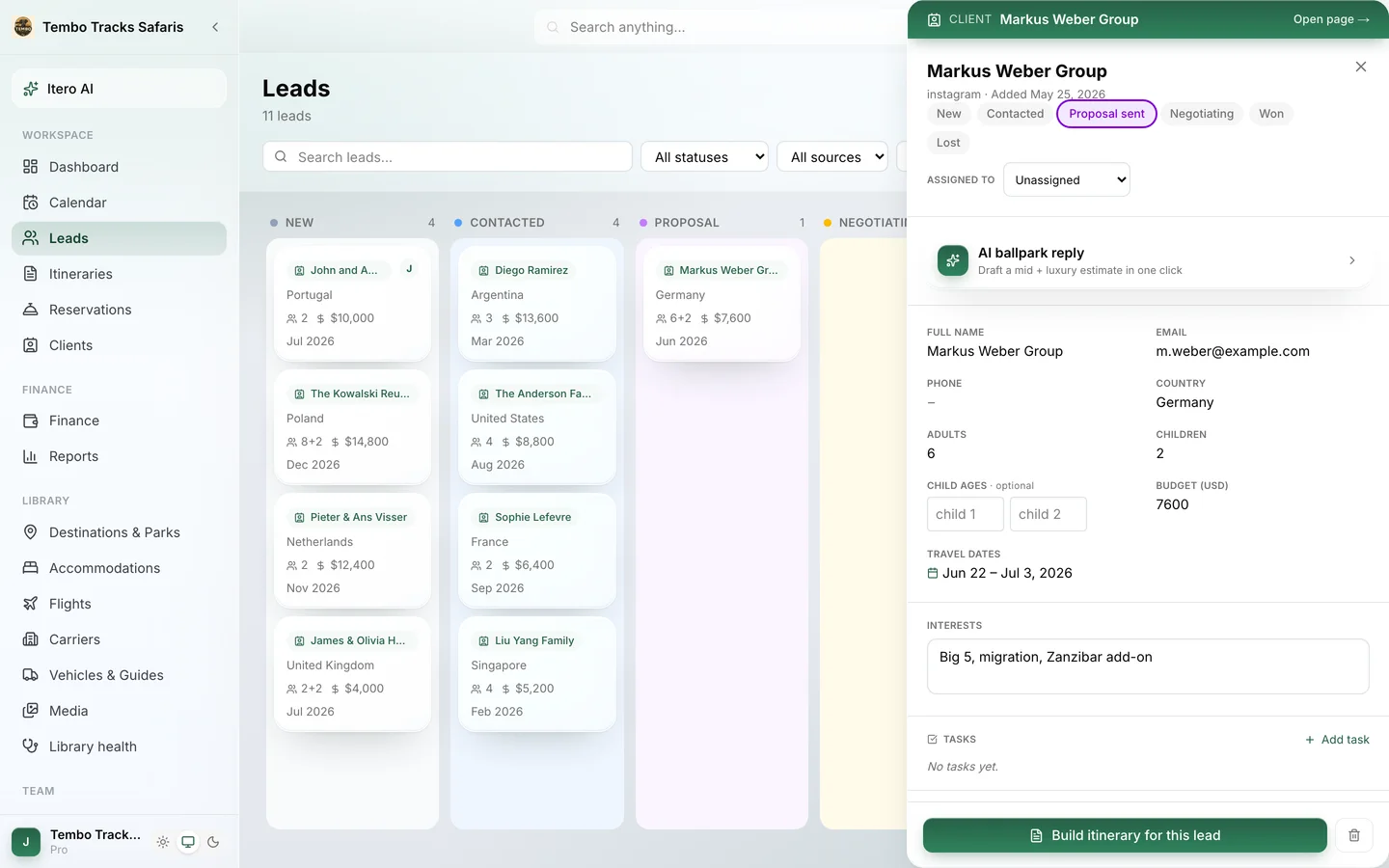
Opening the lead slides out the lead drawer, and in it sits the Ballpark panel: a quick indicative price for the trip shape the client described, before anyone builds a full itinerary. The number is not plucked from the air. Itero AI drafts it from the workspace's own imported rates and the park fee library, so a ten-day June trip for two adults and two children comes back as a realistic figure, not a guess that has to be walked back later. The Composer drafts the reply around it, the desk edits and sends, and the lead moves to contacted. The client heard a credible number the same day they asked. Most desks cannot do that without interrupting whoever owns the pricing spreadsheet.
Proposal: the enquiry becomes a trip.
When the client wants detail, one click converts the lead into an itinerary and opens the safari itinerary builder: six steps from Trip to Proposal, with a live cost panel updating as the route takes shape. Park fees are computed per person and per vehicle, by visitor category and age band, so the seven-year-old is priced in the right child band at every park without anyone checking a fee table by hand. The finished trip renders into a proposal in one of three templates, Lookbook, Rounded or Studio, goes out as a PDF or a web proposal on a share link, and can be translated into seven languages when the client reads better in French or German. The lead sits in proposal, with the document attached to the story so far.
Negotiating: versions instead of chaos.
Safaris are commonly booked many months to over a year ahead, so this stage can run for weeks: the family swaps one lodge, asks what half board would save, adds a night at the second camp. Every change becomes a new version of the itinerary, with compare built in, so the desk can see exactly what moved between quote three and quote four instead of arguing from memory. If a changed date falls outside an imported rate, a rate-gap warning appears in place of a silently wrong price. By now the lead record holds something genuinely valuable: every number ever quoted to this client, and why.
Won: the lead becomes a client automatically.
The client says yes. The lead moves to won, and Itero Desk creates the client record automatically; nobody re-types names from an email thread into a second system. The winning itinerary generates the invoice in its own template set, Classic, Modern, Minimal or Bold, as a share link with a matching PDF. Reservations take over the operational side: hotel requests go out as clean documents with the trip facts and no prices, option holds carry expiry dates, and the desk is reminded when a request sits unanswered for three days or a hold is about to lapse. Meanwhile the client record starts filling with the things a safari needs and a generic sales pipeline never asked for: passports and travel documents, dietary and medical notes.
Travelled, and back years later.
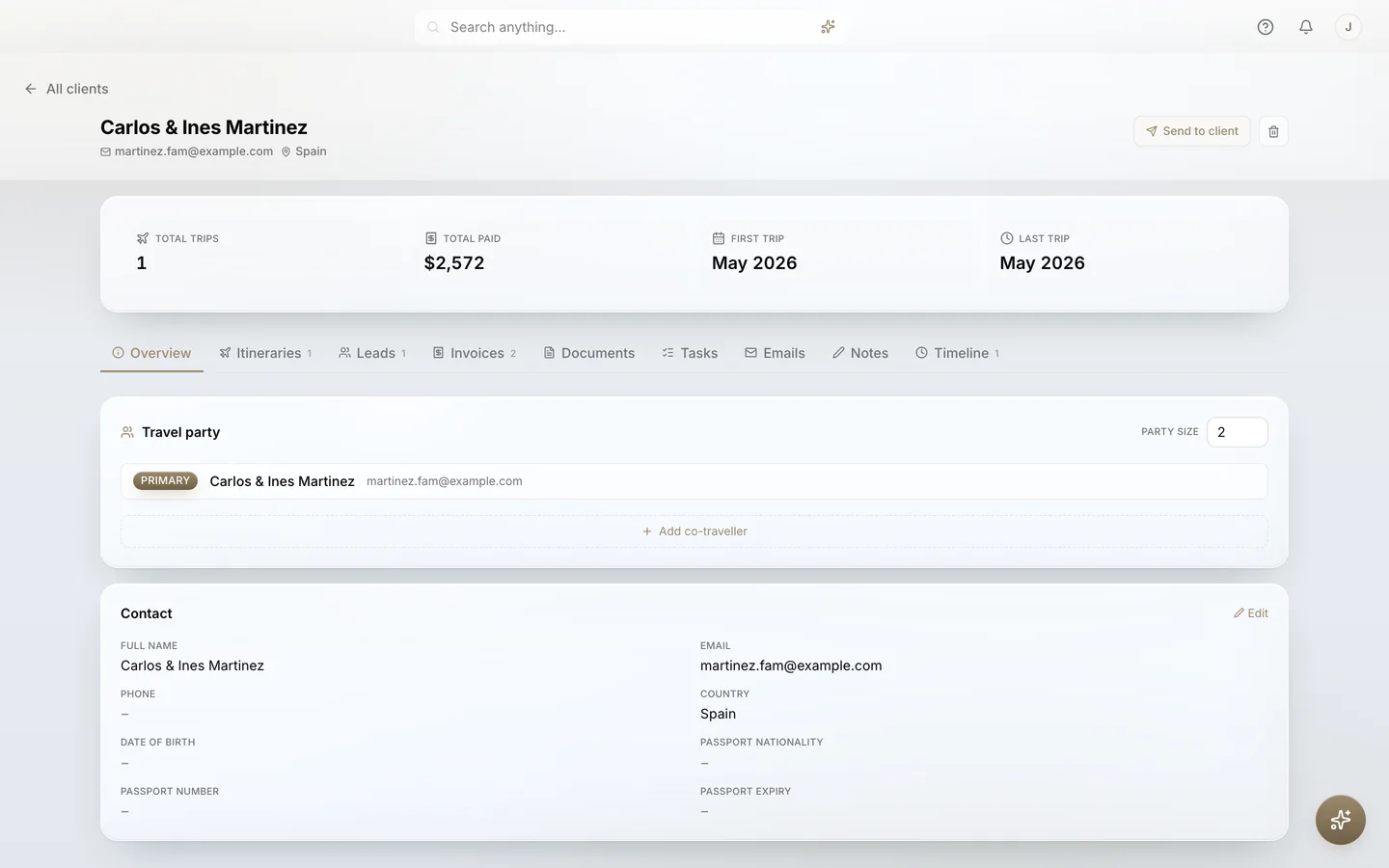
The family travels, and the trip joins their trip history. This is where a safari CRM quietly earns more than the pipeline ever did. Three years later the same guests write again, or their friends do, and the desk that answers already knows the past route, the lodges, the vegetarian in the party and the child who has since moved up a rate band. The old itinerary can be used as a starting point for the new one, repriced from current rates instead of copied numbers. A repeat guest is the cheapest booking a desk ever wins, and losing their history to a departed consultant's inbox is a real cost, not an untidiness. Records can also be trashed and restored, so an overenthusiastic cleanup does not erase a decade of relationship.
The first solid proposal usually wins.
Every safari desk knows the enquiry that went quiet. Usually it did not go quiet at all: it went to several operators at once, one of them replied first with a credible number and a document worth forwarding, and by the time the slower quote arrived the client was already committed elsewhere. That enquiry cost real marketing money to generate, and the loss never shows up in any report. It simply books with the faster desk.
Speed of first reply is the one competitive lever a small operator can reliably pull, and it is mostly a workflow problem. The delay is rarely thinking time; it is waiting. Waiting for the person who owns the rates. Waiting for a spreadsheet to be copied and adjusted. Waiting for a document to be assembled from pieces.
Itero Desk compresses the wait at three points.
- A number the same day. Ballpark produces an indicative price from the desk's own rates while the enquiry is still warm, so the first reply carries substance rather than a promise to get back to them.
- No re-typing between stages. Convert to itinerary carries the lead straight into the builder, and the live cost panel prices the trip while it is being shaped, park fees included.
- A document that renders instead of being assembled. The proposal comes out of a template with the company's colours and fonts already set, as a PDF or a share link, minutes after the trip is priced.
The result is a desk where the gap between enquiry received and solid proposal sent is measured in hours when it needs to be. Not because anyone rushes, but because nothing waits.
The pipeline also travels. Itero Desk installs as an app on a phone, with Leads as a bottom tab, so the owner in the field can see the new enquiry, send the Ballpark reply and leave the full proposal for the office. From the client's side, this is simply a desk that answers.
Time your own quote. Book a demo, bring yesterday's enquiry, and see how fast a credible reply leaves the desk. Book a demo
Agents and direct travellers: one pipeline, two kinds of client.
A safari desk's book of business splits into two relationship worlds. Overseas agents send structured requests and judge the desk like a supplier; direct travellers send stories and judge it like a host. A CRM that treats them identically fails both politely.
| Overseas agents | Direct travellers | |
|---|---|---|
| What the enquiry looks like | Dates, party, budget and a deadline, often sent to more than one operator | A story: an anniversary, a first safari, a long list of questions |
| What the first reply must do | Put a fast, accurate number in their hands | Reassure: show the desk is real, listening and quick |
| What the documents must do | Be consistent and correct every single time | Sell the trip: photography, detail, a document worth sharing at home |
| What earns the next booking | Quoting they can build a habit on | The trip itself, then being remembered when they write again |
| What the record accumulates | The requests, and every quote and version sent | The household: party, passports and documents, dietary and medical notes, trip history |
The same pipeline serves both, because the differences live in the surrounding desk rather than in the stages. An agent's request gets a Ballpark number fast and a consistently branded document rendered from the same template every time. A direct traveller gets a Lookbook proposal that looks the way the trip feels, in their own language when needed. The stages, the records and the quoting engine underneath do not change.
One desk behind the pipeline.
A CRM only earns its keep when the next step after every stage lives in the same place. Behind the Itero Desk pipeline sits the rest of the operation.
- The itinerary builder. Six steps, Trip to Proposal, with versions, compare and saved safaris, so the trip a lead becomes is built where the lead lives.
- The cost engine. Tuned to fifteen safari countries and the way their real fee authorities charge, seasonal lodge rates by board basis, child rate bands, manual overrides per line and margin as its own visible layer. A desk in Arusha gets TANAPA, NCAA and SENAPA fee mechanics from day one, priced once its own rates go in; the Tanzania tour operator software page covers that country in depth.
- The documents. Three proposal templates and four invoice templates, with company colours and fonts set once, so every consultant sends what looks like the same company. This matters most with agents, who see your documents next to everyone else's.
- Reservations and resources. Option holds with expiry warnings, reminders on stale requests, and vehicles and guides that raise a conflict warning, naming the resource, when two trips claim them on the same day.
- The team layer. Owner, admin, finance, member and viewer roles, plus an activity feed of who changed what, so client knowledge stops living in one person's laptop.
- Web and mobile. The same workspace in the office on a laptop and in the field on a phone.
If you are weighing whole platforms rather than CRM features, the best safari tour operator software round-up sets out the options by segment.
Where Itero AI helps the pipeline, and where it stops.
The AI in Itero Desk is a set of specific jobs, not a personality layer over the CRM.
- Ballpark. Drafts the indicative quote on a lead from imported rates and the park fee library.
- The Composer. Drafts enquiry replies and proposal emails in the desk's voice, ready to edit before sending.
- Import. When an enquiry arrives carrying an old itinerary, as a PDF, a pasted email or even a photographed document, Itero AI reads it and drafts the trip in the builder.
- The words around the trip. Welcome letters, rewriting a day's description, translating a proposal into the client's language.
The boundaries are deliberate. The AI never prices from imagination; costs always come from imported rates and the park fee library. It drafts, and the desk decides. Every plan includes a monthly allowance of AI actions, so the assistance is part of the product rather than a metered surprise.
Who it is for, and who it is not for.
This CRM makes sense for safari operators and DMCs in Botswana, Ethiopia, Kenya, Madagascar, Malawi, Mauritius, Mozambique, Namibia, Rwanda, Seychelles, South Africa, Tanzania, Uganda, Zambia and Zimbabwe, selling to overseas agents, direct travellers or both, with a desk of roughly one to fifteen people. That is who the whole workspace is built for, and the CRM does not exist apart from it.
Which is the honest limitation to state plainly: there is no standalone CRM licence. A desk that wants only a CRM, to sit beside a separate quoting tool it intends to keep, is buying more than it needs here. Itero Desk is also not a marketing automation product: it does not run newsletter campaigns or lead scoring. It manages enquiries, clients and the selling of trips. And an operator selling outside the safari world entirely, say European city breaks or US domestic travel, would get the pipeline but not the tuned park and fee mechanics that make the quoting side fast.
Pricing is public. Starter is $74.99 per month and Pro $109.99 per month, both around 20% cheaper billed annually, and every plan includes the CRM alongside the builder, cost engine, documents and Academy training, with a 30-day trial of the full Pro feature set and no credit card. Current numbers live on the pricing page. The social proof is real and short: Itero Desk is built in Arusha, Tanzania, and is used by real operators, including Breeze Safaris in Tanzania and Zanzibar.
Frequently asked questions.
What is a safari CRM?
A safari CRM is client relationship software built around the safari sales cycle: enquiries from overseas agents and direct travellers, trips commonly booked many months to over a year ahead, and repeat guests years later. Beyond a pipeline, it holds the party, passports and documents, dietary and medical notes and trip history, and connects each lead to real quoting so a solid proposal can go out fast.
How does the Ballpark quick quote work?
Ballpark sits in the lead drawer and produces an indicative price for the trip shape the client described, before anyone builds a full itinerary. Itero AI drafts it from the workspace's own imported rates and park fee library, never from imagination, so the desk can send a credible number the same day the enquiry arrives and refine it in the full builder afterwards.
What happens when a lead is marked won?
The won lead becomes a client record automatically, with no re-typing. The winning itinerary generates the invoice, as a share link with a matching PDF, and reservations track the bookings behind the trip with option holds, expiry warnings and reminders on stale requests. The client record then accumulates passports and documents, dietary and medical notes and, after travel, trip history.
Can one pipeline handle both travel agents and direct travellers?
Yes. Both move through the same six stages: new, contacted, proposal, negotiating, won, lost. The difference is what each segment needs from the desk: agents want fast accurate quotes and consistent documents, direct travellers want reassurance, detail and speed. Because quoting, templates and translation live in the same workspace as the pipeline, one flow serves both without separate processes.
What does a client record hold in Itero Desk?
Each client record holds trip history, passports and travel documents, and dietary and medical notes, alongside the conversation and quotes from the original lead. Won leads create client records automatically. Records can be trashed and restored, so a mistaken deletion does not erase the relationship. When a client returns, an old itinerary can be used as a starting point and repriced from current rates.
Does the safari CRM work on a phone?
Yes. Itero Desk installs as an app on a phone, with a mobile layout built around bottom tabs: Home, Leads, Itero AI and Library. The Leads tab means an enquiry can be seen, given a Ballpark number and answered away from the office, which matters in a trade where the owner is often out with guests.
Is the CRM sold separately from the rest of Itero Desk?
No. The CRM is one part of one workspace, alongside the itinerary builder, cost engine, proposals, invoices and reservations, and every plan includes all of it. Starter is $74.99 per month and Pro $109.99 per month, both around 20% cheaper billed annually, with a 30-day trial of the full Pro feature set and no credit card. Details are on the pricing page.
How does the CRM handle long booking lead times?
Safaris are commonly booked many months to over a year ahead, so a lead can sit in negotiating for a long time. Itinerary versions with compare keep every quoted number and change on the record, and rate-gap warnings flag when a shifted date falls outside an imported rate, so a price agreed early does not quietly go wrong as seasons and rate sheets change.
The next enquiry is in someone else's inbox too. Book a demo and see a lead become a priced proposal before the call ends. Book a demo · Existing customer? Sign in