A travel proposal generator that gets the quote out the same day.
A travel proposal generator turns a planned trip into the client-facing document: the route, the stays, the party and the price rendered as a branded proposal, without a design tool and without an afternoon of copy-paste. Itero Desk generates the proposal from live trip data: an itinerary priced from your own imported rates and park fee libraries renders into a web proposal on a share link, or a matching PDF, in one of three templates. Because nothing is re-typed between the quote and the document, the whole journey from new enquiry to sent proposal fits inside a normal working day.
Itero Desk is operations software for safari and tour operators: itineraries, quotes, proposals, invoices, CRM and pricing in one workspace, on web and mobile, with AI assistance built in. This page follows one enquiry through that workspace at speed. If what you want is fine control over the document itself, the wording, the layout, the negotiation rounds, that story lives on the tour proposal software page; this one is about getting a correct, branded proposal out while the enquiry is still warm.
Book a demo. Bring a real enquiry and watch it become a sent proposal, priced from real rates. Book a demo
Slow quotes lose bookings, not minutes.
An overseas agent with a client on the line rarely sends one enquiry. They send three or four, to desks like yours, and the proposal that arrives first, credible and priced from real rates, frames the conversation every later document has to argue against. Each day a quote sits half-built in a spreadsheet is a day the client spends reading somebody else's proposal.
For a small desk the problem compounds. Ten open enquiries in various states of half-quoted are not a workload; they are a backlog of leaking revenue. Every one of them cost marketing money or an agent relationship to earn, and every one dies quietly if the follow-up slips a week. The desks that win are not always the desks with the best rates. They are the desks that answer first with a number that holds.
Speed of this kind has nothing to do with typing faster. It comes from removing the re-typing between stages: enquiry, indicative price, itinerary, cost, document, email. When each stage feeds the next, one person can clear the morning's enquiries before the office closes. That flow is the quote-to-confirm journey Itero Desk is built around, and the rest of this page walks it through one normal day.
One enquiry, one working day.
What follows is not a stopwatch benchmark and contains no invented timings. It is a plain narrative of how an enquiry moves through the workspace on a desk whose rate sheets are already imported.
Morning: the enquiry lands and gets a number.
The enquiry arrives, an agent asking about a week in the north for two adults and two children in July, and becomes a lead in the pipeline at the new stage. The lead drawer holds the whole picture in one place: the conversation, the party details, and a Ballpark panel for a fast indicative price. Ballpark drafts that number from your real rates, not from a guess, so the first reply can already carry substance: a range, the shape of the trip, one or two intelligent questions back. The reply goes out through the Composer without leaving the lead.
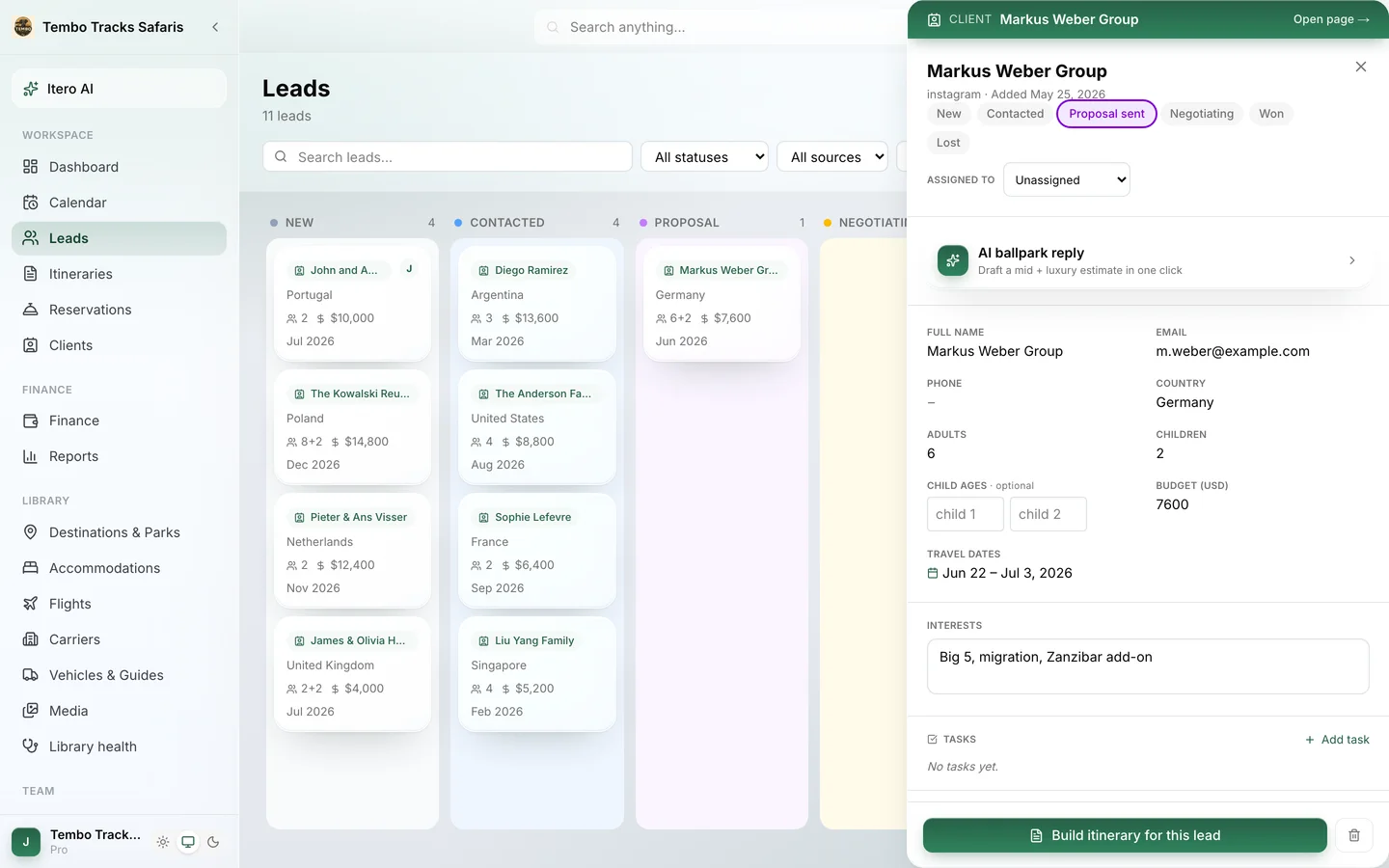
That first reply matters more than it looks. An agent who receives an indicative price and a sensible question before lunch has a reason to wait for your full proposal instead of shortlisting from those who answered first.
Midday: one click from lead to priced itinerary.
When the enquiry deserves the full treatment, one click converts the lead into an itinerary. The party, the dates and the context carry over, so nobody re-types what the agent already wrote. From there the safari itinerary builder walks six steps: Trip, Route, Stays, Days, Costs, Proposal.
The route does not start from a blank map. "Use as starting point" copies a past trip that resembles this one, and a saved safari, a skeleton route the desk keeps for its standard products, gets the whole circuit onto the page in minutes. The rest is adjusting rather than building: swap a lodge, add a night, set the rooms and board basis, place the activities day by day.
While you adjust, the live cost panel re-prices the trip: seasonal lodge rates by board basis, park fees per person and per vehicle by visitor category and age band, the vehicle and guide, and your margin as its own visible layer. If a travel date falls outside every imported rate, a rate-gap warning says so instead of letting a stale number through. By the time the route looks right, the price already is.
Afternoon: pick a template, generate, send.
The Proposal step renders the trip into the client document. Pick one of three templates: Lookbook, a photography-led coffee-table book; Rounded, soft and warm; Studio, a modern dark editorial. The generator pulls everything from the trip data: the cover, the day-by-day plan, photos from your library, the price table, your company colours and fonts.


Then the send. Publish the proposal as a web page on a share link, or download the matching PDF, and let Itero AI draft the proposal email around the link: the trip summary, the highlights, the next step. You read it, adjust a line, and send. The lead card moves to the proposal stage, and the desk moves to the next enquiry.
None of this needs a heroic day. It needs rates that are already in the system and stages that feed each other. With those two in place, most desks are quoting the same day.
See the same day on your own trip. A demo walks a real enquiry from Ballpark to sent proposal, with your rates. Book a demo
What the generator generates, honestly.
The word generator deserves a straight definition, because it currently describes two very different machines.
What Itero Desk generates is the document. The trip is yours: the route you chose, the lodges you contracted, the price your cost engine computed. The generator's job is rendering all of that into a branded proposal, correctly, and again after every change. Nothing invents an itinerary out of thin air, and nothing prints a price it cannot trace back to a rate.
Generic AI document generators work the other way around. Give a language model a prompt and it will produce a handsome proposal with confident numbers in it, and those numbers came from nowhere: a plausible nightly rate, park fees remembered from an old forum post. A generated proposal whose prices come from a language model is a liability with your company's name on the cover, because the agent will hold you to the number.
Itero Desk draws that line structurally, not as a policy promise. AI never prices from imagination anywhere in the product: every cost comes from your imported rates and the park fee library, computed by the cost engine, with margin visible as its own layer. The AI drafts words. The engine does the numbers. The generator turns both into a document.
The difference shows up in every row of a working week:
| A generic document generator | A proposal generated from live trip data | |
|---|---|---|
| Where the prices come from | Typed in, pasted in, or written by a language model | The cost engine: your imported seasonal rates, the park fee libraries, margin as a visible layer |
| What happens when the trip changes | Someone re-edits the file by hand and hopes every number was caught | Change the itinerary and regenerate; the document renders from the current trip data |
| Revision history | File copies named final, final2, final-FINAL | Itinerary versions with compare, plus version history in the proposal editor |
| Matching invoice | A separate tool, numbers re-typed | Generated from the same itinerary, as a share link and matching PDF |
| Translation | Paste into a translator, then repair the layout | The proposal translates into 7 languages inside the same template |
| Brand consistency | Depends on who edited the file last | Company colours and fonts set once in Settings → Templates apply to every document |
The document the client receives.
Speed would be worth little if the output looked rushed. The generated proposal is a document a desk sends with some pride, and the client never sees how quickly it was made.
Each of the three templates has a distinct character, and every one renders with a light or dark background, your company colours and your font presets, all set once in Settings → Templates. That is what brand consistency means in practice: three consultants quoting on the same afternoon send documents that look like the same company made them. The safari itinerary templates page shows all three styles in detail.
Every proposal goes out two ways from one source. The web proposal publishes on a share link, opens cleanly on a phone, and is easy for an agent to forward to their client; the PDF matches it exactly for the inboxes that still want an attachment. When the client reads French or Portuguese, the proposal translates into seven languages, English, Portuguese, Spanish, French, Italian, German and Dutch, inside the same template, with the same layout and price table.
And when one particular deal needs craft rather than speed, the generated document opens in a full proposal editor, closer to a word processor than a form: sections reorder and hide, image slots, pull quotes, page breaks, version history, and a print layout that matches the PDF exactly. That editor, and the slower negotiation rounds it serves, has its own page: tour proposal software. The point here is that you rarely need it on day one; the generated document is already fit to send.
After the send, the trail stays warm.
A proposal generator that stopped at the send would solve half the job. The send is the middle of the sale, not the end of it.
The pipeline keeps score. The lead sits at the proposal stage, and when the agent comes back with questions it moves to negotiating, with the whole exchange held on the lead instead of scattered across an inbox. The tour operator CRM page covers the pipeline end to end.
Revisions go back through the same machine that made the first version. The client wants a lodge swapped or two nights added? Change the trip in the builder and regenerate: the price and the document update together, and itinerary versions with compare keep every round on record. Wording-level changes happen in the proposal editor without touching the trip at all.
Winning closes the loop. A lead marked won becomes a client automatically, with trip history, passports and documents, and dietary and medical notes on the record. The invoice then generates from the same itinerary that won the deal, in its own template set, as a share link and matching PDF. The number on the invoice is the number on the proposal, because both came from the same trip.
Where AI buys back the minutes.
AI inside this workflow is a speed lever, deliberately kept away from the numbers.
- Itinerary import. When the enquiry arrives with a trip already sketched, a PDF, a Word file, a spreadsheet, a pasted email, even a photographed page, Itero AI reads it and drafts the trip in the builder, so the route starts from the agent's own document instead of a blank page.
- The morning's number. Ballpark, the quick-quote panel on every lead, is an AI surface too, and it drafts its indicative price from your real rates.
- Drafting. Proposal emails, welcome letters, rewriting a day's description, translating the proposal into the client's language. The words that surround the document get written in seconds and reviewed by you.
Every plan includes a monthly allowance of AI actions, and the boundary from the honesty section holds everywhere: the AI reads and drafts, while every price is computed by the cost engine from your imported rates and the park fee library.
What it costs, and who it fits.
Itero Desk publishes its prices. Starter is $74.99 per month ($59.99 per month billed annually) with one user and 50 itineraries a month. Pro is $109.99 per month ($89.99 per month billed annually) with four users and 200 itineraries a month. Every plan includes the itinerary builder, the cost engine with its tuned fee mechanics, the proposal templates, invoicing and a monthly AI allowance, and every new workspace starts with a 30-day trial of the full Pro feature set, no credit card. Current details live on the pricing page.
One honest boundary: the same-day story on this page assumes an operator in the fifteen covered countries, from Tanzania and Kenya to Rwanda, Botswana and the Indian Ocean islands, with rate sheets imported. A desk selling outside the safari world entirely, say European city breaks or US domestic travel, would not benefit from the tuned fee mechanics, which are built around parks, camps and safari logistics, and an operator who wants a document tool alone, pricing by hand, may be better served by an itinerary-first product. The full platform picture, from enquiry to invoice, is on the safari tour operator software page.
Frequently asked questions.
What is a travel proposal generator?
A travel proposal generator produces the client-facing trip document automatically: route, stays, day-by-day plan and price rendered into a branded proposal. The distinction that matters is the source. Itero Desk generates proposals from a priced itinerary built on your imported rates and park fee libraries, so the document is a rendering of real numbers, not text written to look like a quote.
Where do the prices in a generated proposal come from?
From the cost engine, never from AI. Lodge rates come from your imported rate sheets, organised by season and board basis; park fees come from your own entries, computed per person and per vehicle by age band through mechanics tuned for fifteen safari countries; margin sits on top as a visible layer. When no rate covers a travel date, you get a rate-gap warning instead of an invented number.
How fast can I send a proposal after an enquiry arrives?
On a desk with rates already imported, the same day is normal. Ballpark puts an indicative price in the first reply, one click turns the lead into an itinerary, a saved safari or a past trip supplies the route, and the proposal renders from the trip data. The honest caveat: the first weeks, while rate sheets are still being imported, run slower.
Can I edit the proposal after it is generated?
Yes. The generated document opens in a full proposal editor with reorderable sections, image slots, pull quotes, page breaks and version history, and the print layout matches the PDF exactly. Most desks send the generated document as it is and keep the editor for deals that need extra craft; the tour proposal software page covers that side in depth.
Does the client get a PDF or a web link?
Both, from the same source. A proposal publishes as a web page on a share link, easy to open on a phone and forward, and downloads as a PDF with a matching layout. Confirmed trips also get a client portal page with no login needed for the traveller, and invoices follow the same pattern: web link plus matching PDF.
What happens when the client asks for changes?
The lead moves to the negotiating stage, so the round is visible in the pipeline. You change the trip in the builder, the cost engine re-prices it, and the proposal regenerates from the updated data, with itinerary versions and compare keeping each round on record. Small wording changes can be made directly in the proposal editor without touching the trip.
Can it generate proposals in other languages?
Yes. A proposal translates into seven languages, English, Portuguese, Spanish, French, Italian, German and Dutch, and the translation renders inside the same template, so the French version carries the same layout, photos and price table as the English one. Itero AI also drafts proposal emails and welcome letters when the reply itself needs to be written quickly.
Does Itero Desk book the trip or hold the traveller's money?
No. Itero Desk is software for the operator's own desk: it is not a travel agency, it does not sell, book or arrange trips, and it does not process or hold traveller payments. The proposal, the share link and the invoice are yours, and you collect payment from clients through whatever channels you already use.
The next enquiry could be quoted before the office closes. Book a demo and watch one of your real trips go from enquiry to sent proposal. Book a demo · Existing customer? Sign in