Tour proposal software built for the revision, not just the send.
Tour proposal software is the tool a tour operator uses to turn a priced itinerary into the sales document that wins the booking: a branded, day-by-day proposal the client reads, questions and asks to change. Because most trips are negotiated rather than accepted first time, the software's real job is control: an editor that behaves like a word processor, a saved version for every round of the negotiation, and a price table that always matches the quote underneath it.
That definition puts the weight where the work is. A proposal is rarely sent once; it is revised until the client says yes, and every revision is a chance for the document and the price to drift apart. This page covers the craft side of proposal work in Itero Desk: the editor, the versions and the negotiation rounds. If your bottleneck is getting the first proposal out on the day of the enquiry, the travel proposal generator page covers that speed story. Itero Desk is operations software for safari and tour operators: itineraries, quotes, proposals, invoices, CRM and pricing in one workspace, on web and mobile, with AI assistance built in.
Book a demo. Bring the proposal you fought with last month and rebuild it live, revisions included. Book a demo
A proposal is a sales document, and sales documents get edited.
Watch where a booking is actually won. The enquiry arrives and gets answered. The first proposal goes out and the client likes it. Then comes the reply that decides everything: can the second camp be a little cheaper, can we add two nights on the coast, can the balloon come out to bring the total down. That reply is not a rejection. It is the sale moving, and the operator who answers it quickly and cleanly usually wins the booking.
The standard toolkit makes that answer expensive. The itinerary lives in one file, the costs in a spreadsheet, the proposal in a word processor or a design tool. One client request touches all three, by hand, in order, and the tools do not check each other. So a consultant retypes the price table at ten in the evening, misses the park fee change that came with the lodge swap, and sends a beautiful document with a number that is quietly wrong. The desk discovers the gap at invoicing time and absorbs it out of margin. Or the revision waits three days because nobody had an evening free, and another operator's answer lands first. Both failure modes cost money, not tidiness.
Tour proposal software earns its keep by making round three as safe as round one. That takes two things a generic tool cannot offer: a live connection to the priced trip, and revision history that belongs to the trip rather than to a folder of files named final, final2 and FINAL-final.
An editor, not a form.
Most travel software treats the proposal as an export: fill the form, pick a theme, download. That holds until the client asks for something the form never anticipated, and then the desk is back in Word. Itero Desk goes the other way. The proposal editor is closer to a word processor than a form: a full writing surface that happens to be wired to a priced safari.
The menu bar says what it is.
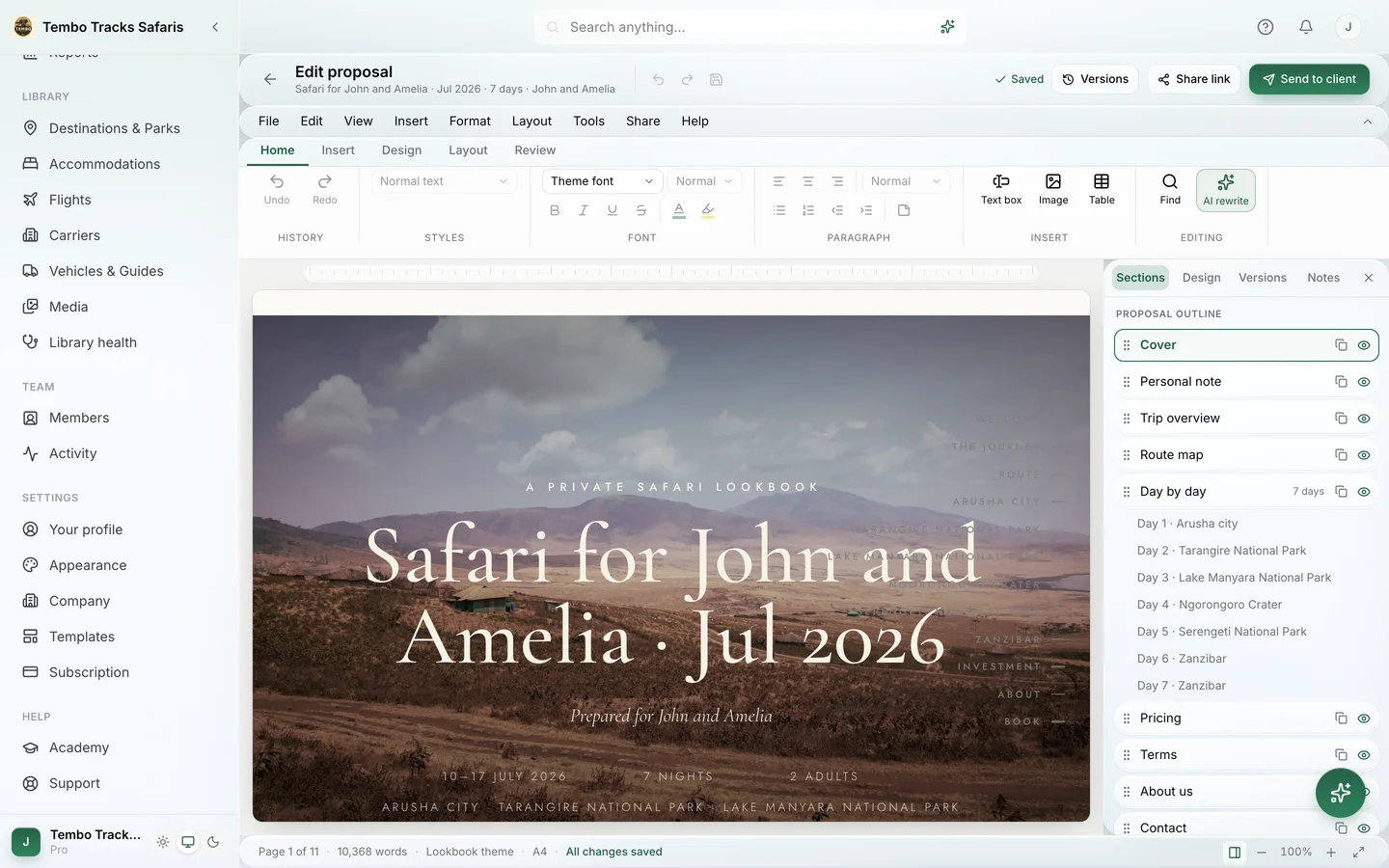
Across the top sit menus any desk already knows how to read: File, Edit, View, Insert, Format, Layout, Tools and Share. Nobody books a training day to find the thing they need; anyone who has written a document anywhere can work here from the first minute. The difference is what sits behind the menus: this document knows its trip, its travellers, its dates and its price.
What you can insert.
The Insert menu carries the blocks a trip document is made of: a text box, an image box, a pull quote, a day-by-day section, a price table, a route map, a terms section, plain tables and page breaks. The trip-aware blocks are the point. The day by day comes from the itinerary. The price table comes from the cost engine. The route map comes from the route. Drop them in and they carry the real trip; change the trip and they follow.
Sections reorder, hide and duplicate.
The document is built from sections the desk can drag into a new order, hide without deleting, or duplicate to try a second treatment of the same content. An agent who wants the price up front gets it moved in seconds. A direct client who should not see the terms until later has them hidden, not destroyed. Nothing about the structure is fixed, because no two clients read a proposal the same way.
Print layout and web layout, one document.
The editor shows two views of the same proposal. Print layout matches the PDF exactly: the page on screen is the page the client prints, break for break. Web layout is a continuous scroll for long writing sessions, with no page furniture in the way. Both views render one source, so there is no export surprise, no "it looked different in the preview", and no separate PDF build to maintain.
The quiet tools that keep long documents honest.
A long proposal needs the boring tools. Comments, so a colleague can mark a paragraph before it goes out. Find, for the lodge name that changed in round two. Spell check, for the late finish. Version history, for the day someone asks what the last round actually said. All of them live in the editor, and none of them require leaving it.
Round two: the client wants a cheaper lodge.
Here is the scenario that decides if proposal software is real or just a brochure maker. Round one went out and the client loves the trip but not the second lodge's price. Round two needs the same document with one camp swapped and every consequence of that swap carried through correctly.
In Itero Desk the desk opens the trip, swaps the lodge in the Stays step, and the cost engine reprices from the operator's own rates: the new lodge's seasonal rate at the right board basis, the child rates for the party, and any park fee consequence if the location changed. The quote is correct before anyone touches the document.
Then the proposal work starts, and it is editing, not rebuilding. Save the current proposal as a new version, so round one stays intact under its own name. Rewrite the day descriptions that mention the old camp. The price table refreshes to the new quote; nobody retypes a number, so no hand-edited total drifts away from what the trip actually costs. The revision takes minutes, not an evening.
Version compare closes the loop. Before sending, put round one and round two side by side and see exactly what changed: the lodge, the affected days, the totals. When the client calls back quoting the old price, the desk opens the old version instead of arguing from memory. A negotiation can run five rounds and the record of what was offered, and when, is on the trip itself.
The discipline this enforces is worth naming plainly: at every round, the number in the document is the number in the cost engine. The proposal cannot promise a price the margin cannot survive, because the proposal never invents its own arithmetic.
See a real negotiation round. Bring a trip that went three rounds and replay it in the editor on a demo call. Book a demo
Proposal software, a word processor, or a design tool.
The honest comparison is not with other proposal tools; most desks fight this battle in a word processor or a design tool. Both are excellent at what they were built for, and both were built for documents that stand alone. A negotiated trip proposal does not stand alone: it is the front of a priced itinerary that keeps changing. The difference shows up in six places.
| Word processor | Design tool | Itero Desk proposal editor | |
|---|---|---|---|
| Filled from trip data | Copied and pasted in | Copied and pasted in | Generated from the itinerary |
| Price always matches the quote | Retyped each round, drifts | Retyped each round, drifts | Pulled from the cost engine, refreshes with the trip |
| Revision history tied to the trip | File names in a folder | Exports in a folder | Named versions on the trip, with compare |
| Web and PDF from one source | PDF only | Usually two separate builds | One document: share link and matching PDF |
| Translation without re-layout | Re-flow every page by hand | Rebuild the layout per language | Translate in place, layout holds |
| Brand consistency across the team | Depends on who edits | Depends on one designer's time | Template, colours and fonts set once for the company |
None of this says a word processor is bad software. It says the proposal for a negotiated trip is not a standalone document, and tools that treat it as one push all the checking work onto a tired human at the end of the day.
Templates set the look. The editor sets the words.
A proposal has to look like the company that sent it, on every send, from every consultant. In Itero Desk that starts with the template. Three ship today, each with its own character: Lookbook, the default, a photography-led coffee-table book; Rounded, soft and warm, made for luxury trips; Studio, a modern dark editorial. Each renders on a light or dark background, and company colours and font presets are set once in Settings → Templates, so the newest hire sends documents that look like the founder made them.
The division of labour is deliberate. The template owns the look: typography, spacing, how a day or a price table is dressed. The editor owns the substance: what is said, in what order, with which images and which sections. A desk that wants a different look switches the template and the same content re-renders; nobody rebuilds the document. The safari itinerary templates page shows all three styles in detail.
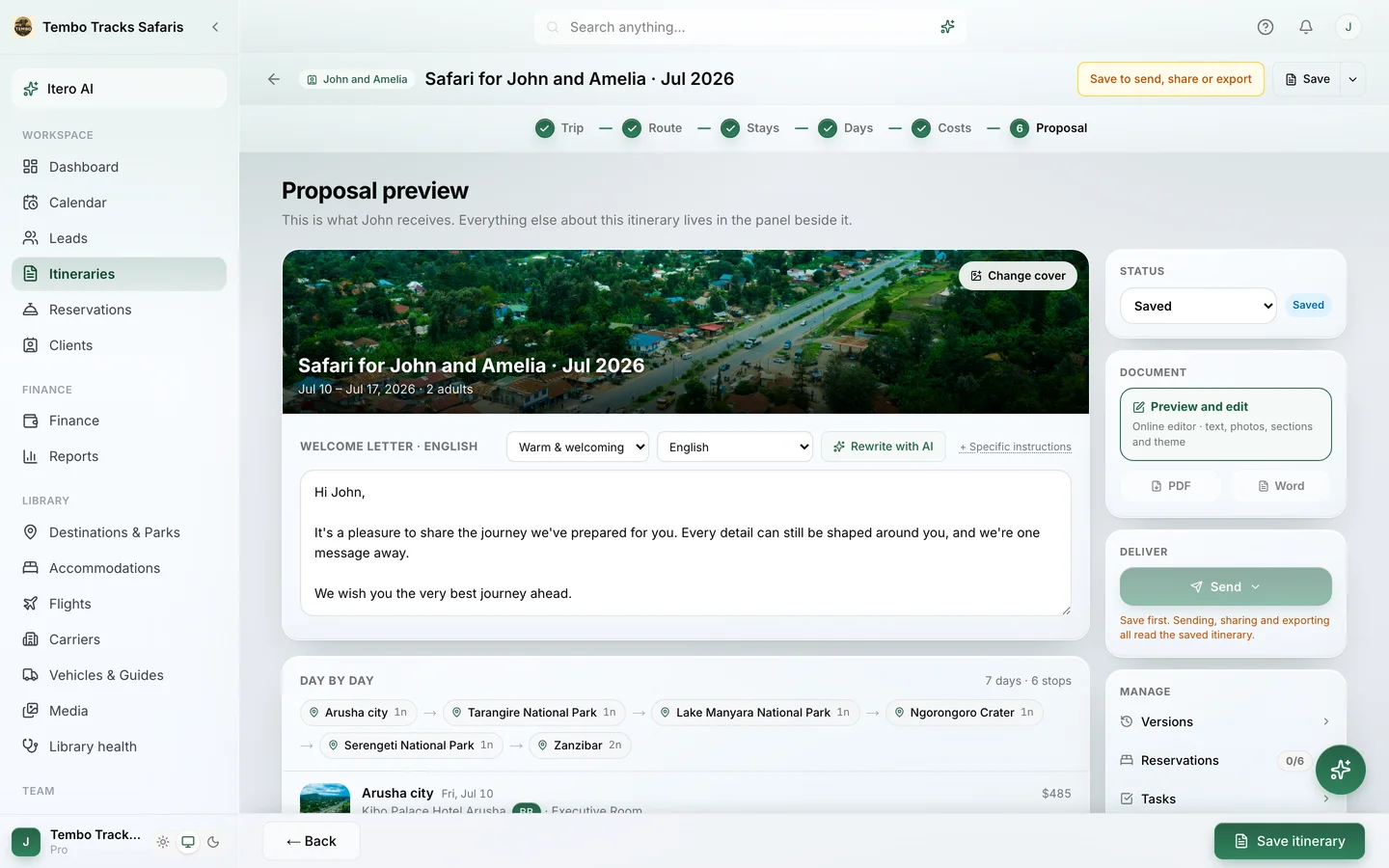
The proposal itself is born in the safari itinerary builder: it is the sixth step, after the trip, route, stays, days and costs are in place. By the time the editor opens, the document already contains the real trip. The editor's job is to make it persuasive.
Send it, publish it, follow it.
When a round is ready, the Share menu offers the same document two ways. Publish it as a web proposal on a share link the client opens in any browser, or download a PDF that matches the web version exactly, because both render from one source in one template. Agents who forward PDFs get a PDF; a traveller reading on a phone over breakfast gets a page built for that screen.
What your team sees
What your client sees


The covering email matters almost as much as the document, and it is the classic end-of-day blocker. Itero AI drafts the proposal email from the trip; the desk edits the draft until it sounds like the desk, then sends it. Assistance, not autopilot.
Sending also moves the deal where the whole team can see it. Once the document goes out, the lead sits in the pipeline at proposal, and it moves to negotiating when the client comes back asking for changes, so nobody has to ask where a deal stands in the Monday meeting. The pipeline, the lead drawer and what happens after the win are covered on the tour operator CRM page.
Where Itero AI helps, and where it stops.
The AI's share of proposal work is deliberately small and specific. It rewrites a day's description when the consultant's fifteenth Serengeti paragraph of the month has gone flat. It translates the finished proposal into seven languages: English, Portuguese, Spanish, French, Italian, German and Dutch, inside the same layout, so an agent in Lisbon gets a Portuguese document without anyone rebuilding pages. And it drafts the proposal email, as above.
Where it stops matters more. Itero AI never invents a price: every number in the price table comes from imported rates and the park fee library, through the cost engine. The desk reviews every draft before anything is sent. Every plan includes a monthly allowance of AI actions, so the cost of the assistance is known before it is used.
Who it is for, and what it costs.
This page is for the desk that wins or loses in the revision rounds: operators selling negotiated, higher-value trips where the proposal is edited three or five times before the yes. If the pain is the first send taking too long, start with the travel proposal generator page instead; same product, the other half of the story. And a desk that sends one proposal a month and is content in Word probably does not need proposal software yet; the honest advice is to switch when the retyping starts costing evenings or bookings.
Two things this software is not. Itero Desk is not a travel agency: it does not sell, book or arrange trips. And it does not process or hold traveller payments; the operator collects from clients exactly as before.
The proposal editor is not an add-on. It is part of every plan, alongside the itinerary builder, cost engine, CRM and invoicing: Starter at $74.99 per month ($59.99 per month billed annually) and Pro at $109.99 per month ($89.99 per month billed annually), with a 30-day trial of the full Pro feature set and no credit card. Current details are on the pricing page. For the full platform picture, the safari tour operator software page covers the whole desk end to end.
Frequently asked questions.
What is tour proposal software?
Tour proposal software turns a priced itinerary into the branded sales document a tour operator sends to win a booking, and keeps that document correct through every revision. The defining features are an editor connected to the trip's real costs, version history for each negotiation round, and output as both a web page and a matching PDF from one source.
Is the proposal generated, or can I edit it by hand?
Both. The proposal is generated from the itinerary with the days and prices already in place, and then a full editor takes over: menus for File, Edit, View, Insert, Format, Layout, Tools and Share, sections you can reorder, hide or duplicate, and blocks for text, images, pull quotes, maps and tables. It behaves like a word processor, not a locked export.
What happens to the price table when the trip changes?
It refreshes from the cost engine. When the desk swaps a lodge or adds a night, the trip reprices from the operator's own seasonal rates and park fees, and the proposal's price table reflects the new quote. Nobody retypes totals, so the document can never quietly disagree with what the trip actually costs.
Can I compare two versions of a proposal?
Yes. Saving a round as a new version keeps every earlier round intact, and version compare shows two versions side by side: what changed, where, and what the totals were. In a long negotiation this becomes the record of what was offered and when, without a folder of near-identical files.
Will the PDF look different from what I built on screen?
No. The editor's print layout matches the PDF exactly, page break for page break, and the published web proposal renders from the same source in the same template. There is one document behind the share link, the PDF and the editing view, so there is nothing to reconcile before sending.
Can proposals be translated without redoing the layout?
Yes. Itero AI translates a finished proposal into English, Portuguese, Spanish, French, Italian, German or Dutch inside the existing layout, so sections, images and price tables stay where they are. The desk reviews the translated text before it goes out, and translations count against the plan's monthly AI allowance.
Is the proposal editor included in every plan?
Yes. The editor, the templates, versions with compare, web publishing and PDF download are part of every Itero Desk plan, from Starter at $74.99 per month upward, and every new workspace starts with a 30-day trial of the full Pro feature set with no credit card. Current plan details are on the pricing page.
The next revision should take minutes, not an evening. Book a demo and replay your last negotiation in the proposal editor. Book a demo · Existing customer? Sign in